Robot umpires are coming to MLB. Here’s how they work
Advertisement
Read this article for free:
or
Already have an account? Log in here »
To continue reading, please subscribe:

Digital Subscription
One year of digital access for only $205*
- Enjoy unlimited reading on winnipegfreepress.com
- Read the E-Edition, our digital replica newspaper
- Access News Break, our award-winning app
- Play interactive puzzles
*First annual payment billed as $205.00 + GST for one year. This annual subscription will automatically renew at $233.00 + GST every 52 weeks (10% off the regular annual price of $259.35). Offer available to new and qualified returning subscribers only. Cancel any time.
To continue reading, please subscribe:
Add Free Press access to your Brandon Sun subscription for only an additional
$1 for the first 4 weeks*
- Enjoy unlimited reading on winnipegfreepress.com
- Read the E-Edition, our digital replica newspaper
- Access News Break, our award-winning app
- Play interactive puzzles
*Your next Brandon Sun subscription payment will increase by $1.00 and you will be charged $17.95 plus GST for four weeks. After four weeks, your payment will increase to $24.95 plus GST every four weeks.
Read unlimited articles for free today:
or
Already have an account? Log in here »
Hey there, time traveller!
This article was published 23/03/2026 (191 days ago), so information in it may no longer be current.
NEW YORK (AP) — Robot umpires are coming to the big leagues this year.
The Automated Ball/Strike System will be introduced in the form of a challenge system in which the human umpire makes each call, which can be appealed to the computer. Robot umpires have been tested in the minor leagues since 2019, with recent testing done at Triple-A since 2022, MLB spring training last year and at the 2025 All-Star Game in Atlanta.
Here’s what to know about MLB’s robot umps.
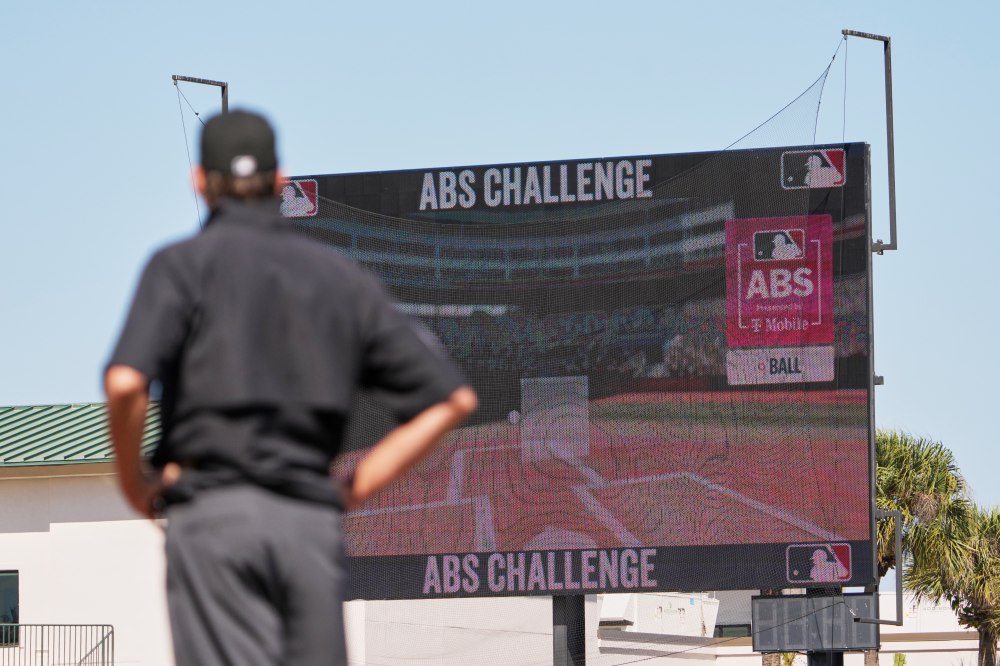
How does the Automated Ball-Strike System work?
Stadiums are outfitted with cameras that track each pitch and judge whether it crossed home plate within the strike zone. In early testing, umpires wore ear buds and would hear “ball” or “strike,” then relay that to players and fans with traditional hand signals.
The challenge system adds a wrinkle. Human umps call every pitch, but each team has the ability to challenge two calls per game. Teams that waste their challenges get one additional challenge in each extra inning. A team retains its challenge if successful, similar to the regulations for big league teams with video reviews, which were first used for home run calls in August 2008 and widely expanded to many calls for the 2014 season.
Only a batter, pitcher or catcher may challenge a call, signaling with the tap of a helmet or cap; and assistance from the dugout is not allowed. A challenge must be made within 2 seconds, and the graphic of the pitch and strike zone is shown on the scoreboard and broadcast feed. The umpire then announces the updated count.
Challenges during spring training last year averaged 13.8 seconds.
What is the technology?
A Hawk-Eye pose-tracking system of cameras tracks pitches and whether they are within a strike zone based on the height of each batter, who is measured without shoes. Each player will be measured for his strike zone starting at 10 a.m. to noon on a rolling basis during spring training — the time of day to maintain uniformity, because height shortens later in the day. Data will be verified by the Southwest Research Institute. MLB estimated the calibration process at less than one minute for each player.
While the strike zone actually called by big league umpires tends to be oval in shape, the ABS strike zone is a rectangle, as in the rule book.
Developing a consensus on what a computer strike zone was an issue.
So what is the MLB strike zone?
MLB has changed the shape of the ABS strike zone several times.
It started with a 19-inch width in 2022, then dropped it to 17 inches — matching the width of home plate. Narrowing the strike zone led to an increase in walks and only small changes in strikeout rates.
The top of the strike zone was 51% of a batter’s height in 2022 and 2023, then raised to 53.5% in 2024 after pitchers complained. The bottom of the strike zone has been 27% since 2022 after initially being set at 28%. A batter’s stance is not taken into account.
ABS makes the ball/strike decision at the midpoint of the plate, 8 1/2 inches from the front and 8 1/2 inches from the back. The contrasts with the rule book zone called by umpires, which says the zone is a cube and a strike is a pitch that crosses any part. Big league umpires call roughly 94% of pitches correctly, according to UmpScorecards.
Where has ABS been tested?
ABS, which utilizes Hawk-Eye cameras, has been tested in the minor leagues since 2019. The independent Atlantic League trialed the system at its 2019 All-Star Game and MLB installed the technology for that’s year Arizona Fall League of top prospects. The ABS was tried at eight of nine ballparks of the Low-A Southeast League in 2021, then moved up to Triple-A in 2022.
At Triple-A at the start of the 2023 season, half the games used the robots for ball/strike calls and half had a human making decisions subject to appeals by teams to the ABS.
MLB switched Triple-A to an all-challenge system on June 26, 2024, then used the challenge system last year at 13 spring training ballparks hosting 19 teams for a total of 288 exhibition games. Teams won 52.2% of their ball/strike challenges (617 of 1,182) challenges.
At last year’s MLB All-Star Game, four of five challenges of plate umpire Dan Iassogna’s calls were successful.
How successful are teams at challenging?

Success rate have hovered around 50% in the minors. At Triple-A last season, the success rate dropped to 49.5% from 50.6%. Defenses — usually catchers — have been more successful, winning 53.7% of challenges compared to 45% by batters. Challenges increased to 4.2 from 3.9 per game.
In 2024 at Triple-A, just 1.6% of first pitches were challenged, but the figure increased to 3.9% for two-strike pitches, 5.2% for three-ball pitches and 8.2% for full counts.
Challenge percentages were higher later in the game. While 1.9% of pitches were challenged in the first three innings, 2.5% were challenged from the fourth through the sixth, 2.8% in the seventh and eighth and 3.6% in the ninth.
___
AP MLB: https://apnews.com/hub/mlb
Related Articles
Even with robot umpires, MLB managers will find reasons to argue and get ejected






Advertisement Advertise With Us
Advertisement Advertise With Us