States are struggling to meet their clean energy goals. Data centers are to blame
Advertisement
Read this article for free:
or
Already have an account? Log in here »
To continue reading, please subscribe:

Digital Subscription
One year of digital access for only $205*
- Enjoy unlimited reading on winnipegfreepress.com
- Read the E-Edition, our digital replica newspaper
- Access News Break, our award-winning app
- Play interactive puzzles
*First annual payment billed as $205.00 + GST for one year. This annual subscription will automatically renew at $233.00 + GST every 52 weeks (10% off the regular annual price of $259.35). Offer available to new and qualified returning subscribers only. Cancel any time.
To continue reading, please subscribe:
Add Free Press access to your Brandon Sun subscription for only an additional
$1 for the first 4 weeks*
- Enjoy unlimited reading on winnipegfreepress.com
- Read the E-Edition, our digital replica newspaper
- Access News Break, our award-winning app
- Play interactive puzzles
*Your next Brandon Sun subscription payment will increase by $1.00 and you will be charged $17.95 plus GST for four weeks. After four weeks, your payment will increase to $24.95 plus GST every four weeks.
Read unlimited articles for free today:
or
Already have an account? Log in here »
Hey there, time traveller!
This article was published 08/04/2026 (184 days ago), so information in it may no longer be current.
LAS VEGAS (AP) — Nevada’s largest utility says it will need three times the electricity required to power Las Vegas just to handle proposed data centers — and it probably can’t do that without fossil fuels.
That means the utility could miss Nevada’s clean energy targets requiring 50% renewable power by 2030.
“I can’t remember a time in the history of the industry where we’ve seen as much interest in adding load, which is primarily driven by data centers,” said Shawn Elicegui, senior vice president of regulatory and resource planning for NV Energy, which provides electricity to 90% of the state.
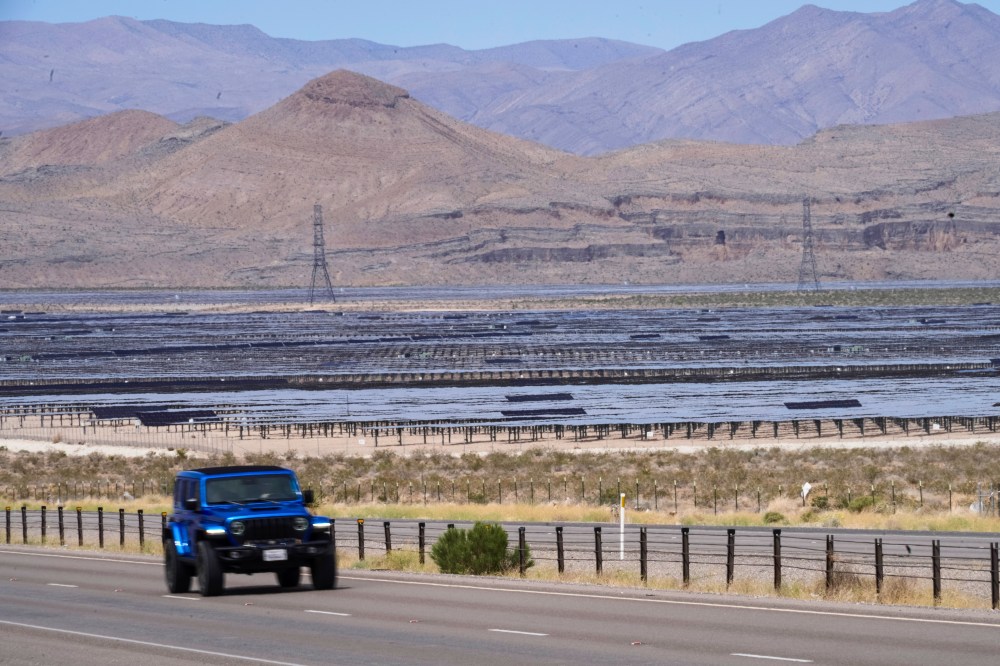
It’s one of many utilities across the country grappling with how to meet the exploding electricity demand for data centers to power artificial intelligence without sacrificing long-term plans to move away from fossil fuels in favor of renewable and zero-carbon sources.
In North Carolina, which is also seeing a surge of data centers, the largest utility is revising its long-term plans to delay the retirement of coal plants and to build more natural gas plants. Legislators removed an interim goal for utilities to cut carbon emissions, spurring concern from environmentalists that the state might miss its goal of zero carbon emissions by 2050.
NextEra Energy, which serve commercial electricity in over a dozen states, completely dropped its goal to reach zero emissions by 2045 due to the “demand for all forms of power generation,” the company said in a recent business filing.
The Trump administration has encouraged states to use coal to meet the demands from manufacturing and data centers. Tech companies are also slowing down on their own climate goals to meet the consumer demands for artificial intelligence.
“It’s very alarming, and it’s probably the single largest natural resource issue of our time,” said Olivia Tanager, director of the Sierra Club’s Toiyabe chapter covering Nevada.
Nevada is one of the fastest-growing data center markets in the U.S. thanks to its lack of a corporate income tax, cheap land and tax breaks for data centers. There are dozens already with more on the way. Now lawmakers are eyeing more regulations and debating how to balance both the state’s clean energy goals with the economic benefits data centers bring.
Some data centers say they want to be part of the solution; the industry was responsible for half of all corporate clean energy procurement in 2024, said Dan Diorio, vice president of state policy for the Data Center Coalition.
But renewable energy’s contribution to the power grid is not growing fast enough. Nationally, orders for gas turbines are backlogged and processing renewable energy projects take time, industry experts say.
One Vegas data center built its own solar fields
South of the Las Vegas Strip, the Switch data center stretches for nearly a square mile (kilometer). It’s the largest data center in Southern Nevada, and it runs entirely on renewable energy, according to Jason Hoffman, chief strategy officer. Unlike other data centers, Switch is licensed to build its own sources of renewable energy at the scale of a utility company. It has built 1 gigawatt of solar energy and is in the process of building more solar fields, he said. The company only uses NV Energy’s grid for the delivery of electricity, and it sources its own power from third-party suppliers.
Inside of the massive buildings, hundreds of servers hum within gigantic soundproof and waterproof chambers. They contain vital information for Switch’s clients, including major banks, streaming services, online shopping websites, casinos and state and local governments.
During the summer heat, when more energy is required to keep the equipment cool, Switch can remove itself from the grid and be self-sufficient, Hoffman said. The data center is designed to require minimal air conditioning during the rest of the year.
Many other utilities and tech companies are turning to gas-fired generation to power data centers, including the controversial xAI data center near Memphis that is using mobile gas turbines strapped to semitrucks.”
Tanager, of the Sierra Club, said multiple proposed data centers in Northern Nevada would use hundreds of low-quality diesel-powered backup generators that will worsen air quality. Data centers have backup generators in case the power goes out and are not used often.
At a recent seven-hour legislative meeting, Nevadans complained to lawmakers about the noise data centers produce, and their worries about how the centers will affect water supply and energy bills. Residents of Boulder City, home of the Hoover Dam, are also opposing a proposed center for similar concerns.
State provides financial incentives for clean power
NV Energy requires data center developers to agree to fund their own infrastructure and energy needs — but it doesn’t have to be renewable.
Nevada designed a volunteer funding model that allows companies to put up money for NV Energy’s clean energy development then count it toward their corporate energy goals. It was the first such model of its kind in the country and led to the development of a geothermal plant in Northern Nevada with Google as a partner.

Environmental groups want the state to make that model mandatory, but still worry it wouldn’t bring enough clean energy to meet demand. They also worry NV Energy could expand its reliance on fossil fuel without the guarantee that all the proposed data centers will be built.
NV Energy will require companies to sign contracts ensuring their commitment to the state before energy is built, Elicegui said. The utility’s philosophy is that “growth is welcomed,” but that companies need to be responsible for power load added on their behalf “whether they show up or not.”
The public utilities commission in Nevada may impose a fine, grant an exemption or take some other action if it determines NV Energy failed to meet the state’s clean energy goals. The utility is set to publish a report with more specifics by the end of the month.
Democratic Assemblymember Howard Watts of Las Vegas said it is “unacceptable” to bring forward projects that will threaten the state’s renewable energy portfolio. Watts wants to see it required that data centers take on the costs of clean energy development. While many companies are already taking those steps, putting those guardrails in statute is necessary, he said.
“Building more gas plants seems like going in the exact opposite direction of what we need to do as a state,” he said, noting the state has “tremendous solar and geothermal energy potential.”