A 1.9 billion-year-old bedrock will soon house the world’s first permanent nuclear waste site
Advertisement
Read this article for free:
or
Already have an account? Log in here »
To continue reading, please subscribe:

Digital Subscription
One year of digital access for only $205*
- Enjoy unlimited reading on winnipegfreepress.com
- Read the E-Edition, our digital replica newspaper
- Access News Break, our award-winning app
- Play interactive puzzles
*First annual payment billed as $205.00 + GST for one year. This annual subscription will automatically renew at $233.00 + GST every 52 weeks (10% off the regular annual price of $259.35). Offer available to new and qualified returning subscribers only. Cancel any time.
To continue reading, please subscribe:
Add Free Press access to your Brandon Sun subscription for only an additional
$1 for the first 4 weeks*
- Enjoy unlimited reading on winnipegfreepress.com
- Read the E-Edition, our digital replica newspaper
- Access News Break, our award-winning app
- Play interactive puzzles
*Your next Brandon Sun subscription payment will increase by $1.00 and you will be charged $17.95 plus GST for four weeks. After four weeks, your payment will increase to $24.95 plus GST every four weeks.
Read unlimited articles for free today:
or
Already have an account? Log in here »
OLKILUOTO, Finland (AP) — With the push of a button, the elevator descends hundreds of meters in seconds into the dark depths of Onkalo.
“We are now at about minus 430 meters (1,411 feet),” muttered geologist Tuomas Pere as he steered a car through a labyrinth of man-made tunnels. “We are driving through 1.9-billion year old bedrock.”
After decades of construction, the world’s first facility for permanently disposing spent nuclear fuel is set to begin operations in Finland, becoming a final resting place for tons of dangerous radioactive waste.
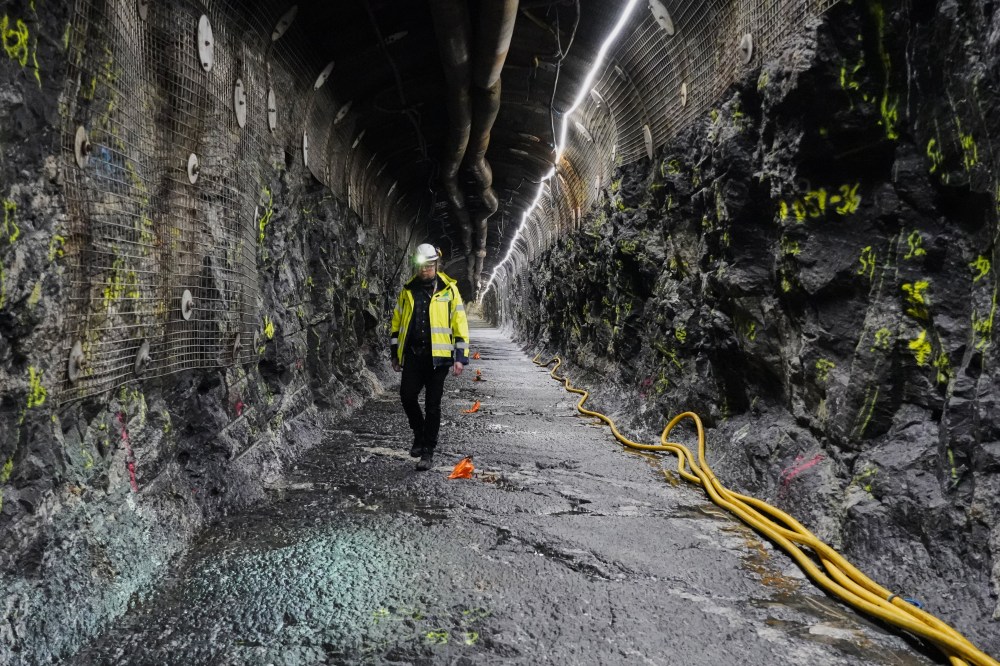
Construction of Onkalo — which means “cave” in Finnish — began on the west coast in 2004. It sits on the secluded island of Olkiluoto, in a dense wooded area. The closest town is Eurajoki, about 15 kilometers (9.3 miles) inland, which is home to about 9,000 people. Many work at the nuclear power plant or storage facility.
The 1 billion euro ($1.2 billion) project could soon become operational, with authorities expected to grant a license within months.
The Associated Press took a tour of the facilities where humans soon will not be allowed to tread.
‘Isolated from civilization’
Pere said the site — near three of Finland’s five nuclear reactors — was chosen for its migmatite-gneiss bedrock, which is known for its high stability and low risk of earthquakes.
“It’s the isolation from civilization and mankind on the surface that’s important,” he said, standing in a darkened disposal tunnel, soon to be sealed from humanity. “We can dispose of the waste more safely than by storing it in facilities located on the ground.”
Using unmanned machinery at a nearby encapsulation plant, radioactive rods will be sealed in copper canisters and then buried deep in tunnels over 400 meters underground, then packed in with “buffer” layers of water-absorbing bentonite clay.
Posiva, the company responsible for the long-term management of Finland’s spent nuclear fuels, says Onkalo can store 6,500 tons of spent nuclear fuel.
The final disposal canisters are designed to remain sealed “long enough for the radioactivity of spent fuel to decrease to a level not harmful to the environment,” it said.
“The solution that we have, it’s the missing point for sustainable use of nuclear energy,” said Posiva communications manager Pasi Tuohimaa.
Finnish nuclear power companies are paying for the project, he said, adding that they have saved money for decades for that purpose.
Posiva estimate it will take hundreds of thousands of years before the radioactivity falls to normal, background levels.
According to a 2022 report by the International Atomic Energy Agency, almost 400,000 tons of spent fuel have been produced globally since the 1950s, with two-thirds remaining in temporary storage and one third being recycled in a complex process.
The world’s spent nuclear fuel is currently temporarily stored inside spent nuclear fuel pools at individual reactors and at dry cask storage sites above ground.
There is currently no permanent underground disposal facility for commercial nuclear waste operational anywhere in the world. Sweden began building a repository in Forsmark — about 150 kilometers north of Stockholm — last year, but it’s not expected to open until the late 2030s. France’s Cigéo project is yet to begin construction and has seen opposition.
The Onkalo facility is expected to operate until the 2120s, when it will be permanently sealed.
‘There are uncertainties’
But Edwin Lyman, director of nuclear power safety at the Union of Concerned Scientists, an American nonprofit organization, warned that geologic disposal of nuclear waste is still fraught with “uncertainties.”
“My view of nuclear waste disposal is that there’s no good option, but it’s important to find the least bad option, and geologic disposal in general is going to be the least bad option among a range of, you know, bad options,” he said.
Lyman said that the copper canisters that contain the spent nuclear fuel will eventually corrode, adding that there are different scientific opinions about how fast that could happen.
“The hope is that is such a slow process that most of the radioactive material will have decayed away by then. But again, there are uncertainties,” he said.
Still, Lyman said that permanently storing spent nuclear fuel deep underground is better than “leaving it on the surface of the Earth forever,” because nuclear material kept above ground “is vulnerable to sabotage.”
“For many decades after spent fuel is discharged from a reactor, it’s so radioactive that it makes transporting and reprocessing very difficult,” Lyman said. But eventually the main radioactive component will decay, he added, making it less risky to handle.
“So over time the plutonium becomes more accessible either to terrorists or to a country that may want to use it,” he said, adding that the only way a terrorist — or a state — could theoretically use the material for a nuclear bomb would be if they had “an off-site reprocessing capability.”
During reprocessing, spent nuclear fuel is separated to recover uranium and plutonium to recycle it for use in new fuel. The process also carries proliferation risks because the separated plutonium could potentially be diverted to build a nuclear weapon.
Overall, the risks associated with nuclear waste repositories will mainly affect “future generations,” Lyman concluded.
To deal with this challenge, an interdisciplinary field of study called nuclear semiotics has been established that looks into developing warning signs about nuclear waste repositories that can be understood by humans 10,000 years from now — or much longer given that it takes hundreds of thousands of years before nuclear waste is no longer dangerous.
For reference: the first humans lived around 300,000 years ago. The earliest writing system was developed in Mesopotamia roughly 5,200 to 5,400 years ago. Stonehenge in Britain is around 5,000 years old, while the Giza pyramids in Egypt are approximately 4,500 years old.
‘Nuclear message’
Austrian artist and inventor Martin Kunze has led an expert group on long-term information preservation at the Nuclear Energy Agency of the Paris-based Organization for Economic Cooperation and Development. He has developed a system that he calls the “nuclear message” — crucial information for future generations that is printed on a solid ceramic plate below a hard glazed surface.
Kunze said that the ceramic plates are “inexpensive and very robust” and should ideally be buried “in large numbers” in the area around the repository as well as “inside the foundations” of every house in the community. The goal should be to distribute as many ceramic plates in the area as possible.
Finnish officials say the Onkalo nuclear repository reflects the country’s long-term approach to nuclear energy policy.
A 1994 act required radioactive waste generated in Finland to be handled, stored and permanently disposed of within the country’s borders.
“Back then… some of the waste was still exported, but we wanted to take care of it ourselves,” said Sari Multala, Finland’s environment minister. “We also stick to the decisions, unlike many other countries.”

Multala did not rule out eventually accepting limited amounts of nuclear waste from other countries. “In the small scale there could be some kind of possibilities, as long as it is allowed by the international regulators,” she said.
___
Liechtenstein reported from Vienna.
___
The Associated Press receives support for nuclear security coverage from the Carnegie Corporation of New York and Outrider Foundation. The AP is solely responsible for all content. ___ Additional AP coverage of the nuclear landscape: https://apnews.com/projects/the-new-nuclear-landscape/