Africa’s off-grid solar sector courts mainstream investors with landmark financing deals
Advertisement
Read this article for free:
or
Already have an account? Log in here »
To continue reading, please subscribe:

Digital Subscription
One year of digital access for only $205*
- Enjoy unlimited reading on winnipegfreepress.com
- Read the E-Edition, our digital replica newspaper
- Access News Break, our award-winning app
- Play interactive puzzles
*First annual payment billed as $205.00 + GST for one year. This annual subscription will automatically renew at $233.00 + GST every 52 weeks (10% off the regular annual price of $259.35). Offer available to new and qualified returning subscribers only. Cancel any time.
To continue reading, please subscribe:
Add Free Press access to your Brandon Sun subscription for only an additional
$1 for the first 4 weeks*
- Enjoy unlimited reading on winnipegfreepress.com
- Read the E-Edition, our digital replica newspaper
- Access News Break, our award-winning app
- Play interactive puzzles
*Your next Brandon Sun subscription payment will increase by $1.00 and you will be charged $17.95 plus GST for four weeks. After four weeks, your payment will increase to $24.95 plus GST every four weeks.
Read unlimited articles for free today:
or
Already have an account? Log in here »
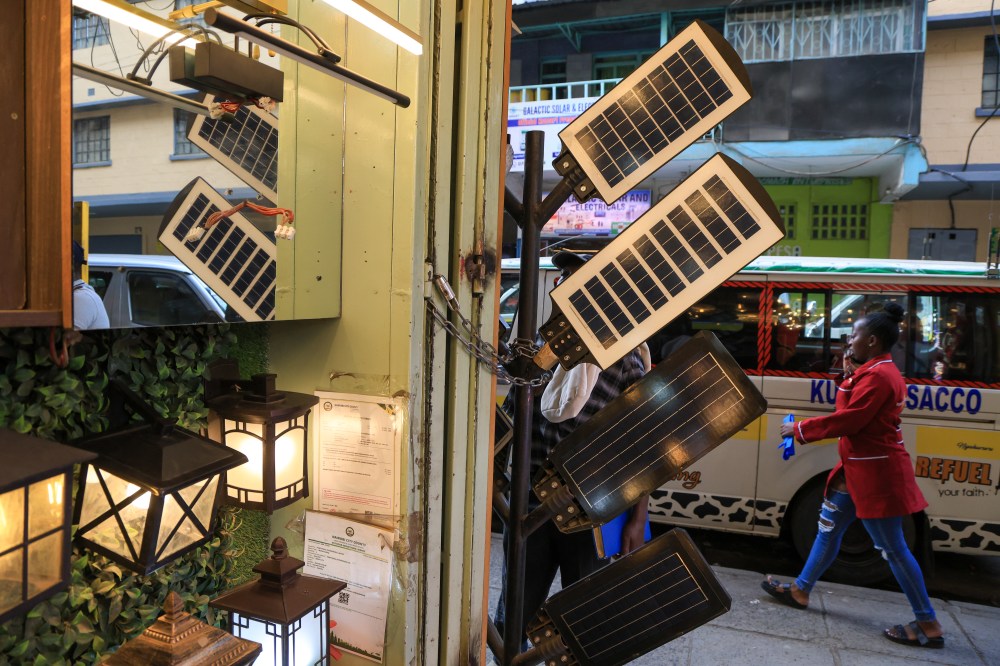
NAIROBI, Kenya (AP) — Landmark fundraising deals by two of Africa’s largest off-grid solar companies are raising hopes that private capital markets could become a major source of funding to help bring electricity to millions of homes lacking access to reliable power.
A $50 million green bond issued by affordable energy company D.light in June, and $286 million in securitized debt by rival Sun King mid-2025 are testing whether institutional investors will back a pay-as-you-go business model on a commercial scale.
Such strategies are fueling debate over whether Africa’s off-grid solar sector has reached a financial turning point, attracting mainstream investors beyond its traditional base of donor agencies and development finance institutions.
Raising fresh capital to fund solar installations
Both d.light and Sun King sell solar home systems and appliances to households that lack electricity using a pay-as-you-go (PAYGo) model. Customers pay in small instalments, often through mobile apps, instead of putting up the full price upfront. The remaining future payments, known as receivables, are bundled together and used as collateral for bonds or other securities that can be sold to investors, allowing the two companies to raise fresh capital immediately.
Sun King’s global chief financial officer, Krishna Swaroop, called the transactions “pathbreaking” for the industry.
“They demonstrate the entry of a serious scale of commercial capital, investors and instruments not seen before in this sector,” Swaroop said.
But he cautioned that the deals reflect years of operational experience that many smaller companies lack. Investors typically expect to see five to seven years of repayment data before considering similar financing structures.
Securitization allows solar firms to bundle future payments such as Pay-go receivables and sell them to investors to raise capital. While it can lower financing costs for larger firms, the process requires costly legal, regulatory and credit guarantees. Those fixed expenses make securitization uneconomical for smaller firms.
“The biggest risk that still deters mainstream investors is the portfolio quality risk,” Swaroop said, referring to the possibility of loans not performing as expected. “Many off-grid companies struggle to quantify and explain the portfolio quality data to investors in terms they understand.”
Innovative financing techniques gain ground
The financial tools the companies are using are unfamiliar outside capital markets.
A green bond works like a conventional bond, purchased by investors who earn interest payments. The proceeds finance environmentally beneficial projects. In d.light’s case, the bond is backed by a special-purpose firm holding thousands of PAYGo customer account receivables.
Sun King’s transactions use securitization, a financing technique widely used in mortgage and auto-loan markets. Instead of mortgages, the underlying assets are future customer payments for solar systems. That allows the company to convert years of future repayments into immediate capital.
Industry leaders say the deals show the market for climate financing has matured.
Years of improvements in product quality, certification and repayment records have made customer receivables increasingly attractive to investors, said Sarah Malm, executive director of the off-grid solar industry association GOGLA.
“These deals are proof that the model works,” Malm said. “Today, PAYGo receivables are rated, listed and bought by institutional investors in London and New York.”
Financial tools are drawing in new investors
GOGLA’s 2025 Investment Data Report found Africa’s off-grid companies are increasingly attracting sophisticated financing, with local-currency investment reaching a record 47.2% of funding. The rest was U.S. dollar-denominated. It said 18 new investors were participating, including commercial banks in Nigeria, Kenya, Tanzania and Madagascar.
Wangari Muchiri, founder and chief executive of Africa-based clean energy transition firm RE.Think Energy, said the transactions represent “an important tipping point” rather than isolated successes.
“Every successful transaction reduces perceived risk and makes the next one easier to finance,” Muchiri said, adding that wider adoption will require more investment-ready companies, standardized financing structures, stronger performance data and supportive regulation.
Analysts caution that the transactions still rely on significant credit enhancements, such as a full guarantee from the Green Guarantee Co., which mobilizes private capital for climate investment in emerging markets.
It backed d.light’s green bond, substantially reducing the risk for investors, said Penny Herbst, senior energy adviser at the Rabia Transition Initiative, a nonprofit energy transition research firm.
“While it may be a first of its kind, it is significantly de-risked,” Herbst said. She noted that because the bond was privately placed, key pricing and guarantee details remain confidential.
Reshaping Africa’s electrification
Supporters argue that if such financing becomes more common, it could reshape Africa’s electrification efforts.
Improved technology is helping. Lithium-ion batteries now last up to 10 years, and battery prices have fallen by more than 90% since 2010, Malm noted. Independent product certification, warranties and repair networks have further reduced investor risk.
“All of this matters to an investor because it is what turns a stream of household payments into a predictable, well-performing financial asset,” she said.
Swaroop said one remaining challenge is ensuring that commercial returns don’t deter investors from helping the poorest households.
“Theoretically, capital markets and institutional investors can provide cheaper and longer-tenured capital,” he said. “But we also need to ask whether chasing capital-market-level returns leads companies toward larger, more creditworthy customers and away from the hardest-to-reach, lowest-income segment.”
___
The Associated Press’ climate and environmental coverage receives financial support from multiple private foundations. AP is solely responsible for all content. Find AP’s standards for working with philanthropies, a list of supporters and funded coverage areas at AP.org.