Swapping supper
Trading meals with friends and neighbours builds the community and diversifies everyone's menus
Advertisement
Read this article for free:
or
Already have an account? Log in here »
To continue reading, please subscribe:

Digital Subscription
One year of digital access for only $205*
- Enjoy unlimited reading on winnipegfreepress.com
- Read the E-Edition, our digital replica newspaper
- Access News Break, our award-winning app
- Play interactive puzzles
*First annual payment billed as $205.00 + GST for one year. This annual subscription will automatically renew at $233.00 + GST every 52 weeks (10% off the regular annual price of $259.35). Offer available to new and qualified returning subscribers only. Cancel any time.
To continue reading, please subscribe:
Add Free Press access to your Brandon Sun subscription for only an additional
$1 for the first 4 weeks*
- Enjoy unlimited reading on winnipegfreepress.com
- Read the E-Edition, our digital replica newspaper
- Access News Break, our award-winning app
- Play interactive puzzles
*Your next Brandon Sun subscription payment will increase by $1.00 and you will be charged $17.95 plus GST for four weeks. After four weeks, your payment will increase to $24.95 plus GST every four weeks.
Read unlimited articles for free today:
or
Already have an account? Log in here »
Hey there, time traveller!
This article was published 27/02/2018 (3055 days ago), so information in it may no longer be current.
Tired of looking at the same ol’ same ol’ in your pantry? Are you wishing that, as good a cook as you are, there was something different to eat, that didn’t come from the drive-thru?
A food swap might be the answer.
If, when you hear the phrase “food swap,” the first thing that pops into your head is a Christmas cookie exchange — where a group of home bakers gets together and trades cookies so everybody gets a variety of goodies for the dainty tray, you’d be really close to the mark. A food swap is the same idea on a larger scale — with a much greater variety of food. It is a community event based on barter and trading (no money changes hands) and the celebration of homegrown, home-cooked ingenuity. The idea is to get a variety of homemade items into the participants’ pantries so everyone can expand their menus at home.
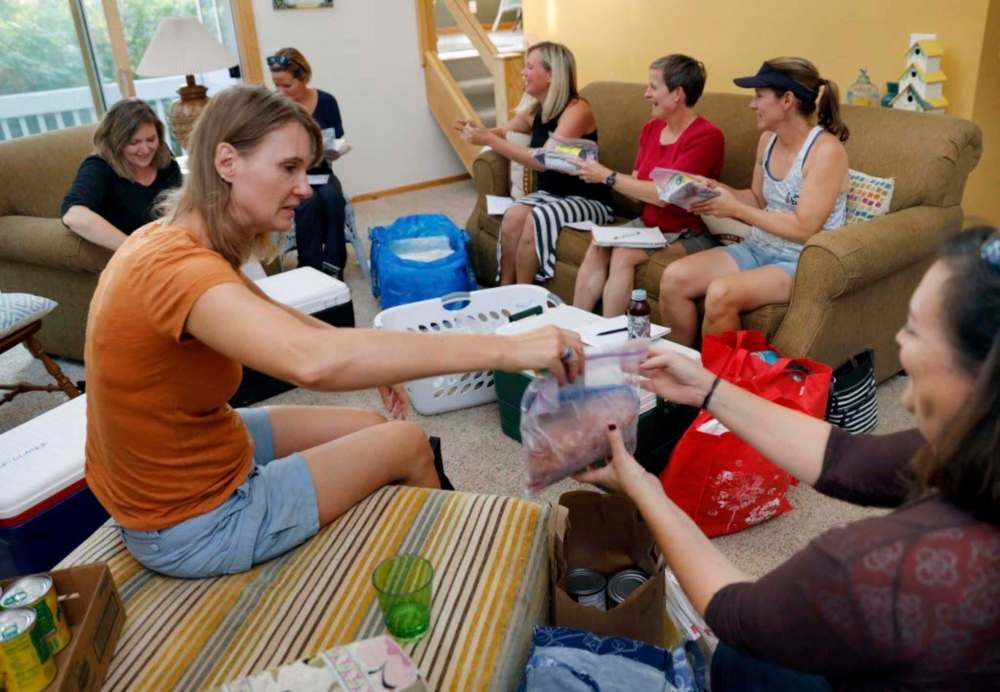
A food swap takes research and planning. Go to the Food Swap Network (foodswapnetwork.com) and read through the checklists and suggestions. See Emily Paster’s website (www.chicagofoodswap.com) as well.
Emily Paster is also the author of Food Swap (Storey Publishing, $26.65), a how-to manual that draws from the experiences of seasoned swappers and organizers. She’s got swap-ready recipes and the book even includes tear-out labels to attach to your packaging. This book gives you detailed guidelines on starting a food swap — with just a few friends, a church or small community, or even a much larger group — something more akin to the style of a small-scale farmers market.
Paster got started after spending a summer on an obsessive fruit and vegetable canning project — producing more than her family could ever eat — and then reading about a Philadelphia food swappers event. She organized and started one of her own, the Chicago Food Swap, and, as these things do, it grew, inspiring others to pop up in other communities.
The food swap turned into a second career for her, and she now teaches canning classes, writes on food and entertaining and has developed recipes for an online grocery delivery service.
If you want to take the plunge, the first thing you should do is find a like-minded partner with complementary strengths to share the organizing tasks. It’s also a good idea to do a small-scale road test. Survey a few friends, start small and give it a go. You can scale your expansion for subsequent events.
Here are a some pointers from Emily Paster’s Food Swap.
● No money changes hands. It’s about trading not buying. Adding cash to the transaction may invite unwanted and unwelcome legal considerations.

● All items must be made or grown by the traders. The offerings can vary wildly from soups to nuts to desserts to canned goods or even hand-milled flours (if you’re into that). You can also choose a theme, like a soup swap, a jam swap, or an hors d’ouevre swap. The best choices are portable, distinctive, not-too-perishable and delicious. They should also be packaged nicely with clear instructions if needed.
● All events are different. A small swap among friends might just need phone calls. A large community event is going to require communications and networking, registration, a community-based location, and tables and chairs.
● Swaps are negotiated. Swap cards, filled out by traders, outline the offering with space for other traders to make offers. These are not binding but help to start negotiations. The first part of the swap is spent mingling and sampling so everyone can make a fair and educated offer on presented items. The host designates the time for trading and individuals begin to barter and trade amongst themselves.
● Once trading is complete, traders pack up and take their goodies home. Social media for the event allows participants to share photos of their hauls and talk about the event, compliment each other’s cooking and ask questions.
Twitter: @WendyKinginWpg
wfpsummary:
Cold Pea Soup with Mint
Here is one example of a recipe that would be a suitable and healthful item to bring to a food swap. It is excerpted from Food Swap © by Emily Paster. Photography by © Michael Piazza Photography. Used with permission from Storey Publishing.
:wfpsummary
Cold Pea Soup with Mint
Makes 2.3 litres (5 pints)
Fresh peas are in season for such a short time and they are truly sublime. But you can make a decent version of this soup with frozen peas, which will save you the trouble of having to shell them.
60 ml (4 tbsp) butter
2 yellow onions, diced
1.5 litres (6 cup or about 2 lbs) fresh or frozen peas
1 litre (4 cups) chicken broth
250 ml (1 cup) buttermilk
125 ml (1/2 cup) loosely packed mint leaves (about 15 g or 1/2 oz)
3 ml (1/2 tsp) salt
Melt the butter in a large Dutch oven or stockpot over medium heat. Add the onions and sweat them over medium-low heat until softened but not browned, approximately 5 minutes.
Add the peas and stir to combine. Add the chicken broth and bring the mixture to a boil. Reduce the heat and simmer until the peas are tender, 2 to 3 minutes. Remove from the heat. Allow to cool slightly.
Transfer the soup to a high-speed blender and add the buttermilk, mint, and salt, and purée until smooth. Alternatively, add the buttermilk and mint to the pot with the soup and purée using an immersion blender.
Chill the soup for several hours until cold. Taste and adjust the seasonings. Store in the refrigerator until ready to eat or swap.
For swapping, pour the soup into clean glass pint jars and decorate with a label or hanging tag. Suggest serving the soup garnished with a dollop of sour cream or plain Greek yogurt. Label as perishable.
Why swap?
It increases your options. Your pantry, like your portfolio, could always use some diversification.
It’s a sustainable practice. By swapping excess food, you help to reduce the waste of a valuable resource.
It can make you a better cook. You will find yourself encouraged to keep trying new and better recipes for the fun and excitement of trading with others — and because you’re proud of what you can do. Some traders end up starting small food businesses based on the success of their food offerings.
It builds communities. Food forges connections. You will meet and learn from other people.

Advertisement Advertise With Us
Advertisement Advertise With Us