WEATHER ALERT

US to require breast density information after mammograms

Advertisement

Advertise with us

WASHINGTON - All U.S. women getting mammograms would receive information about breast density, which can sometimes make cancer harder to spot, under a government proposal released Wednesday.

Read this article for free:

or

Already have an account? Log in here »

To continue reading, please subscribe:

Subscribe and receive a limited-edition Free Press branded hat or tote.

Digital Subscription

One year of digital access for only $205*

  • Enjoy unlimited reading on winnipegfreepress.com
  • Read the E-Edition, our digital replica newspaper
  • Access News Break, our award-winning app
  • Play interactive puzzles

*First annual payment billed as $205.00 + GST for one year. This annual subscription will automatically renew at $233.00 + GST every 52 weeks (10% off the regular annual price of $259.35). Offer available to new and qualified returning subscribers only. Cancel any time.

To continue reading, please subscribe:

Add Free Press access to your Brandon Sun subscription for only an additional

$1 for the first 4 weeks*

  • Enjoy unlimited reading on winnipegfreepress.com
  • Read the E-Edition, our digital replica newspaper
  • Access News Break, our award-winning app
  • Play interactive puzzles
Start now

*Your next Brandon Sun subscription payment will increase by $1.00 and you will be charged $17.95 plus GST for four weeks. After four weeks, your payment will increase to $24.95 plus GST every four weeks.

Hey there, time traveller!
This article was published 27/03/2019 (2679 days ago), so information in it may no longer be current.

WASHINGTON – All U.S. women getting mammograms would receive information about breast density, which can sometimes make cancer harder to spot, under a government proposal released Wednesday.

The Food and Drug Administration’s proposed rules would standardize the information given to millions of women following scans to detect breast cancer. Some states already require the notices.

More than half of women over age 40 have dense breasts, with less fatty tissue and more connective and glandular tissue. That tissue appears white on X-rays, the same colour as growths in the breast, making mammograms harder to read. Dense breast tissue is one of the factors that can increase a woman’s chances of developing cancer.
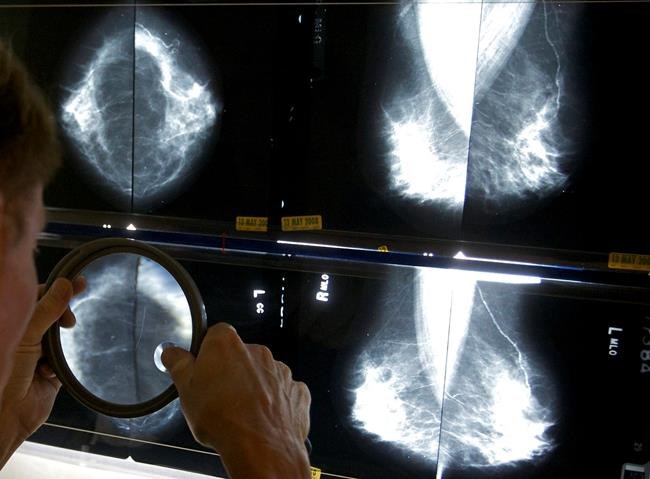
FILE - In this Thursday, May 6, 2010 file photo, a radiologist uses a magnifying glass to check mammograms for breast cancer in Los Angeles. Under a proposal released Wednesday, March 27, 2019, all U.S. women undergoing mammograms would receive extra information about breast density, which can sometimes make cancer harder to spot. (AP Photo/Damian Dovarganes, File)

Under the FDA’s proposal, all women would receive a short summary about their breast density. For those with dense breasts, the letter would note that their tissue “makes it harder to find breast cancer,” and could require additional testing. The letter would also recommend that they speak with a doctor about their “individual situation.”

More than 35 states already require some kind of notification for dense breasts. But the FDA’s proposal, if finalized, would apply to all states and set minimum standards for the information disclosed.

“We set a particular bar — you can’t go below that bar — but states can impose more stringent requirements,” said Dr. Jeffrey Shuren, the FDA’s director for medical devices.

The American Cancer Society’s Cancer Action Network said the FDA proposal would “help ensure women get the most accurate information they need following a mammogram,” in a statement.

Regulators will take public comments for three months before finalizing the proposal, a process that can take months or sometimes years.

Professional guidelines don’t specify next steps for women identified with dense breasts, but some physicians may recommend additional forms of scanning, including ultrasound or MRI.

Mammogram reports to doctors have long included information about density. But it wasn’t routinely shared with women until some cancer survivors began pushing for disclosure laws. Congress gave the FDA authority to regulate standards for mammograms in 1992 and recently directed the agency to develop standard summary language.

Regulators said it was the first proposed update to national mammography standards in more than 20 years.

Other proposed regulations would:

— Allow the FDA to contact patients directly if their mammography provider is not meeting quality standards or disclosing required information.

— Sanction mammography providers that don’t adequately track patient records and information.

___

Follow Matthew Perrone at @AP_FDAwriter

___

The Associated Press Health and Science Department receives support from the Howard Hughes Medical Institute’s Department of Science Education. The AP is solely responsible for all content.


Report Error Submit a Tip

More Stories

Man accused of breaking into Kingsway homes, high school

1 minute read Updated: Yesterday at 9:50 PM CDT

A 35-year-old man has been accused of breaking into six Crescentwood homes and a nearby high school on Saturday morning, causing damage estimated at $25,000.

At about 6:30 a.m. July 25, Winnipeg police got several 911 calls about an unknown man breaking into homes in the 100 block of Kingsway after throwing bricks and rocks through windows and glass doors. In some cases, a man confronted and threatened residents and stole their belongings, the Winnipeg Police Service said in a news release Sunday.

One of the victims flagged down officers when police arrived on scene, pointing out a man walking down the street armed with a broken liquor bottle. The suspect dropped the bottle and police arrested him.

No one was injured and the Major Crimes Unit took on the investigation.

Pre-lust logistics can help rein in randy racket

Maureen Scurfield 5 minute read 2:00 AM CDT

DEAR MISS LONELYHEARTS: I’ve discovered my wife is quite amorous out at the lake. It’s our first year having a fair bit of alone time at the cottage, and I’m all for an exciting sex life with the breeze blowing in through the windows.

Our kids are grown up now and not out here regularly anymore, so my wife doesn’t think she needs to keep it down. And she can be pretty noisy in bed.

Our neighbour behind us invited me over for drinks on his deck yesterday afternoon. When he’d had a few, he made a crack about the “free symphony” coming from our bedroom window.

Of course, I went home and told my wife, and she was mortified.

Daycare grapples with five-year-old’s outbursts, choking incidents

Maggie Macintosh 4 minute read Preview

Daycare grapples with five-year-old’s outbursts, choking incidents

Maggie Macintosh 4 minute read Friday, Jul. 24, 2026

A Windsor Park child-care facility is weighing a five-year-old’s right to care versus the safety of other children who have been choked.

Little People’s Place expelled a pre-schooler in the spring in response to his aggressive behaviour toward other children and staff.

The child’s family has appealed to the province for him to be reinstated.

The case is raising concerns about inclusion support resources and measures to protect everyone at the Cottonwood Road daycare.

Read
Friday, Jul. 24, 2026

Protests spur Ukraine military reshuffle

Kyle Volpi Hiebert 5 minute read Preview

Protests spur Ukraine military reshuffle

Kyle Volpi Hiebert 5 minute read 2:01 AM CDT

Even nations fighting for their survival can’t escape politics.

“The president should not choose sides during a war,” Ukrainian President Volodymyr Zelenskyy told reporters earlier this month after sacking his defence minister to quell a growing rift between him and the country’s military chief. “But if the parties cannot solve the issue, then I have to solve it.”

Many Ukrainians felt their leader picked the wrong side.

Protesters poured into Ukraine’s streets for days beginning July 16 to condemn the dismissal of 35-year-old Mykhailo Fedorov. The tech savvy iconoclast is fiercely popular. He’s also considered the architect of Kyiv’s robot-first military strategy that has tilted the war in Ukraine’s favour.

Read
2:01 AM CDT

Take care of them; there is enough

David Driedger 5 minute read 2:01 AM CDT

THE PARABLE of the Good Samaritan is one of those stories that has endured far beyond its original context, far beyond religion itself. Someone is robbed, assaulted and left for dead.

The parable names names. The equivalent of political and community leaders, who should know better, pass by on the other side of the street. A Samaritan, someone of questionable standing in the community, stops and helps. The only person who isn’t identified is the one beaten. He could be any of us. It is a powerful call to compassion and not turning away.

Something that is rarely, if ever, mentioned is that the Samaritan brings the person along with him to an inn where they stay the night. In the morning, the Samaritan must be on his way and so says to the innkeeper, “Take care of him and when I come back, I will repay you whatever more you spend.”

I know many who try to live out the Samaritan ethic. We roll down our windows at an intersection with some spare change. We hand out water during a heat wave.

US to require breast density information after mammograms

Matthew Perrone, The Associated Press 3 minute read Preview

US to require breast density information after mammograms

Matthew Perrone, The Associated Press 3 minute read Wednesday, Mar. 27, 2019

WASHINGTON - All U.S. women getting mammograms would receive information about breast density, which can sometimes make cancer harder to spot, under a government proposal released Wednesday.

The Food and Drug Administration's proposed rules would standardize the information given to millions of women following scans to detect breast cancer. Some states already require the notices.

More than half of women over age 40 have dense breasts, with less fatty tissue and more connective and glandular tissue. That tissue appears white on X-rays, the same colour as growths in the breast, making mammograms harder to read. Dense breast tissue is one of the factors that can increase a woman's chances of developing cancer.

Under the FDA's proposal, all women would receive a short summary about their breast density. For those with dense breasts, the letter would note that their tissue "makes it harder to find breast cancer," and could require additional testing. The letter would also recommend that they speak with a doctor about their "individual situation."

Read
Wednesday, Mar. 27, 2019