

SATURDAY SPECIAL: Still waiting
Comprehensive flood defence for Fargo remains on drawing board

Advertisement
Read this article for free:
or
Already have an account? Log in here »
To continue reading, please subscribe:

Digital Subscription
One year of digital access for only $205*
- Enjoy unlimited reading on winnipegfreepress.com
- Read the E-Edition, our digital replica newspaper
- Access News Break, our award-winning app
- Play interactive puzzles
*First annual payment billed as $205.00 + GST for one year. This annual subscription will automatically renew at $233.00 + GST every 52 weeks (10% off the regular annual price of $259.35). Offer available to new and qualified returning subscribers only. Cancel any time.
To continue reading, please subscribe:
Add Free Press access to your Brandon Sun subscription for only an additional
$1 for the first 4 weeks*
- Enjoy unlimited reading on winnipegfreepress.com
- Read the E-Edition, our digital replica newspaper
- Access News Break, our award-winning app
- Play interactive puzzles
*Your next Brandon Sun subscription payment will increase by $1.00 and you will be charged $17.95 plus GST for four weeks. After four weeks, your payment will increase to $24.95 plus GST every four weeks.
Read unlimited articles for free today:
or
Already have an account? Log in here »
Hey there, time traveller!
This article was published 28/03/2009 (6368 days ago), so information in it may no longer be current.
FARGO — John Clement has seen the river rise and fall for more than a half-century from his tiny home in Oak Grove, one of this city’s oldest neighbourhoods.
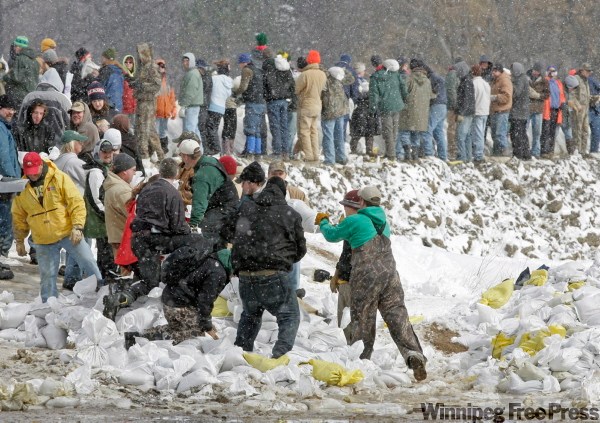
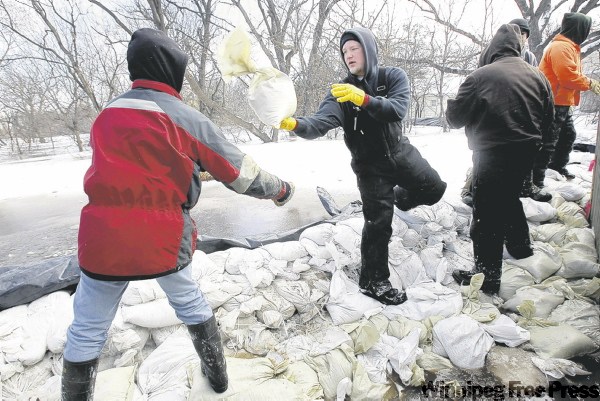
And if Clement knows anything, it is that every spring, the Red River is going to come knocking on his back door and those of his neighbours. "It’s going to keep happening, the flooding," Clement said as he watched a beehive of volunteers shore up a sandbag dike behind his home. "Fargo is just plain flat. Really, nobody should live here."
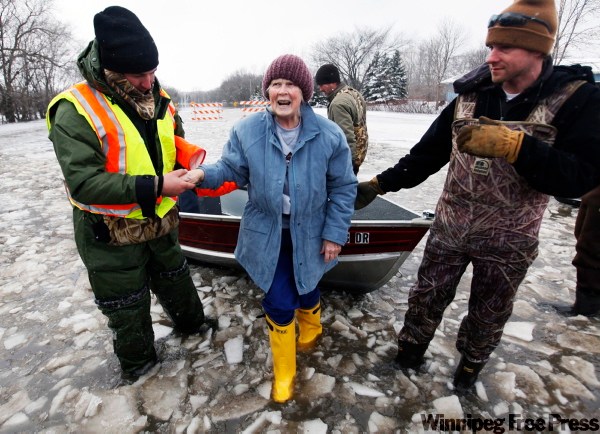
But live they do, all up and down the meandering Red River, which runs through the communities of Fargo, N.D., and Moorhead, Minn., like a tangled extension cord. Over the years, Fargoans have jammed every nook and cranny of the river’s twisted path with homes, ensuring that every spring brings a showdown between human and muddy water.
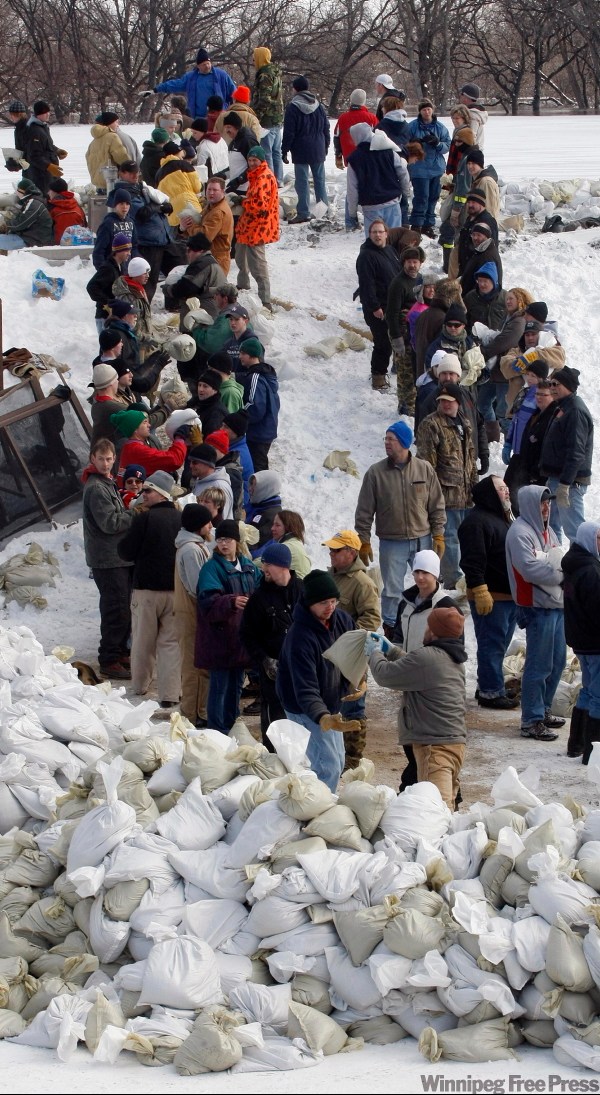
Just down the street, Bryan Hest paces nervously back and forth along the dike that protects his home from the surging river. A farmer from nearby Perley, Hest bought this home 18 months ago in the hope that it would give his family a place of respite from the overland flooding they have to battle at the farm.
Hest would like to see more permanent flood protection added to Fargo’s infrastructure, but understands that it has been difficult over the years to get people to agree on exactly what to do. There have been grand plans for diversions like the Red River Floodway that protects Winnipeg, and smaller projects that involve more strategically placed permanent levees within the city itself.
"It’s such a beautiful neighbourhood," Hest said of Oak Grove. "I don’t know what they have to do, but they need to do something. We can’t go through this every year."
The residents of this community are certainly trying to rationalize the monumental urgency of the flood-fighting measures needed this spring. Although everyone here is familiar with the Red River’s capacity for mayhem when the snow melts, this year in particular has people thinking long and hard about how they could be in such a vulnerable position some 12 years after the great flood of 1997.
In 1997, shocked North Dakotans watched as the Red River rose up and consumed Grand Forks. In the years since, North Dakota has rendered itself virtually flood-proof. Fargoans are coming to terms now with the fact that they have simply not kept up when it comes to fighting back the river.
"Should there have been more done since ’97?" said Rob Lynsch, a former Fargo city commissioner. "Absolutely. More should have been done. We need to get on with this once and for all."
That is not to say nothing was done in Fargo. In fact, more than $41 million was spent in Fargo alone to add permanent dikes, purchase and remove 100 homes from flood-prone neighbourhoods, and move sewer pumping stations away from low-lying areas near the river.
However, Fargo’s total flood protection investment pales in comparison to the more than $400 million spent in Grand Forks, a city half the size. Hundreds of vulnerable homes were purchased and razed, permanent dikes were raised to levels that would withstand a flood nearly twice the height of 1997. Although you never say never when it comes to a fight with the Red River, Grand Forks officials feel they have erected a watertight defence.
There are grander plans on the drawing board for the Fargo-Moorhead area. These include a $165-million program of diking, retention and diversion in the southern parts of the cities, and a glorious $2-billion diversion project that would mirror the Red River Floodway in Winnipeg.
Unfortunately, the state and local governments have not made progress on these larger projects, leaving Fargo extremely vulnerable in this spring of record river levels.
The disparity between the value and magnitude of flood protection measures in the two cities prompted Fargo Mayor Dennis Walaker to remark in early March that he felt his community was being punished for having successfully withstood the 1997 flood.
Walaker tried to soften his comments, and assure Grand Forks residents that he wasn’t blaming them for the 1997 disaster. However, even this week, the gregarious mayor continued to suggest his city had been shortchanged on flood protection investments while state and federal officials concentrated on Grand Forks and other communities more adversely affected in ’97.
Walaker said he has visited Winnipeg to witness the wonder that is the Red River Floodway, and would very much like to see a similar project take flight in his community. However, a flood-fighting program of that magnitude has proven to be elusive.
"We’ve tried to do as much as we can on our own, but we’ve been told to get in line behind other communities we were told were of greater need," Walaker said. "We were told we were not one of those communities."
Not surprisingly, this is not a perspective shared by the state. Gov. John Hoeven, who is a constant presence now in Fargo, said the state has set aside money for cities like Fargo to undertake significant flood protection programs, but so far there hasn’t been enough agreement among the various local governments to move forward.
"We’ve budgeted the money for the state’s share of these bigger projects," said Hoeven. "It’s up to the communities now to tell us what kind of flood protection structure they want."
The most important word Hoeven used was "communities," as in many different communities all with competing interests. The Fargo-Moorhead area involves as many as 10 different administrative authorities: four urban centres, two counties, two states and two federal jurisdictions. Nothing as invasive as a diversion project could be undertaken without approval of these, and many other small upriver communities that would surely be impacted by measures designed to save the cities.
In this regard, Fargo-Moorhead is facing the same challenge faced by former Manitoba premier Duff Roblin in the 1950s when he first broke ground on the Red River Floodway. And to this day, the politics continue to rage as communities south of the floodway’s intake channel protest the artificial flooding that occurs whenever the floodway is activated.

In fact, the political battle lines in Fargo-Moorhead over flood-protection measures is a mirror image of the lines drawn in Manitoba. The most vociferous opponents of a diversion around Fargo-Moorhead include two towns and five upscale subdivisions immediately south of the city limits that were established by property-tax refugees fleeing the increasing cost of city services.
Patrick Zavoral, city administrator for Fargo, said the state governments have insisted that there be complete consensus on any plan that moves forward for shared funding. That provision, Zavoral noted, has meant it is virtually impossible for any comprehensive plan to go forward.
And because Fargo did not suffer the disaster seen in Grand Forks, there has been less federal money and influence to push the various parties toward consensus, he added.
"It seems that if you suffer a catastrophic event, you get a top-down solution and lots of federal help," Zavoral said. "When you’re trying to do it in a logical, pre-emptive process, you get no help from above. The problem is, I’m not sure we can afford to wait much longer for everyone to get on the same page."
dan.lett@freepress.mb.ca
Dan Lett is a columnist for the Free Press, providing opinion and commentary on politics in Winnipeg and beyond. Born and raised in Toronto, Dan joined the Free Press in 1986. Read more about Dan.
Dan’s columns are built on facts and reactions, but offer his personal views through arguments and analysis. The Free Press’ editing team reviews Dan’s columns before they are posted online or published in print — part of the our tradition, since 1872, of producing reliable independent journalism. Read more about Free Press’s history and mandate, and learn how our newsroom operates.
Our newsroom depends on a growing audience of readers to power our journalism. If you are not a paid reader, please consider becoming a subscriber.
Our newsroom depends on its audience of readers to power our journalism. Thank you for your support.
Dan Lett is a columnist for the Free Press, providing opinion and commentary on politics in Winnipeg and beyond. Born and raised in Toronto, Dan joined the Free Press in 1986. Read more about Dan.
Dan’s columns are built on facts and reactions, but offer his personal views through arguments and analysis. The Free Press’ editing team reviews Dan’s columns before they are posted online or published in print — part of the our tradition, since 1872, of producing reliable independent journalism. Read more about Free Press’s history and mandate, and learn how our newsroom operates.
Our newsroom depends on a growing audience of readers to power our journalism. If you are not a paid reader, please consider becoming a subscriber.
Our newsroom depends on its audience of readers to power our journalism. Thank you for your support.
Related Articles
Don't be alarmed by flooding in Fargo, say Manitoba forecasters



Advertisement Advertise With Us
Advertisement Advertise With Us