

Protesters remain camped outside Winnipeg INAC offices
Still closed to public as lobby occupied
Advertisement
Read this article for free:
or
Already have an account? Log in here »
To continue reading, please subscribe:

Digital Subscription
One year of digital access for only $205*
- Enjoy unlimited reading on winnipegfreepress.com
- Read the E-Edition, our digital replica newspaper
- Access News Break, our award-winning app
- Play interactive puzzles
*First annual payment billed as $205.00 + GST for one year. This annual subscription will automatically renew at $233.00 + GST every 52 weeks (10% off the regular annual price of $259.35). Offer available to new and qualified returning subscribers only. Cancel any time.
To continue reading, please subscribe:
Add Free Press access to your Brandon Sun subscription for only an additional
$1 for the first 4 weeks*
- Enjoy unlimited reading on winnipegfreepress.com
- Read the E-Edition, our digital replica newspaper
- Access News Break, our award-winning app
- Play interactive puzzles
*Your next Brandon Sun subscription payment will increase by $1.00 and you will be charged $17.95 plus GST for four weeks. After four weeks, your payment will increase to $24.95 plus GST every four weeks.
Read unlimited articles for free today:
or
Already have an account? Log in here »
Hey there, time traveller!
This article was published 18/04/2016 (3818 days ago), so information in it may no longer be current.
Staff returned to work at the downtown Winnipeg offices of Indigenous and Northern Affairs Canada Monday, but several dozen protesters remain camped in the lobby demanding an end to the Indian Act.
Additional protesters were camped out around a fire outside the INAC building on Hargrave Street near Ellice Avenue.
Over the weekend, Assembly of Manitoba Chiefs Grand Chief Derek Nepinak visited to show support.
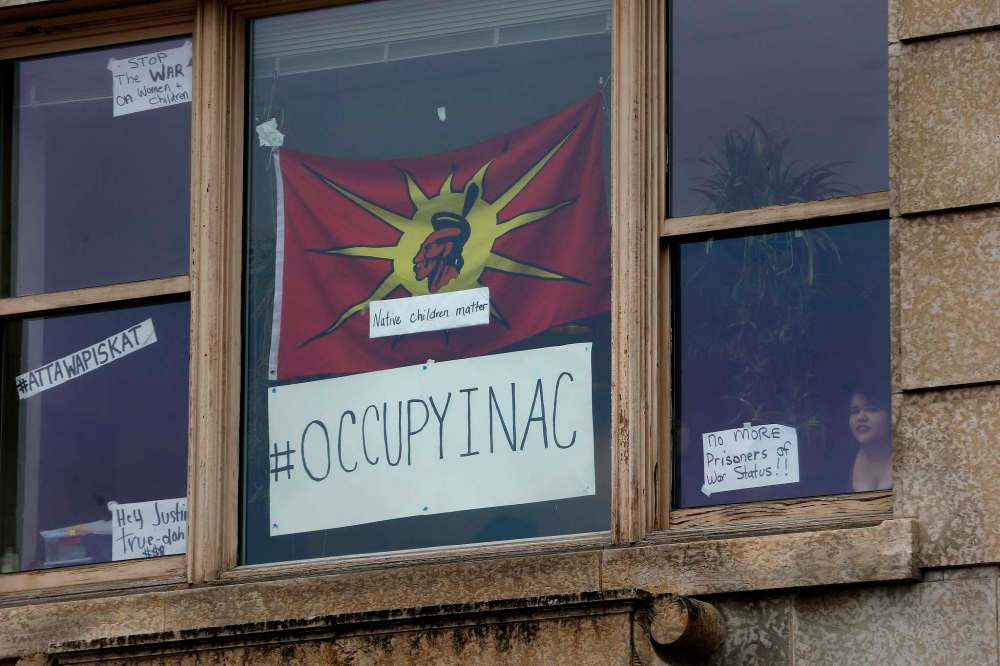
The protesters, who refer to themselves as Occupy INAC Winnipeg, began staking out the INAC offices in Winnipeg Friday. Similar protests are underway in Toronto, Regina, Gatineau, Que., and Vancouver. The Winnipeg office as well as those in Toronto and Regina were closed Friday, but in a statement from INAC headquarters in Gatineau Monday, officials said all offices were “operating” but were closed to the public.
“The Government of Canada is committed to ensuring minimal disruption of services to Canadians during this time,” reads the statement.
Workers within the Winnipeg building confirmed they were in the office; however, public access for services such as the registration office is not allowed. INAC has set up a phone number for people who have business with the registration office to call — 1-800-567-9604 — and is also directing people to the website: http://wfp.to/indianaffairs.
Winnipeg police said they are “aware of and monitoring” the situation.
The protesters are there to draw attention to the suicide epidemic plaguing northern remote First Nations including Pimicikamak Cree Nation in Manitoba, where band leaders called a state of emergency last month after six people took their own lives since December and more than 100 were on a suicide watch.
Rusty Garrioch, a youth leader from Pimicikamak, travelled to Winnipeg to meet with the protesters Sunday. In a video posted to the group’s blog, Garrioch said he wants to “show the youth out there hope.”
“Enough of being hopeless,” he said. “All I see out there is hopeless.”
He said he was proud of the protesters for taking a stand.
Attawapiskat First Nation in northern Ontario declared a state of emergency last week after 11 people attempted suicide in one weekend.
Indigenous Affairs Minister Carolyn Bennett flew to Attawapiskat Monday to show support and talk to band and youth leaders.
She was accompanied by NDP indigenous affairs critic and the MP for the area, Charlie Angus.

However, the Winnipeg protesters want Prime Minister Justin Trudeau to meet with First Nations youth.
In a written statement posted to Facebook using the hashtag #occupyINAC Friday, the Winnipeg group said, “This issue is inseparable from the epidemic of missing and murdered indigenous women; the legacy of residential schools; the 11,000 and counting children in care in Manitoba; and the theft, pollution, and exploitation of the land, water, and air.”
The Winnipeg protesters made several demands, including the abolition of the Indian Act, the reserve system and numbered treaties.
They also want an end to the denial of adequate health care, housing and education, the restoration of culture and spirituality to indigenous communities, a respect by the “colonial state” of the land and water, and an end to “two-spirited discrimination causing much of the suicidal crisis our youth are facing.”
mia.rabson@freepress.mb.ca
Related Articles
A look inside the INAC sit-in protest movement

Advertisement Advertise With Us
Advertisement Advertise With Us