

Pilot projects going permanent

Advertisement
Read this article for free:
or
Already have an account? Log in here »
To continue reading, please subscribe:

Digital Subscription
One year of digital access for only $205*
- Enjoy unlimited reading on winnipegfreepress.com
- Read the E-Edition, our digital replica newspaper
- Access News Break, our award-winning app
- Play interactive puzzles
*First annual payment billed as $205.00 + GST for one year. This annual subscription will automatically renew at $233.00 + GST every 52 weeks (10% off the regular annual price of $259.35). Offer available to new and qualified returning subscribers only. Cancel any time.
To continue reading, please subscribe:
Add Free Press access to your Brandon Sun subscription for only an additional
$1 for the first 4 weeks*
- Enjoy unlimited reading on winnipegfreepress.com
- Read the E-Edition, our digital replica newspaper
- Access News Break, our award-winning app
- Play interactive puzzles
*Your next Brandon Sun subscription payment will increase by $1.00 and you will be charged $17.95 plus GST for four weeks. After four weeks, your payment will increase to $24.95 plus GST every four weeks.
Read unlimited articles for free today:
or
Already have an account? Log in here »
Hey there, time traveller!
This article was published 11/10/2016 (3587 days ago), so information in it may no longer be current.
Resistance to change is a natural human condition. We feel security in what is familiar and see risk in what is unknown.
As cities grow and progress, this inertia can be a difficult obstacle for planners, developers and political leaders trying to implement new ideas. When change threatens to alter familiar, established patterns in a community, opposition galvanizes, and decision-makers face the uphill challenge of articulating the goals and benefits of new proposals in an effort to alleviate neighbourhood concerns.
Cities across North America are looking for new ways to engage in this dialogue and inspire a greater feeling of public inclusion in the decision-making process. In some cases, cities are implementing short-term pilot projects as a method of testing ideas and building community support.
Pilot projects allow residents to observe the real-world effects of an idea, fundamentally changing the nature of public outreach. Traditional open house-type consultation offers case studies from other cities, academic theory and glossy renderings that often do little to change attitudes and preconceptions. By implementing smaller-scale pilot projects, the starting point for public engagement is shifted from a hypothetical description to a discussion about an observed experience.
The lower cost and flexibility of pilot projects often means designers can very quickly implement substantial change in a city, evaluate performance, react to public feedback and easily modify or remove components before a permanent solution is implemented. These temporary projects often face less public resistance because the impact of failure is perceived to be lower.
A successful example of this will soon come to an end in Calgary. In April 2014, the city decided to create a temporary 6.5-kilometre-long protected bike-lane network throughout the downtown. The argument was made that a minimum grid needed to be established to realize an impact on cycling participation.
Constructed using moveable planters, precast parking curbs and plastic bollards, the system opened in June of that same year. To evaluate the effects, a record of 82 different metrics has been kept, including participation rates, percentage of female riders and impact on traffic congestion. Fourteen months later, a celebration was held for the one millionth rider to pass one of the counting stops and surveys have shown the number of bike commuters into the downtown has doubled since the network was built. Public acceptance of the lanes has substantially increased, and the city is now preparing to make the system permanent and is even looking for ways to expand.
Last week, the City of Edmonton decided to follow Calgary’s lead and build its own seven-kilometre-long downtown cycling network next spring. Compare this to Winnipeg’s piecemeal approach, where a 1.5-kilometre-long permanent protected bike lane on a single downtown road began public consultation in 2015 and will not experience its first full summer season until 2019. At that pace, it will be far more than a decade until we achieve the minimum effective network Edmonton will establish in two months.
Having seen the effects of the pilot project, initial fears in Calgary have largely been overcome, meaning further expansion of cycling infrastructure will likely meet with less resistance moving forward. In Winnipeg, each new lane will continue to face opposition because their effect cannot be fully evaluated until the network is complete.
There are many other pilot projects Winnipeg could borrow from other cities to test designs and gauge public reaction. During the last election, Mayor Bowman mused about creating a pedestrian promenade in the Exchange District. Last year, Montreal created five different temporary pedestrian mall pilot projects across the city to observe how they would work and evaluate their impacts. The City of Montrose, Col., recently implemented temporary diagonal parking stalls, much like those Coun. Pagtakhan is currently proposing for downtown Winnipeg.

One of the city’s most contentious urban planning issues, the opening of Portage and Main to pedestrians, might also achieve greater public acceptance through a pilot-project strategy. This approach could allow Winnipeggers the opportunity to experience the benefits of a vibrant public space at the heart of their city, while planners and engineers could observe the real-world consequences of their designs, responding to public fears of congestion and safety before a final scheme is implemented.
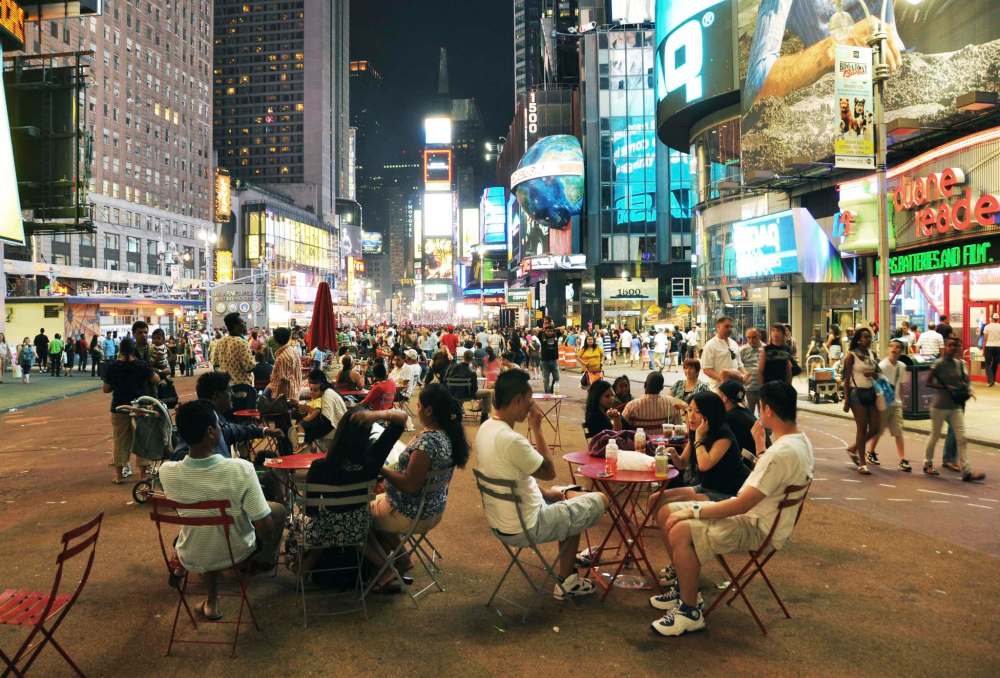
A relevant precedent study for this would be from New York City where, in 2009, five blocks of Broadway, including three of the seven vehicle lanes running through Times Square, were closed and transformed into a series of public plazas for a one-year test period. The asphalt was painted red, seating areas were delineated by planters and the spaces were filled with lawn chairs, moveable tables, umbrellas and public art. Concerts and events were held, allowing people to imagine the possibilities of what a new public space could become.
After the year, predictions of stifling traffic congestion and fears for public safety were alleviated, and community support for the project went from 40 per cent to 75 per cent. Today, the public plazas are becoming a permanent centrepiece of the Manhattan cityscape.
As we move forward in our community, we might learn from the experience of other cities and consider implementing pilot projects such as these, as a strategy to ensure effective investment in key urban design initiatives and encourage a more informed public dialogue.
Brent Bellamy is chairman of CentreVenture’s board and the creative director at Number Ten Architectural Group.
Brent Bellamy is creative director for Number Ten Architectural Group.
Our newsroom depends on a growing audience of readers to power our journalism. If you are not a paid reader, please consider becoming a subscriber.
Our newsroom depends on its audience of readers to power our journalism. Thank you for your support.
Brent Bellamy is creative director for Number Ten Architectural Group.
Our newsroom depends on a growing audience of readers to power our journalism. If you are not a paid reader, please consider becoming a subscriber.
Our newsroom depends on its audience of readers to power our journalism. Thank you for your support.
Advertisement Advertise With Us
Advertisement Advertise With Us