

Mayoral candidate Klein pushes to speed up school zone lights installations

Advertisement
Read this article for free:
or
Already have an account? Log in here »
To continue reading, please subscribe:

Digital Subscription
One year of digital access for only $205*
- Enjoy unlimited reading on winnipegfreepress.com
- Read the E-Edition, our digital replica newspaper
- Access News Break, our award-winning app
- Play interactive puzzles
*First annual payment billed as $205.00 + GST for one year. This annual subscription will automatically renew at $233.00 + GST every 52 weeks (10% off the regular annual price of $259.35). Offer available to new and qualified returning subscribers only. Cancel any time.
To continue reading, please subscribe:
Add Free Press access to your Brandon Sun subscription for only an additional
$1 for the first 4 weeks*
- Enjoy unlimited reading on winnipegfreepress.com
- Read the E-Edition, our digital replica newspaper
- Access News Break, our award-winning app
- Play interactive puzzles
*Your next Brandon Sun subscription payment will increase by $1.00 and you will be charged $17.95 plus GST for four weeks. After four weeks, your payment will increase to $24.95 plus GST every four weeks.
Read unlimited articles for free today:
or
Already have an account? Log in here »
Hey there, time traveller!
This article was published 09/09/2022 (1480 days ago), so information in it may no longer be current.
A mayoral candidate is promising to spend $2.5 million to speed up the installation of flashing school zone lights the City of Winnipeg first expected to obtain through a donation after contract disputes stalled a plan to put them in place.
Kevin Klein, the Charleswood-Tuxedo-Westwood councillor now running for mayor, said he would divert some funds from photo radar revenues if elected to add 480 lights approaching schools during his first term of office, arguing the solar-powered amber beacons heighten safety by better alerting drivers they’re about to enter a reduced-speed zone. Those areas have limits that drop to 30 km/h between September and June.
“The purpose of these lights is to alert drivers that they must reduce their speed and be vigilant because of children and other pedestrians while traveling through that area. These lights are important. These lights send a warning to drivers,” said Klein.
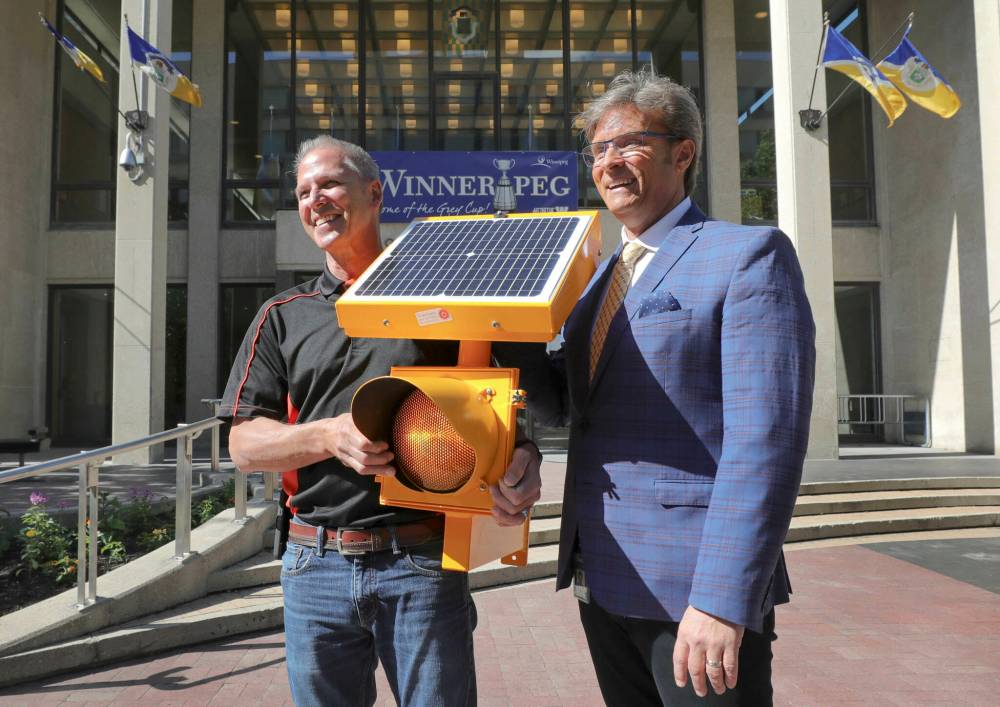
Chuck Lewis of Expert Electric (left) and Coun. Kevin Klein hold a press conference in 2020 about Lewis’s proposed donations of flashing amber lights. (Ruth Bonneville / Winnipeg Free Press files)
Expert Electric owner Chuck Lewis first offered to donate the lights to the city in 2017, triggering years of debate and municipal study. Lewis briefly withdrew his offer out of frustration over the wait, before council ultimately approved a plan to accept the gift in September 2020.
The first set of lights was installed on Bedson Street near Winnipeg Mennonite Elementary and Middle School in April 2021. While the city’s plan called for the lights to be installed at a minimum rate of one pair per month until the 480 donated beacons were in place, only the initial set has been added.
Lewis has blamed the delay on a contract dispute with the city. He previously said the municipal government asked him to sign a revised contract that would leave him at risk of legal claims if the lights malfunctioned and a child was hurt, or even for potential lost traffic ticket revenue.
He finally agreed on a revised contract without those liability issues in June, but has been waiting for the city to sign it, he said.
In a Friday interview, Lewis said he can’t personally afford to speed up the pace of donations, especially since the price of the beacons has risen to $9,000 from $7,000 per pair since he first made the offer.
“The costs have gotten way higher because of the sluggish mentality of the city and, if they keep stalling further, those costs will go higher and higher,” Lewis said.
The business owner said he’s still willing to install one set of lights per month at his own cost, should the revised contract be finalized.
However, Lewis said Klein’s proposal to speed up installations using photo radar revenues makes sense since he believes it would make the areas safer much sooner.
“If you had a kid go to school and you had (thousands of) people a year speeding at that school, that’s basically (that many potential near misses) for that kid to get hit.”
Klein said he would also like to find a way to better identify the presence of photo radar vehicles, though he acknowledged such a change would likely require the co-operation of the provincial government.
“Our photo radar vehicles blend in as a parked car. I want to do what Edmonton’s doing, where the cars are painted bright yellow so that they are identifiable,” said Klein, arguing the enhanced visibility would also help ensure drivers slow down.
In an emailed statement, a City of Winnipeg spokeswoman confirmed the city has received a new contract for the school zone lights donation, which awaits a council vote to approve its terms.

It appears Klein may also require the support of police to use photo radar revenue to speed up the installations.
“All revenue from photo radar is directed back to (the) Winnipeg Police Service budget and is reinvested at their discretion,” wrote spokeswoman Julie Horbal Dooley.
Winnipeggers will vote for their next mayor and council Oct. 26.
joyanne.pursaga@freepress.mb.ca
Twitter: @joyanne_pursaga
Joyanne is city hall reporter for the Winnipeg Free Press. A reporter since 2004, she began covering politics exclusively in 2012, writing on city hall and the Manitoba Legislature for the Winnipeg Sun before joining the Free Press in early 2020. Read more about Joyanne.
Every piece of reporting Joyanne produces is reviewed by an editing team before it is posted online or published in print — part of the Free Press‘s tradition, since 1872, of producing reliable independent journalism. Read more about Free Press’s history and mandate, and learn how our newsroom operates.
Our newsroom depends on a growing audience of readers to power our journalism. If you are not a paid reader, please consider becoming a subscriber.
Our newsroom depends on its audience of readers to power our journalism. Thank you for your support.
Joyanne is city hall reporter for the Winnipeg Free Press. A reporter since 2004, she began covering politics exclusively in 2012, writing on city hall and the Manitoba Legislature for the Winnipeg Sun before joining the Free Press in early 2020. Read more about Joyanne.
Every piece of reporting Joyanne produces is reviewed by an editing team before it is posted online or published in print — part of the Free Press‘s tradition, since 1872, of producing reliable independent journalism. Read more about Free Press’s history and mandate, and learn how our newsroom operates.
Our newsroom depends on a growing audience of readers to power our journalism. If you are not a paid reader, please consider becoming a subscriber.
Our newsroom depends on its audience of readers to power our journalism. Thank you for your support.
Related Articles
Climate change absent on campaign trail





Advertisement Advertise With Us
Advertisement Advertise With Us