Northern First Nations demand heath-care centre, decry suicide crises
Read this article for free:
or
Already have an account? Log in here »
To continue reading, please subscribe:

Digital Subscription
One year of digital access for only $205*
- Enjoy unlimited reading on winnipegfreepress.com
- Read the E-Edition, our digital replica newspaper
- Access News Break, our award-winning app
- Play interactive puzzles
*First annual payment billed as $205.00 + GST for one year. This annual subscription will automatically renew at $233.00 + GST every 52 weeks (10% off the regular annual price of $259.35). Offer available to new and qualified returning subscribers only. Cancel any time.
To continue reading, please subscribe:
Add Free Press access to your Brandon Sun subscription for only an additional
$1 for the first 4 weeks*
- Enjoy unlimited reading on winnipegfreepress.com
- Read the E-Edition, our digital replica newspaper
- Access News Break, our award-winning app
- Play interactive puzzles
*Your next Brandon Sun subscription payment will increase by $1.00 and you will be charged $17.95 plus GST for four weeks. After four weeks, your payment will increase to $24.95 plus GST every four weeks.
Read unlimited articles for free today:
or
Already have an account? Log in here »
Hey there, time traveller!
This article was published 02/11/2022 (1435 days ago), so information in it may no longer be current.
Island Lake leaders say “a pandemic of suffering” is plaguing their fly-in communities and the only way to stop suicide crises in the northern First Nations is to build a regional health centre so preventative and primary care is available close to home.
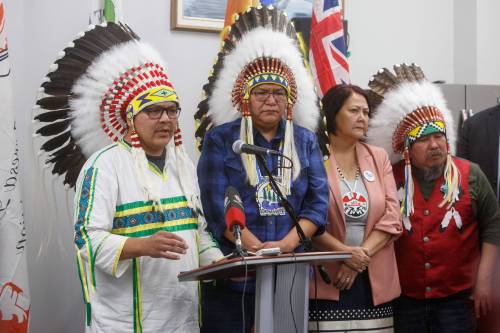
Chiefs from Red Sucker Lake, Garden Hill, Wasagamack and St. Theresa Point held a news conference Wednesday in Winnipeg to raise awareness about the dire state of mental health among their more than 15,000 residents.
Anishininew Okimawin Grand Chief Scott Harper, who oversees the First Nations’ grand council, told reporters self-harm, addictions and other severe mental health challenges are daily concerns in all four communities he represents.

MIKE DEAL / WINNIPEG FREE PRESS
Grand Chief Scott Harper of Anishininew Okimawin (Island Lake Tribal Council) told reporters self-harm, addictions and other severe mental health challenges are daily concerns in all four communities he represents.
In Harper’s home community of Red Sucker Lake, there have been two recent deaths by suicide and at least 17 attempts. On Oct. 20, the First Nation declared a state of emergency over the mental health crisis and serious need for support workers.
“An urgent strategy is needed to address colonization’s intergenerational, traumatic effects, combined with decades of insufficient resources and funding, which has created a pandemic of suffering,” Harper said, during an event at Anishininew Okimawin’s office on Broadway.
The council is calling on both provincial and federal governments to provide money for a local hospital, addictions treatment centre, and land-based programs for mental health concerns. While the First Nations await permanent infrastructure, their leaders want immediate dollars for interim programs in the region.
For years, Island Lake members have been sounding alarms about the need for increased mental health services in the region, which can only be accessed via plane or winter road.
Northern families walked to Parliament Hill in 2018 to beg for a treatment centre. Federal officials promised support at the time and accepted the community’s feasibility study for a hub at Red Sucker Lake roughly two years later.
More recently, Indigenous Services Canada confirmed in August the methamphetamine rehab centre is not a priority for government funding.
Area residents currently rely on nursing stations and medical evacuations to receive health-care services.
Red Sucker Lake Chief Samuel Knott, Garden Hill Chief Charles Knott, Wasagamack Chief Walter Harper and St. Theresa Point Chief Elvin Flett all spoke about their shared concerns regarding the status quo Wednesday.
“I want my youth to succeed in life, not to fall and to be depressed,” Harper said. “Enough is enough. We need to be looked after.”
Food insecurity, crowded housing, inadequate access to clean tap water, unreliable airplane services, limited policing, and preventable deaths — some of which have occurred in transit or prior to boarding a flight due to both lengthy processes and wait times for service — were discussed.
Garden Hill’s chief noted the fact mould was found in the community’s high school, which has resulted in a weeks-long ongoing shutdown, is only making mental health matters worse for teenagers.
Anishininew Okimawin estimates a health-care facility would cost approximately $300 million, excluding the price tag of transporting materials to the region, located more than 450 kilometres north of Winnipeg.
Asked how the communities would staff such a facility amid widespread health-care worker burnout and shortages, Anishininew Okimawin indicated it would make postings for any qualified local or outsider professionals, as it currently does for its nursing stations.
The grand council leaders said they are asking for no more than mental health services that are equal to those offered in non-Indigenous communities. An investment into facilities would save governments money in the long-term, they argued.
“How could it be that suicide is the leading cause of death for Indigenous youth in Canada? How can that be acceptable? This is not a new problem and it is accelerating at a pace that should be frightening for everyone and every family,” said Cindy Woodhouse, Manitoba regional chief at the Assembly of First Nations.
“Our young people need to be shown (care) and support, our young people need education, running water and housing in order to have hope.”
Indigenous Services Canada pledged to continue working with local leaders, but did not address specific construction requests Wednesday.

MIKE DEAL / WINNIPEG FREE PRESS
The Chiefs of the four Island Lake First Nations (Anishininew Okimawin), Chief Samuel Knott (Red Sucker Lake First Nation), Chief Walter Harper (Wasagamack First Nation), Chief Charles Knott (Garden Hill First Nation), Chief Elvin Flett (St. Theresa Point First Nation) asked for support.
“We recognize there is more work to do in order to close the gap in access to quality health care between Indigenous and non-Indigenous peoples in Canada,” spokesman Randy Legault-Rankin said in a prepared statement.
Legault-Rankin noted Ottawa provides nurses, funding for community-based health programs, routine and air ambulance travel costs, and has long-supported the Island Lake’s Four Arrows Regional Health Authority with initiatives, including funding for a mental health crisis team.
The Hope for Wellness help line provides immediate, toll-free telephone and online chat resources for all Indigenous people in Canada, he added. Counsellors can be accessed through the 24-7 service (1-855-242-3310 or hopeforwellness.ca) available in English and French, in addition to Cree, Ojibwa and Inuktitut, upon request.
On Wednesday, the Assembly of Manitoba Chiefs, Manitoba Keewatinowi Okimakanak and the NDP critic for Indigenous affairs expressed solidarity with Anishininew Okimawin.
Mental Health Minister Sarah Guillemard said the province is happy to join the federal government is discussions about how officials can support residents in the region.
Meantime, the Manitoba Adolescent Treatment Centre’s outreach team has already been assisting Red Sucker Lake, and centre employees will soon be dispatched to provide hands-on help, Guillemard said.
“My heart goes out to the community. It is tough anytime you lose someone – but certainly when there’s multiple losses and (it is) surrounding suicide,” the minister added.
Health Minister Audrey Gordon was unavailable to answer questions from reporters.

Alan Lagimodiere, who oversees the Indigenous reconciliation and northern relations portfolio, was attending a meeting after question period Wednesday and was also unavailable to answer questions.
In a statement, a spokesperson for Manitoba Health said the province is committed to strengthening northern health care and is working towards creating a new so-called Intermediate Health Care Hub in the North to reduce the need to travel to southern regions for services.
— with files from Danielle Da Silva and Carol Sanders
maggie.macintosh@freepress.mb.ca
Twitter: @macintoshmaggie

Maggie Macintosh
Education reporter
Maggie Macintosh reports on education for the Free Press. Originally from Hamilton, Ont., she first reported for the Free Press in 2017. Read more about Maggie.
Funding for the Free Press education reporter comes from the Government of Canada through the Local Journalism Initiative.
Every piece of reporting Maggie produces is reviewed by an editing team before it is posted online or published in print — part of the Free Press‘s tradition, since 1872, of producing reliable independent journalism. Read more about Free Press’s history and mandate, and learn how our newsroom operates.
Our newsroom depends on a growing audience of readers to power our journalism. If you are not a paid reader, please consider becoming a subscriber.
Our newsroom depends on its audience of readers to power our journalism. Thank you for your support.
Related Articles
Two out of three at health-care table not good enough