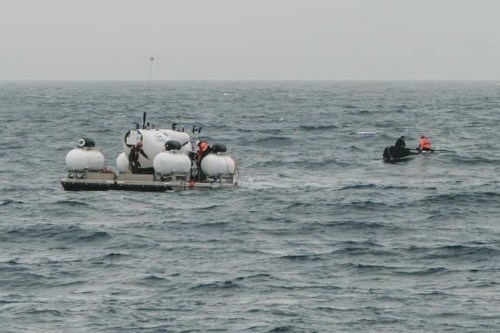
Outlook bleak for passengers on the Titan, despite massive rescue effort
Read this article for free:
or
Already have an account? Log in here »
To continue reading, please subscribe:

Digital Subscription
One year of digital access for only $205*
- Enjoy unlimited reading on winnipegfreepress.com
- Read the E-Edition, our digital replica newspaper
- Access News Break, our award-winning app
- Play interactive puzzles
*First annual payment billed as $205.00 + GST for one year. This annual subscription will automatically renew at $233.00 + GST every 52 weeks (10% off the regular annual price of $259.35). Offer available to new and qualified returning subscribers only. Cancel any time.
To continue reading, please subscribe:
Add Free Press access to your Brandon Sun subscription for only an additional
$1 for the first 4 weeks*
- Enjoy unlimited reading on winnipegfreepress.com
- Read the E-Edition, our digital replica newspaper
- Access News Break, our award-winning app
- Play interactive puzzles
*Your next Brandon Sun subscription payment will increase by $1.00 and you will be charged $17.95 plus GST for four weeks. After four weeks, your payment will increase to $24.95 plus GST every four weeks.
Read unlimited articles for free today:
or
Already have an account? Log in here »
Hey there, time traveller!
This article was published 21/06/2023 (1183 days ago), so information in it may no longer be current.
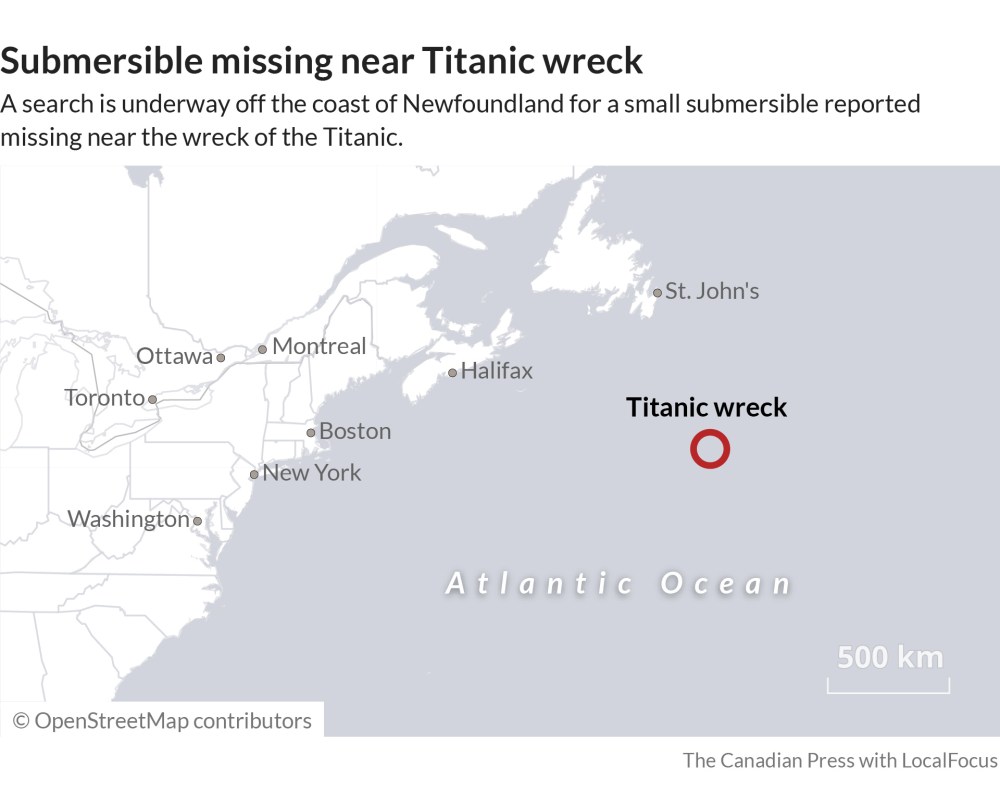
BOSTON (AP) — Time is quickly running out in the search for a missing submersible that lost contact with its mother ship on Sunday as it descended to the wreck of the Titanic with five people aboard.
As an international fleet of surveillance vessels and aircraft forges ahead with ongoing search and rescue efforts, each passing second makes it less likely that the passengers on the Titan will be found alive as their oxygen supply is expected to run out by Thursday morning.
Even if the Titan is located in the North Atlantic, it could be nearly impossible to reach if it is stuck on the ocean floor at roughly 12,500 feet (3,800 meters) near the Titanic’s wreckage.
The five people on board are pilot Stockton Rush, the CEO of OceanGate, the company leading the expedition; British adventurer Hamish Harding; Shahzada and Suleman Dawood, a father and son from a prominent Pakistani family; and French undersea explorer and Titanic expert Paul-Henry Nargeolet.
There are several possible outcomes for the Titan and its passengers.
TITAN FOUND ON SURFACE
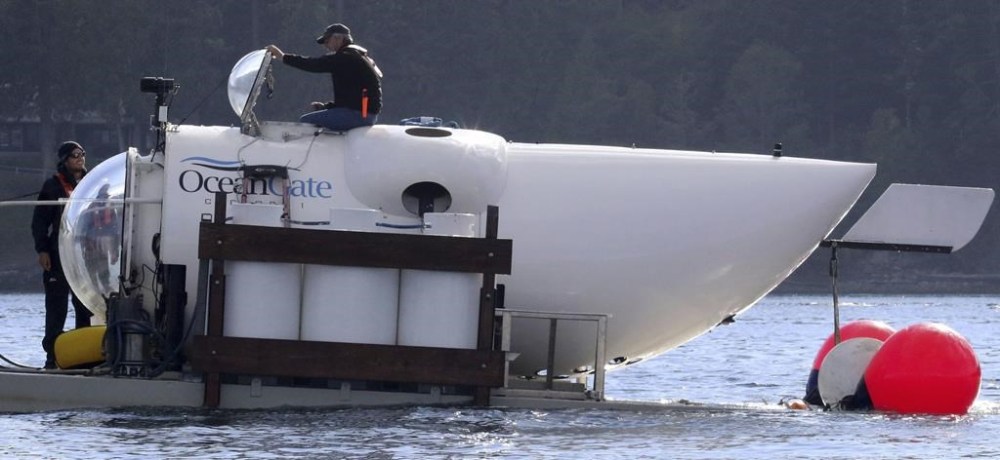
The Titan has built-in safety systems that help it rise to the surface in case of emergency including sandbags and lead pipes that can be released, as well as an inflatable balloon. The system was designed to work even if everyone on board is unconscious.
That would be the best case scenario, but even then there would not necessarily be any survivors, said Lawrence Brennan, a professor at Fordham University’s School of Law.
The Titan’s hatch cannot be unlocked from the inside, “so they will have to open the hatch and the bolts from the outside and rescue the people in there. That’s the best scenario, and I’m not sure it’s likely,” said Brennan, a retired Navy captain who has been involved in investigating and prosecuting cases involving submarine rescue ships.
VESSEL FOUND INTACT ON OCEAN FLOOR — NO SURVIVORS
If the Titan is stuck on the ocean floor the occupants would eventually run out of oxygen and develop hypothermia from extreme cold, according to experts.
Nargeolet, who has made more than 30 trips to the Titanic’s wreckage, explained to the Titanic Channel in a 2019 interview the possible dangers of being trapped in another submersible, called the Nautile, in the deep ocean.
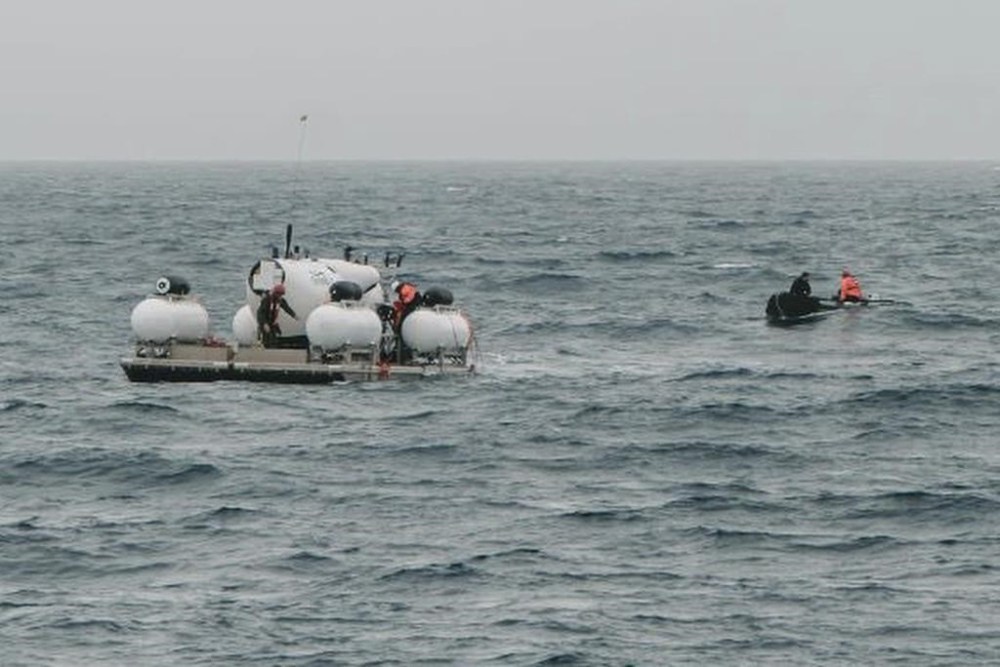
There is enough oxygen for four or five days, but that’s no help because it’s unlikely help will arrive in that time, he said. The biggest issue at the ocean floor is the water temperature of roughly 33 degrees.
ENTANGLEMENT
Getting stuck in ropes, lines or nets is another possibility.
There’s a lot of old fishing rope in the ocean and there is danger of entanglement from the Titanic’s ropes or cables, said Greg Stone, a California-based ocean scientist who has been on similar submersibles.
“Buoyant lines will have, if they’re attached on both ends, can have a big arc through the water that you’re not even aware of,” he said. “I’ve run through those myself and gotten caught not knowing it was there.”
In that case, the mother ship should have had a remotely operated submersible vehicle with cutters that could descend and cut the lines, Stone said.
Mission pilot Rush was aware of entanglement dangers.
“What I worry about most are things that will stop me from being able to get to the surface — overhangs, fish nets, entanglement hazard,” he said in an interview with CBS News last year, adding that a good pilot can avoid those perils.
VESSEL FOUND INTACT WITH SURVIVORS
A Canadian military surveillance aircraft detected underwater noises in the area of the Titanic wreck, which might indicate that at least someone is alive on the Titan and trying to signal for help.
“We have to retain hope as part of what we are doing as a human community to find the explorers and bring them to safety,” Joyce Murray, Canada’s Minister of Fisheries, Oceans and the Canadian Coast Guard, said Wednesday.
The U.S. Coast Guard said they couldn’t say what was making the noises but they are searching the area where they were detected.
The noises are encouraging because submarine crews unable to communicate with the surface are taught to bang on their hull to be detected by sonar.
“It sends a message that you’re probably using military techniques to find me and this is how I’m saying it,” said Frank Owen, a submarine search and rescue expert.
The problem in that scenario is finding another vessel that can go deep enough for a rescue.
The best chance to reach the submersible could be to use a remotely operated robot on a fiber optic cable, said Jeff Karson, a professor emeritus of earth and environmental sciences at Syracuse University.
HULL BREACH
A breach of the Titan’s hull at depth would mean instant death from the heavy pressure in the deep ocean.
The water pressure 12,500 feet (3,800 meters) below the surface at the site of the Titanic wreck is roughly 400 atmospheres or 6,000 PSI.
“So if there was a pressure failure, it’s going to be very fast and it’s just going to be over in a second,” Stone said.
CBS News journalist David Pogue said the vessel’s two communications systems stopped working about an hour and 45 minutes after the Titan submerged on Sunday.
“There are only two things that could mean. Either they lost all power or the ship developed a hull breach and it imploded instantly. Both of those are devastatingly hopeless,” Pogue told the Canadian CBC network on Tuesday.
NO HOPE OF SURVIVAL
Even when there is no hope of any occupants surviving because their oxygen is depleted, recovery of the vessel will be difficult.
One of the problems with locating the submersible could be that debris from the Titanic is spread out over a kilometer and some could be as big as the submersible itself, Karson said.
The submersible is essentially “another lump down there,” he said.
If it is on the bottom, what would be needed to retrieve it?
“Things that are not available presently,” said Brennan.
Equipment used for deepwater oil drilling could work, but that equipment likely isn’t anywhere near the search site, he said.
Related Articles
How search teams could use sound to find the Titan sub -- and why it's a challenge A different frontier: Stockton Rush started Titanic sub company to expand access to the deep sea