Dozen panellists appointed to hear teacher disciplinary matters
Read this article for free:
or
Already have an account? Log in here »
To continue reading, please subscribe:

Digital Subscription
One year of digital access for only $205*
- Enjoy unlimited reading on winnipegfreepress.com
- Read the E-Edition, our digital replica newspaper
- Access News Break, our award-winning app
- Play interactive puzzles
*First annual payment billed as $205.00 + GST for one year. This annual subscription will automatically renew at $233.00 + GST every 52 weeks (10% off the regular annual price of $259.35). Offer available to new and qualified returning subscribers only. Cancel any time.
To continue reading, please subscribe:
Add Free Press access to your Brandon Sun subscription for only an additional
$1 for the first 4 weeks*
- Enjoy unlimited reading on winnipegfreepress.com
- Read the E-Edition, our digital replica newspaper
- Access News Break, our award-winning app
- Play interactive puzzles
*Your next Brandon Sun subscription payment will increase by $1.00 and you will be charged $17.95 plus GST for four weeks. After four weeks, your payment will increase to $24.95 plus GST every four weeks.
Read unlimited articles for free today:
or
Already have an account? Log in here »
Hey there, time traveller!
This article was published 13/01/2025 (616 days ago), so information in it may no longer be current.
A police officer, a First Nations lawyer and a community-health program manager are among a dozen people who’ve been chosen to serve as panellists in disciplinary cases involving teachers under a new Manitoba Education Department professional registry and complaint process.
Bobbi Taillefer, the province’s first independent education commissioner, has the discretion to dismiss or investigate reports made regarding allegations of improper teacher conduct. Calling a disciplinary panel is one of the options available to her.
The new system, which is intended to increase transparency to the disciplinary process, launched just over a week ago online. Members of the public and employers are able to flag incidents to the commissioner’s office via separate forms available on the web page. There is also a self-reporting option for certified teachers and clinicians.

Bobbi Taillefer is Manitoba’s first independent education commissioner and will be investigating misconduct reports (Supplied).
Taillefer told the Free Press her expectation is that all submissions will be accompanied with a name and contact information, although she will not immediately dismiss anonymous tips.
“This is high-stakes process… these are peoples’ names, careers, and so it has to be a process in which everybody — the complainant, the respondent, the employer, even (the Manitoba Teachers’ Society) — all feel that everybody is getting fair treatment,” said Taillefer, a francophone teacher from Winnipeg who has spent the last 25 years in union support and management roles.
There were no official complaints received during the first week, she said, noting that an employer did, however, report a situation that was already known to the education department.
“We are ready, so if anything comes forward, we have people in place and, in fact, the nominees just came through for (disciplinary hearing) panels,” she said, adding each of the 12 volunteers who were selected hold “impressive” resumés.
A panel must include at least three members, one of whom must be a certified teacher, one person nominated by the school boards association and at least one public representative, per provincial legislation.
Disciplinary proceedings, which previously took place in private under the purview of MTS, which represents nearly 17,000 public-school teachers in the province, are expected to happen online and be made available to the public.
Panelists will be called to volunteer as the need arises on a rotating basis and with consideration of their availability.
“You want to make sure you have high-quality learning and teaching that goes on, and that depends hugely on the educators,” said Vinh Huynh, a veteran public school principal and father of three children, including two high schoolers, in Winnipeg.
“We have to ensure teachers are, first and foremost, competent, committed and compassionate in doing that work.”
Huynh — a professional teacher certificate holder in good standing — was endorsed by the teachers’ union to be one of its three disciplinary panel representatives under the new system.
“You want to make sure you have high-quality learning and teaching that goes on, and that depends hugely on the educators.”–Vinh Huynh
There are 111 names on the Education Department’s list of individuals who have had their licence either suspended or cancelled during their career; there are few details, aside from name, date of decision and, if applicable, reinstatement.
Huynh noted there is confusion regarding issues related to competence in the legislation that laid the groundwork for the registry and public hearing processes.
The school administrator said he is aligned with the teachers’ union in his belief that conduct and competency are different matters that require separate processes.
There are ongoing consultations between Manitoba’s Professional Certification Unit and stakeholders such as the Canadian Centre for Child Protection, superintendents and MTS, whose leaders have been critical of the registry over concerns about member privacy.
Taillefer said the main worries that have been raised in recent weeks are a product of catastrophizing or, as she put it, “the human condition,” and do not have much merit.
There are fears about a slew of historical complaints that will be difficult to substantiate and others that are simply difficult, she said.
She acknowledged that any change in practice over which someone has no control can be anxiety-inducing, so meetings continue to get everyone in the education sector familiar with the new processes.
“There’s an important balance to strike here,” said Bruce Strang, a history professor at Brandon University who is on the roster of public representative panellists and has previously worked in various union leadership roles and as a post-secondary school administrator.
Strang said students need to be protected and, in some cases, the safety of other colleagues and school communities at large will likely come into question, but there also needs to be a structure for evidence to be rigorously examined.
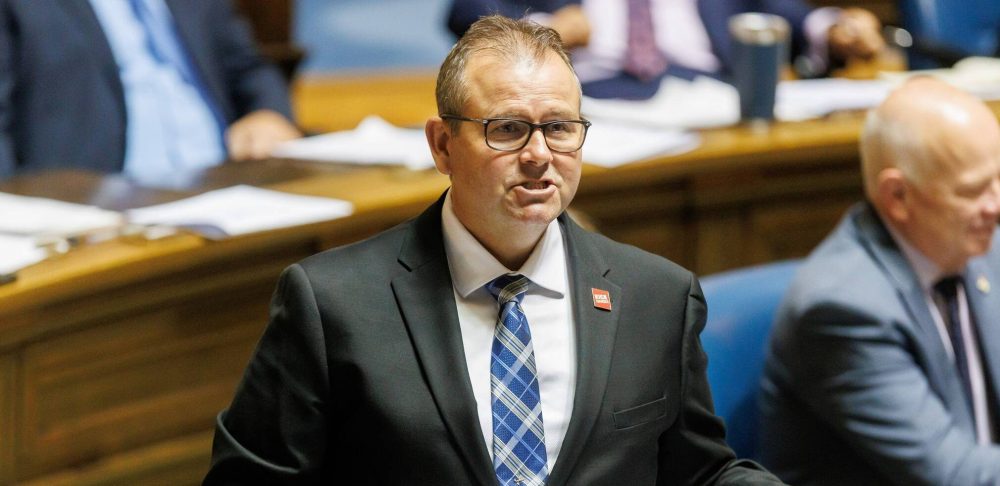
He added his training in labour relations and experience on the Municipal Board, a quasi-judicial administrative body that issues decisions on landowner and citizen challenges to local government policies and plans, will come in handy, should he be called to serve on a panel.

Charles Cochrane called it a personal honour to be named a panellist, as well as a wider honour that “our First Nation people are being recognized more and more in the provincial context.”
The executive director of the Manitoba First Nations Education Resource Centre recalled his colleagues who work for the centre and oversee its school board sharing the perspective that the registry was “very progressive” after it was first announced.
“It will be a good tool to use to make sure we look at hiring people that are in good standing,” added Cochrane, one of four employer representatives named to the list.
The commissioner of teacher professional conduct can be reached via email: tcs@gov.mb.ca.
maggie.macintosh@freepress.mb.ca
Disciplinary hearing panelists
At least one public representative, one teacher and one individual nominated by the Manitoba School Boards Association must be selected to preside over any given disciplinary hearing.
Public representatives:
- Erin Bockstael, manager of family and community programs at the Women’s Health Clinic
- Bruce Strang, a professor in the department of history at Brandon University
- Gord Schumacher, executive director of the Manitoba Association of Chiefs of Police
- Raven-Dominique Gobeil, senior in-house attorney for the First Nations Family Advocate Office
Employer representatives:
- Morgan Whiteway, director of labour relations and human resources services at the Manitoba School Boards Association
- Elizabeth Mitchell, senior labour relations consultant at the Manitoba School Boards Association
- Alison Bourrier, labour relations consultant at the Manitoba School Boards Association
- Charles Cochrane, executive director of the Manitoba First Nations Education Resource Centre
Teacher representatives:
- Vinh Huynh, a high school principal in Winnipeg
- Jesse Thomaschewski, a kindergarten-to-Grade 12 principal in Elm Creek
- Nicole Lavallee, an Indigenous education teacher in Winnipeg
- Kevin Sterner,a private school vice-principal in Winnipeg
— Manitoba Education

Maggie Macintosh
Education reporter
Maggie Macintosh reports on education for the Free Press. Originally from Hamilton, Ont., she first reported for the Free Press in 2017. Read more about Maggie.
Funding for the Free Press education reporter comes from the Government of Canada through the Local Journalism Initiative.
Every piece of reporting Maggie produces is reviewed by an editing team before it is posted online or published in print — part of the Free Press‘s tradition, since 1872, of producing reliable independent journalism. Read more about Free Press’s history and mandate, and learn how our newsroom operates.
Our newsroom depends on a growing audience of readers to power our journalism. If you are not a paid reader, please consider becoming a subscriber.
Our newsroom depends on its audience of readers to power our journalism. Thank you for your support.
Related Articles
Manitoba launches teacher registry, pledges future transparency