Transit overhaul’s first month a bumpy ride Cut to late-night service main issue as councillors take riders’ concerns, complaints to one of citywide bus system transformation’s architects
Read this article for free:
or
Already have an account? Log in here »
To continue reading, please subscribe:

Digital Subscription
One year of digital access for only $205*
- Enjoy unlimited reading on winnipegfreepress.com
- Read the E-Edition, our digital replica newspaper
- Access News Break, our award-winning app
- Play interactive puzzles
*First annual payment billed as $205.00 + GST for one year. This annual subscription will automatically renew at $233.00 + GST every 52 weeks (10% off the regular annual price of $259.35). Offer available to new and qualified returning subscribers only. Cancel any time.
To continue reading, please subscribe:
Add Free Press access to your Brandon Sun subscription for only an additional
$1 for the first 4 weeks*
- Enjoy unlimited reading on winnipegfreepress.com
- Read the E-Edition, our digital replica newspaper
- Access News Break, our award-winning app
- Play interactive puzzles
*Your next Brandon Sun subscription payment will increase by $1.00 and you will be charged $17.95 plus GST for four weeks. After four weeks, your payment will increase to $24.95 plus GST every four weeks.
Read unlimited articles for free today:
or
Already have an account? Log in here »
Hey there, time traveller!
This article was published 30/07/2025 (413 days ago), so information in it may no longer be current.
It’s been one month since Winnipeg Transit’s controversial mass overhaul, and city councillors brought constituents’ questions and concerns Wednesday to the first of ongoing meetings on the change.
“We probably get something like one commendation for every 100 complaints, it’s just the way it always is,” Bjorn Radstrom, the manager of service development with Winnipeg Transit, said after the meeting.
“And we’re probably pretty close to that right now, the only difference is that now we’re hearing 10 or 15 times as many of each as before, because of the nature of the change.”
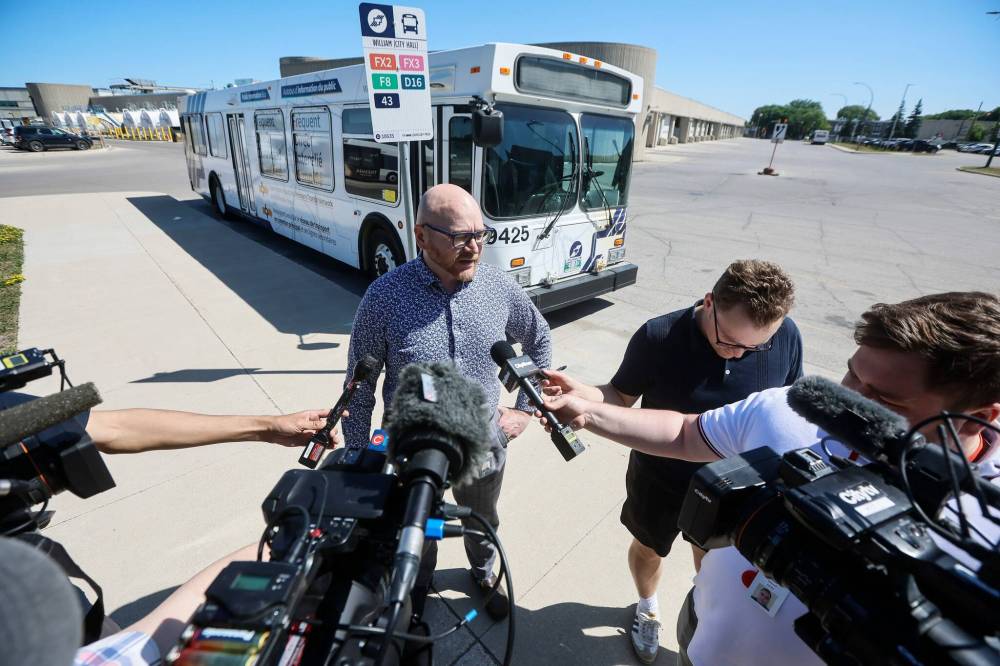
JOHN WOODS / FREE PRESS FILES
Bjorn Radstrom, manager of service development with Winnipeg Transit, is pictured on launch day for the new transit network. Radstrom said the “absolute earliest” Transit could implement changes based on incoming feedback is next summer.Winnipeg’s transit system network moved to a spine-and-feeder model June 29 with the goal of providing more frequent service citywide, rather than the previous downtown-centred hub-and-spoke system.
The change, which included the elimination of more than 1,000 bus stops and expanded access to Transit’s on-request bus service, has received mixed reactions from Winnipeg riders.
Transit staff plan to meet monthly with city council to collect feedback, in addition to other channels such as 311, but Radstrom said the “absolute earliest” they could implement changes is next summer, if not later.
“The value in today’s meeting is with helping the councillors to understand that we are listening and we’re reading all this feedback, and we’re plotting out how we’re going to address it — we do care about this, and we want to deal with this,” Radstrom said.
“The thing that we don’t want to do is, after it’s been in place for only a month, is just react initially to what people’s first reactions are, because once people settle into routines on the new network, they might have different feedback.”
Councillors leaving the meeting at city hall Wednesday afternoon said concerns varied by ward, but some changes appear to be necessary across the system.
“One of the big issues is the time; we want (bus schedules) to go later,” said Waverley West Coun. Janice Lukes, the city’s chair of public works.
“One of the big issues is the time; we want (bus schedules) to go later.”–Coun. Janice Lukes
“I think we all agreed that was the big one.”
Coun. Ross Eadie said service to bus stops along Selkirk Avenue and Mountain Avenue was eliminated after 10:30 p.m., forcing people in an unsafe part of his Mynarski ward to walk.
“There’s potential danger at night any time… but Mountain and Selkirk, it’s easy to get jumped,” he said.
Radstrom said there have been many complaints about where the reduced number of stops are located; some people are angry about stops that are now farther away. Others are unhappy about increased bus traffic near their homes. Still others have complained about the lack of late-night service.
He said Transit will spend the next few months researching how it could extend service later into the evening.
“It’s a question of, can we actually hire operators in time to deploy an extension of service by next June, or next September or something like that?” he said. “Right now, I don’t know the answer to that question, because it still continues that every transit system across the country has challenges hiring bus operators.”
“Once people settle into routines on the new network, they might have different feedback.”–Bjorn Radstrom
Other issues brought forward by council members on Wednesday included possible changes to snow clearing in the coming winter to reflect the new, longer walks for some riders. There were also questions about bus crowding when school starts anew in September.
At an unrelated press conference, Mayor Scott Gillingham said Transit would have to see how the new system handles the fall surge in ridership before considering changes.
“We’re going to have to see how this new network system does under that pressure, as well, before we make any substantial changes, but some small tweaks, if possible, that our staff can make, then I’d like to see them make them,” he said.
Meanwhile, a GPS failure that resulted in Winnipeg Transit posting incorrect arrival times for stops across the system earlier this month continues to be a problem.
Radstrom said about 10 to 12 per cent of bus location reports are currently incorrect, a reduction from the peak of the issue, when 18 to 24 per cent of reports were off. The regular baseline for report errors is three to four per cent.

Transit staff are still working on a fix, Radstrom said.
“I’m hoping it’s not going to be more than a few weeks, but still, it’s not good that it’s happening, and we’ve got to fix it as quickly as we can,” he said.
“It’s a question of, can we actually hire operators in time to deploy an extension of service…. I don’t know the answer to that question, because it still continues that every transit system across the country has challenges hiring bus operators.”–Radstrom
He plans to reach out to local organizations for visually impaired people so they can advise their members of the issue, and suggested people concerned about incorrect stops speak to their bus driver.
— With files from Scott Billeck
malak.abas@freepress.mb.ca

Malak Abas is a city reporter at the Free Press. Born and raised in Winnipeg’s North End, she led the campus paper at the University of Manitoba before joining the Free Press in 2020. Read more about Malak.
Every piece of reporting Malak produces is reviewed by an editing team before it is posted online or published in print — part of the Free Press‘s tradition, since 1872, of producing reliable independent journalism. Read more about Free Press’s history and mandate, and learn how our newsroom operates.
Our newsroom depends on a growing audience of readers to power our journalism. If you are not a paid reader, please consider becoming a subscriber.
Our newsroom depends on its audience of readers to power our journalism. Thank you for your support.
Related Articles
Better hold on for the ride after Transit overhaul North Kildonan residents blame transit overhaul for attempted break-ins