

First Nation’s power-outage misery ‘frozen like a rock’

Advertisement
Read this article for free:
or
Already have an account? Log in here »
To continue reading, please subscribe:

Digital Subscription
One year of digital access for only $205*
- Enjoy unlimited reading on winnipegfreepress.com
- Read the E-Edition, our digital replica newspaper
- Access News Break, our award-winning app
- Play interactive puzzles
*First annual payment billed as $205.00 + GST for one year. This annual subscription will automatically renew at $233.00 + GST every 52 weeks (10% off the regular annual price of $259.35). Offer available to new and qualified returning subscribers only. Cancel any time.
To continue reading, please subscribe:
Add Free Press access to your Brandon Sun subscription for only an additional
$1 for the first 4 weeks*
- Enjoy unlimited reading on winnipegfreepress.com
- Read the E-Edition, our digital replica newspaper
- Access News Break, our award-winning app
- Play interactive puzzles
*Your next Brandon Sun subscription payment will increase by $1.00 and you will be charged $17.95 plus GST for four weeks. After four weeks, your payment will increase to $24.95 plus GST every four weeks.
Read unlimited articles for free today:
or
Already have an account? Log in here »
Hey there, time traveller!
This article was published 14/01/2026 (249 days ago), so information in it may no longer be current.
An army of plumbers, engineers and members of the Canadian Armed Forces are continuing to assess damages after a lengthy power outage at Pimicikamak Cree Nation froze water and sewage pipes.
Chief David Monias said it is going to take months to repair damage to homes and years to install new water and sewage treatment plants and systems.
“They have frozen pipes — the sewage plant is completely frozen,” Monias said Wednesday. “The raw sewage has frozen like rock, it is as hard as rock. There is enough (methane) gas in there that we can’t even enter the building. So they are trying to figure out a way how to air out that building so that they can assess the sewage problem.”
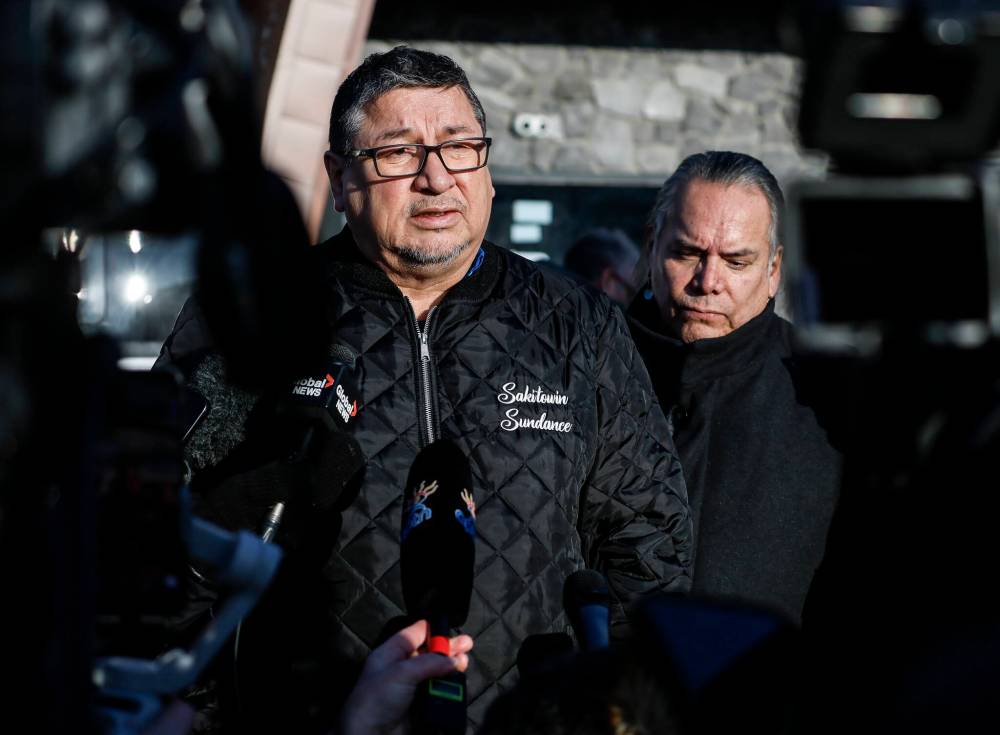
John Woods / THE CANADIAN PRESS FILES
Pimicikamak Cree Nation Chief David Monias, left, and Manitoba Keewatinowi Okimakanak Inc. (MKO) Grand Chief Grand Chief Garrison Settee speak to the media during a tour with politicians and media at Pimicikamak Cree Nation, Man., last Wednesday.
Monias said the experts are going to try to get the water and sewage systems up and running while the community works with government on a longer term solution. He said the plants will eventually need to be decommissioned.
“You can’t even find parts for them,” the chief said. “They are trying to figure out a way how to get them operational until we get a new system.”
Three additional Armed Forces members arrived Wednesday in Pimicikamak, joining seven others who arrived Monday, The Canadian Press reported.
A broken hydro transmission line cut power for four days to the community, located more than 500 kilometres north of Winnipeg.
One of the community’s water treatment plants has been out of service for more than two weeks and thousands of the First Nation’s 7,000 residents were forced to leave.
A temporary camp has been set up to accommodate the plumbers and other workers needed to repair the damage.
Monias said they are also assessing damage to homes.
“We examined 40 homes yesterday and we found 80 per cent of the houses had broken pipes or were damaged due to flooding,” Monias said.
“There was flooding in the crawl spaces and on the floors.”
Monias said the damage at Pimicikamak wouldn’t have been as bad if Manitoba Hydro had moved its power lines closer to the highway years ago.

“If we could have got to it in a few hours, and not days, we could still have been at home,” he said.
“Yes, we would have had a broken system, but we were negotiating to get it replaced anyway. A -30 C winter going up to -45 with the wind chill — everything freezes in a matter of minutes. And if it is a deep freeze for six days, everything freezes. Wires, water, food and everything is spoiled.
“It is just a sad state of affairs.”
Manitoba Hydro said last week a power line along the road would double its length but wouldn’t guarantee outages longer than two days would cease.
kevin.rollason@freepress.mb.ca
Kevin Rollason
Reporter
Kevin Rollason was a general assignment reporter at the Free Press.
Our newsroom depends on a growing audience of readers to power our journalism. If you are not a paid reader, please consider becoming a subscriber.
Our newsroom depends on its audience of readers to power our journalism. Thank you for your support.
Kevin Rollason
Reporter
Kevin Rollason was a general assignment reporter at the Free Press.
Our newsroom depends on a growing audience of readers to power our journalism. If you are not a paid reader, please consider becoming a subscriber.
Our newsroom depends on its audience of readers to power our journalism. Thank you for your support.
Related Articles
Military members arrive in Pimicikamak with eye on fixing water plant





Advertisement Advertise With Us
Advertisement Advertise With Us