

Brainstorming session proposes solutions to alarming rate of student absenteeism
Educators, students, parents come together at day-long summit to probe chronic problem

Advertisement
Read this article for free:
or
Already have an account? Log in here »
To continue reading, please subscribe:

Digital Subscription
One year of digital access for only $205*
- Enjoy unlimited reading on winnipegfreepress.com
- Read the E-Edition, our digital replica newspaper
- Access News Break, our award-winning app
- Play interactive puzzles
*First annual payment billed as $205.00 + GST for one year. This annual subscription will automatically renew at $233.00 + GST every 52 weeks (10% off the regular annual price of $259.35). Offer available to new and qualified returning subscribers only. Cancel any time.
To continue reading, please subscribe:
Add Free Press access to your Brandon Sun subscription for only an additional
$1 for the first 4 weeks*
- Enjoy unlimited reading on winnipegfreepress.com
- Read the E-Edition, our digital replica newspaper
- Access News Break, our award-winning app
- Play interactive puzzles
*Your next Brandon Sun subscription payment will increase by $1.00 and you will be charged $17.95 plus GST for four weeks. After four weeks, your payment will increase to $24.95 plus GST every four weeks.
Read unlimited articles for free today:
or
Already have an account? Log in here »
Dante Taylor spent much of his early high school career ditching class — a routine occurrence outside of football season — to hang out at trap houses in Winnipeg.
“For so long, I just didn’t care,” the 16-year-old told an auditorium packed with 200 people, many of them principals and superintendents, at a summit on student absenteeism.
“It wasn’t something that seemed to be important to me because it didn’t seem to be important to anybody that I was around.”
“For so long, I just didn’t care.”
Dante said his perspective changed recently, after meeting with a guidance counsellor, doing extensive self-reflection and enrolling in a physics course that he finds equally fascinating and challenging.
The Grade 11 student is now encouraging his friends to work towards graduation; he’s on track to obtain his diploma from Tec-Voc High School next year.
RUTH BONNEVILLE / FREE PRESS Dante Taylor spoke at Thursday’s summit on student absenteeism. The Grade 11 student is now encouraging his friends to work towards graduation.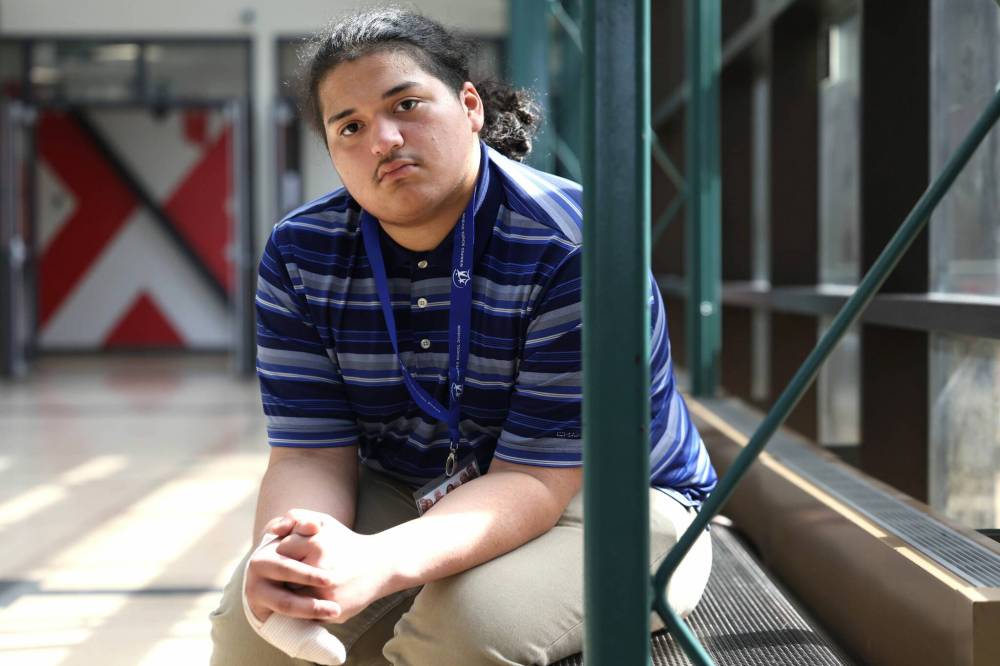
Teenagers spoke candidly about their personal challenges at the Thursday event put on by the Winnipeg School Division and University of Winnipeg.
The first panel of the day focused on both what draws students to school and why they cut class.
Diverse extracurriculars, mentors and words of encouragement were repeatedly raised as magnetic forces. Panelists identified a range of deterrents, such as teachers demanding students explain why they’re late, in and beyond a school’s control.
One 13-year-old described how self-doubt and social anxiety caused her to plead to her mother to stay home from Isaac Newton School.
Another panelist, a Grade 12 student at R.B. Russell Vocational School, spoke about how bullying, dyslexia and teachers’ lack of understanding about her learning disability have taken their toll.
Sharing a parent’s perspective, Cathy Bird talked about how food insecurity, transportation costs and poverty in general affects families in her neighbourhood.
“Not every child comes from a stable home. Some kids don’t even come from a home,” said the mother of nine children, three of whom are adopted.
“Not every child comes from a stable home.”
The discussion, which ended with a standing ovation in a U of W auditorium, elicited an emotional response from speakers and members in the audience.
“Those were hard things for us to hear,” said Kathy Heppner, chair of the board of trustees in the Winnipeg School Division.
The key takeaway for Heppner, a trustee, parent and teacher, was that every adult in every school needs to feel a sense of urgency about their shared responsibility to make all young people feel welcome.
The conference was structured so that attendees heard all about barriers to consistent attendance in the morning and spent the afternoon brainstorming solutions. Organizers have pledged to identify strategic actions and share them with the public.
Ten per cent of the division’s student body — approximately 3,000 children and youth — had “severe chronic absenteeism” in 2023-24. The provincial average was eight per cent, representing more than 15,000 kindergarten-to-Grade 12 students.
An elementary student enters this category once they’ve missed 20 per cent of classes during a reporting period. High school students are flagged if they accumulate 20 unexcused absences in a core course.
“It’s important to believe in the youth and the kids we work with and not just the academics but also the ones who maybe don’t fit in the box that we create,” said Tamara Rondeau, vice-principal of Daniel McIntyre Collegiate Institute.
Rondeau spoke about how students need to have a sense of purpose and see themselves reflected in the people who work at their school.
One of her colleagues, Indigenous graduation coach Robyn Boulanger urged her teacher colleagues to be cautious of the language they use around attendance.
“Side comments of ‘why are you late’ or stuff like that can really send them away… We really need to be cautious and understanding… At least they’re in the building,” Boulanger said.
She noted that she’s had success making plans “with” students rather than “for” them.
“Comments of ‘why are you late’ or stuff like that can really send them away.”
During his keynote speech Kevin Chief, a graduate of the school division, spoke about how important it was for him to hear about what his future could look like if he obtained a high school diploma.
The former provincial NDP cabinet minister and co-founder of the Winnipeg Aboriginal Sport Achievement Centre talked about the struggles of growing up with a single father who had substance abuse issues, relied on social assistance and never attended a parent-teacher meeting.
He called it “irresponsible” to ask students to overcome hardships without telling them about and connecting them with others — including those who aren’t all that much older than they are — who have.
Last week, Ontario introduced legislation that would tie high school attendance to marks to address chronic absenteeism.
“Attendance matters, but we also don’t believe attendance is the same thing as learning,” Manitoba Education Minister Tracy Schmidt said.
Schmidt’s office is taking a different approach to address the complex issue that requires “complex, dynamic solutions,” she said.
The minister noted one of those solutions is eliminating public transit fares for high schoolers – a commitment that was announced in this spring’s budget in response to school leaders’ advocacy efforts.
At the summit, Dante talked about how he’s often felt out of place because of his mixed-race identity. His mom is an Anishinaabe woman from Grassy Narrows First Nation and his father is a Black man from Texas.
“Every system I see and place around me was initially put there to destroy who I am,” the Grade 11 student said.
Not feeling heard, seen or understood at school and outside it has been a huge barrier, he said.
“I’m so hateful. I’m so angry at the world,” the 16-year-old said.
But Dante told the Free Press he’s been learning how to channel those feelings into motivation.
“For me, to not educate myself, knowing my ancestors fought so hard for (the equal right to access education), that would be disrespecting them,” he said.
maggie.macintosh@freepress.mb.ca
Maggie Macintosh
Education reporter
Maggie Macintosh reports on education for the Free Press. Originally from Hamilton, Ont., she first reported for the Free Press in 2017. Read more about Maggie.
Funding for the Free Press education reporter comes from the Government of Canada through the Local Journalism Initiative.
Every piece of reporting Maggie produces is reviewed by an editing team before it is posted online or published in print — part of the Free Press‘s tradition, since 1872, of producing reliable independent journalism. Read more about Free Press’s history and mandate, and learn how our newsroom operates.
Our newsroom depends on a growing audience of readers to power our journalism. If you are not a paid reader, please consider becoming a subscriber.
Our newsroom depends on its audience of readers to power our journalism. Thank you for your support.
Maggie Macintosh
Education reporter
Maggie Macintosh reports on education for the Free Press. Originally from Hamilton, Ont., she first reported for the Free Press in 2017. Read more about Maggie.
Funding for the Free Press education reporter comes from the Government of Canada through the Local Journalism Initiative.
Every piece of reporting Maggie produces is reviewed by an editing team before it is posted online or published in print — part of the Free Press‘s tradition, since 1872, of producing reliable independent journalism. Read more about Free Press’s history and mandate, and learn how our newsroom operates.
Our newsroom depends on a growing audience of readers to power our journalism. If you are not a paid reader, please consider becoming a subscriber.
Our newsroom depends on its audience of readers to power our journalism. Thank you for your support.
Related Articles
Manitoba summit to explore solutions to chronic truancy


Advertisement Advertise With Us
Advertisement Advertise With Us
History
Updated on Thursday, April 23, 2026 8:14 PM CDT: Fixes formatting