

‘Prevention and protection’: police set to return to buses, stops

Advertisement
Read this article for free:
or
Already have an account? Log in here »
To continue reading, please subscribe:

Digital Subscription
One year of digital access for only $205*
- Enjoy unlimited reading on winnipegfreepress.com
- Read the E-Edition, our digital replica newspaper
- Access News Break, our award-winning app
- Play interactive puzzles
*First annual payment billed as $205.00 + GST for one year. This annual subscription will automatically renew at $233.00 + GST every 52 weeks (10% off the regular annual price of $259.35). Offer available to new and qualified returning subscribers only. Cancel any time.
To continue reading, please subscribe:
Add Free Press access to your Brandon Sun subscription for only an additional
$1 for the first 4 weeks*
- Enjoy unlimited reading on winnipegfreepress.com
- Read the E-Edition, our digital replica newspaper
- Access News Break, our award-winning app
- Play interactive puzzles
*Your next Brandon Sun subscription payment will increase by $1.00 and you will be charged $17.95 plus GST for four weeks. After four weeks, your payment will increase to $24.95 plus GST every four weeks.
Read unlimited articles for free today:
or
Already have an account? Log in here »
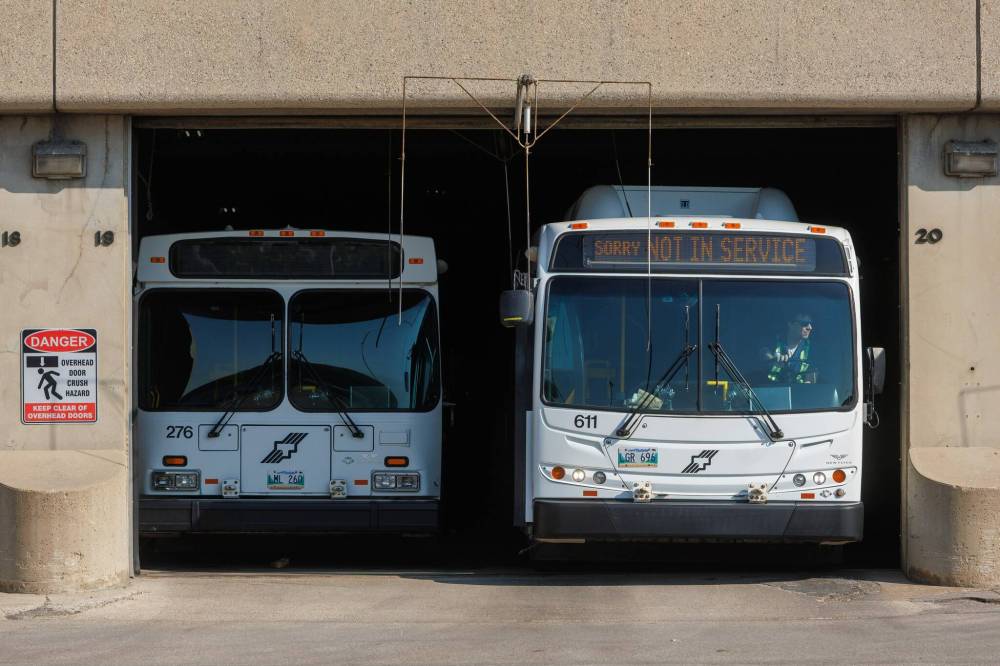
Undercover and uniformed police officers are returning to Winnipeg Transit buses this weekend.
The Winnipeg Police Service, citing the success of the fall pilot project, announced Friday that regular patrols will resume monitoring activity on and around buses, stops and transit hubs.
“Everyone — riders, operators, and transit staff — deserves to feel safe. Violent and disruptive conduct will not be tolerated,” police said in a news release.
It described the initiative as one “rooted in prevention and protection.”
Police partnered with city officials in September to launch a targeted, 15-week crackdown on crime across the transit system.
The pilot, involving constables and the city’s community safety officers, was announced following a year of violent crime.
The number of annual incidents reported at transit locations, including on buses and in bus shelters, nearly tripled from 2019 to 2024. The record is now 325 events during a 12-month period.
Increasing police presence across public transit is a no-brainer in the current climate, said Gord Delbridge, a spokesperson for Workers for Downtown Public Safety.
Delbridge stopped short of calling the announcement “a win” for the coalition that represents upwards of 10,000 employees who regularly commute to the core.
“A win would be when we don’t need to have security and metal detectors at the library or police on the bus and that’s a long way away,” said the president of the Canadian Union of Public Employees Local 500.
The Amalgamated Transit Union is one of the eight founding unions, along with CUPE, that recently joined forces to lobby for policy changes to better protect bus drivers and other public-sector workers. Representatives from the coalition recently met with the mayor to outline their calls to action, one of which was bolstering security on buses.
“An employer has a responsibility to provide a safe workplace for their workers,” Delbridge added.
During the enhanced enforcement period in the fall, violent crime in and around buses fell 18 per cent.
Levels of property crime and criminal incidents in these settings also dropped between Sept. 17 and Dec. 31.
Mayor Scott Gillingham said he was “very pleased” to learn the police force is once again deploying extra resources to tackle problems on buses.
“Police resources are limited. We don’t have enough police to put everywhere — that’s why we’re taking a co-ordinated approach to public safety,” Gillingham said.
He noted that having more eyes on Winnipeg Transit helps reduce violence and recuperate fees.
The civil service estimates fare evasion costs the city about $7 million annually.

Police said a dozen suspects were arrested during the fall pilot. Fare evasion was enforced on 98 occasions over the three-month period.
WPS Supt. Brian Miln told reporters in the winter the results had exceeded his expectations.
Members of the newly formed rapid response unit, a flexible, 32-person team created to alleviate evolving pressures on front-line officers, will be among the new group of patrollers.
WPS did not release information about the estimated length or cost of the new initiative.
maggie.macintosh@freepress.mb.ca
Maggie Macintosh
Education reporter
Maggie Macintosh reports on education for the Free Press. Originally from Hamilton, Ont., she first reported for the Free Press in 2017. Read more about Maggie.
Funding for the Free Press education reporter comes from the Government of Canada through the Local Journalism Initiative.
Every piece of reporting Maggie produces is reviewed by an editing team before it is posted online or published in print — part of the Free Press‘s tradition, since 1872, of producing reliable independent journalism. Read more about Free Press’s history and mandate, and learn how our newsroom operates.
Our newsroom depends on a growing audience of readers to power our journalism. If you are not a paid reader, please consider becoming a subscriber.
Our newsroom depends on its audience of readers to power our journalism. Thank you for your support.
Maggie Macintosh
Education reporter
Maggie Macintosh reports on education for the Free Press. Originally from Hamilton, Ont., she first reported for the Free Press in 2017. Read more about Maggie.
Funding for the Free Press education reporter comes from the Government of Canada through the Local Journalism Initiative.
Every piece of reporting Maggie produces is reviewed by an editing team before it is posted online or published in print — part of the Free Press‘s tradition, since 1872, of producing reliable independent journalism. Read more about Free Press’s history and mandate, and learn how our newsroom operates.
Our newsroom depends on a growing audience of readers to power our journalism. If you are not a paid reader, please consider becoming a subscriber.
Our newsroom depends on its audience of readers to power our journalism. Thank you for your support.
Related Articles
‘He hears voices’: man who shattered bus windows with head gets 60 days



Advertisement Advertise With Us
Advertisement Advertise With Us
History
Updated on Friday, May 22, 2026 7:35 PM CDT: Adds details