

Police-to-population ratio increases for first time since 2013

Advertisement
Read this article for free:
or
Already have an account? Log in here »
To continue reading, please subscribe:
Digital Subscription
One year of digital access for only $1.44 a week*
- Enjoy unlimited reading on winnipegfreepress.com
- Read the E-Edition, our digital replica newspaper
- Access News Break, our award-winning app
- Play interactive puzzles
*Billed as $5.77 plus GST every four weeks. After 52 weeks, price increases to the regular rate of $19.95 plus GST every four weeks. Offer available to new and qualified returning subscribers only. Cancel any time.
To continue reading, please subscribe:
Add Free Press access to your Brandon Sun subscription for only an additional
$1 for the first 4 weeks*
- Enjoy unlimited reading on winnipegfreepress.com
- Read the E-Edition, our digital replica newspaper
- Access News Break, our award-winning app
- Play interactive puzzles
*Your next Brandon Sun subscription payment will increase by $1.00 and you will be charged $17.95 plus GST for four weeks. After four weeks, your payment will increase to $24.95 plus GST every four weeks.
Read unlimited articles for free today:
or
Already have an account? Log in here »
The ratio of Winnipeg Police Service officers to the city’s population has increased for the first time in more than a decade.
In 2025, the so-called “cop-to-pop” ratio reached 166.8 officers per 100,000 people, up from 164.8 the previous year.
While that falls behind a national average of 180.3 per 100,000, it was the first local increase since 2013.
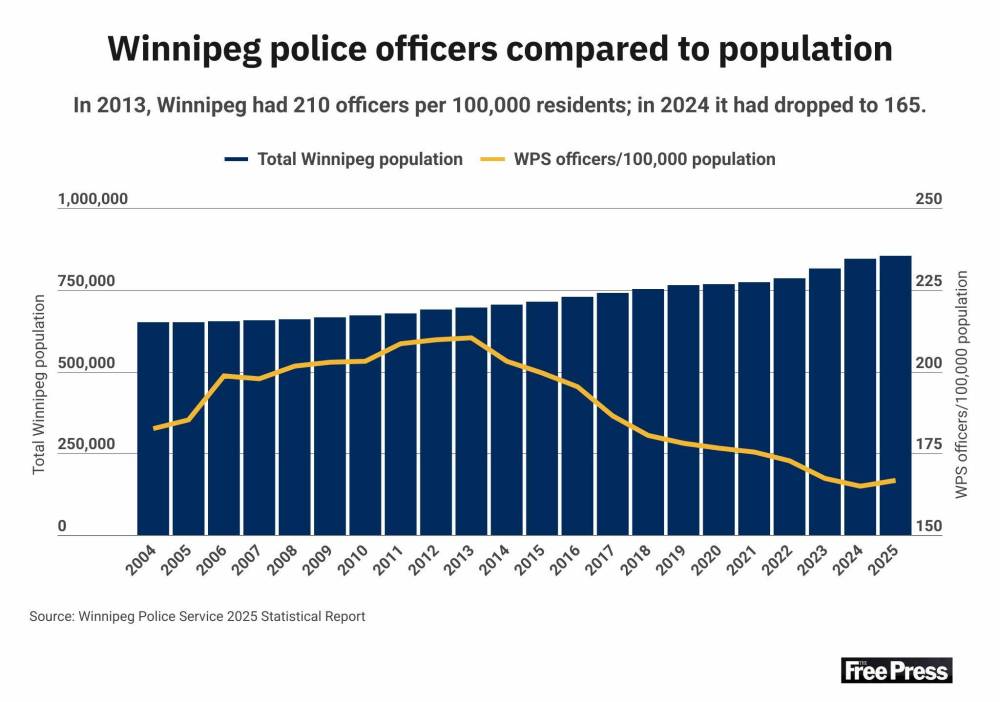
Overall, the service added 35 more officers since 2024, to reach a complement of 1,425.
That staffing boost will support more crime-prevention work, such as downtown safety and violent offender apprehension programs, said Colleen Mayer, chairwoman of the Winnipeg Police Board.
“I think that the increase in available resources has always allowed for an increase of proactive policing and for the dedicated specialty units that address (specific) needs in the community,” said Mayer, whose board oversees WPS.
She also expects the change to help officers answer calls for help sooner.
“Any time there is boots on the ground, it allows them to manage their resources better and that will (lead to) better response times,” said Mayer.
The union that represents Winnipeg police officers has long called for more staff, arguing existing officers are stretched thin responding to a high volume of emergency calls.
“Our hirings have not kept up with the city growth, which the mayor just recently acknowledged has surpassed 850,000 people … I estimate, we are short in excess of 50 officers,” said Cory Wiles, president of the Winnipeg Police Association, in an email Monday.
Wiles said calls for service are still high, at times with hundreds of calls in the queue on weekends.
“Winnipeg has its challenges and based on how many calls continue to wait for police response, week after week, I would say we still have some work to do. Even if the ratio has changed, it needs to improve further,” he said.
However, some organizations say the city still needs to spend much more of its budget on recreation, as a strategy to help prevent crime.
“I would rather see them put more money in other crime-prevention solutions rather than policing. Let police do police work but there needs to be a far more robust response to crime than just police,” said Kate Kehler, executive director of the Social Planning Council of Winnipeg.
Kehler said activities geared to youth, for example, help reduce crime.
WPS also released its latest reports on bias-free policing, criminal flight pursuits and use of force Monday, based on 2025 data.
The total number of complaints to the service’s professional standards unit rose to 127 last year, which was the highest number since at least 2020 and exceeded a five-year average of 86.
It’s not immediately clear what caused the increase. The report breaks down types of complaints only for those that triggered investigations.
In 2025, there were 38 investigations of 40 allegations (with some probes handling more than one allegation).
Two complaints accused police of bias, down from four in 2024.
The professional standards unit did not conduct a formal investigation on 89 of the total complaints reported last year, which were instead handled by clarifying policies and procedures, explaining laws and exemptions and/or determining some incidents that appeared to involve officers actually did not, the report notes.
Kehler said it’s difficult to draw conclusions from the report and more detail would help.
“It’s my understanding there (are) some conversations going on that perhaps there will be things published publicly about disciplinary manners…. With the previous police chief, we certainly did have meetings talking about the need for people to see that there’s actual followup,” she said.
WPS declined comment on any of the reports prior to a public Winnipeg Police Board meeting on Friday.
Meanwhile, police use of force declined slightly in 2025, occurring in 780 incidents, or 0.31 per cent of the 254,183 times police were dispatched to calls for service. That’s down from 0.4 per cent in 2024 and below the 0.34 per cent five-year average.
“Members resolved 99.7 per cent of all dispatched events without using force or displaying a weapon,” WPS Chief Gene Bowers notes in the report.
Officers displayed or used firearms 160 times last year, stopping at presenting the weapon in “the vast majority” of cases, Bowers wrote. There were two police involved shootings last year, with one death.
Taser use was reported 366 times, down from 524 the previous year.
“The (conducted energy weapon)… is considered one of the most effective control options, with a lower likelihood of causing injury,” the report notes.
Meanwhile, police officers continued a downward trend in the number of suspects they pursued in a chase. The number of criminal flight pursuits fell to 47 last year, down from 122 in 2020.
Police also aborted 31 of the 47 pursuits in 2025 over public safety risks.

“I think any time that a pursuit takes place, it’s an inherent danger to, not just the (police) members but to the public and to the individuals involved in that,” said Mayer.
The police helicopter was used in five of the pursuits, leading to an arrest in each of those cases.
Mayer said that shows the helicopter is an effective use of resources.
joyanne.pursaga@freepress.mb.ca
X: @joyanne_pursaga
Joyanne is city hall reporter for the Winnipeg Free Press. A reporter since 2004, she began covering politics exclusively in 2012, writing on city hall and the Manitoba Legislature for the Winnipeg Sun before joining the Free Press in early 2020. Read more about Joyanne.
Every piece of reporting Joyanne produces is reviewed by an editing team before it is posted online or published in print — part of the Free Press‘s tradition, since 1872, of producing reliable independent journalism. Read more about Free Press’s history and mandate, and learn how our newsroom operates.
Our newsroom depends on a growing audience of readers to power our journalism. If you are not a paid reader, please consider becoming a subscriber.
Our newsroom depends on its audience of readers to power our journalism. Thank you for your support.
WPS likely to fall short of savings target
Winnipeg Police Service predicts it will end 2026 with a $4.5-million shortfall, based on figures up to the end of March.
A finance report shows police currently expect to meet just part of a city council-imposed $7-million in-year savings target, creating the potential budget gap.
Police have found savings through reduced overtime hours in past years but high demand for service could hinder that approach, while inflation could also raise equipment costs, the report notes.
— Joyanne Pursaga
Joyanne is city hall reporter for the Winnipeg Free Press. A reporter since 2004, she began covering politics exclusively in 2012, writing on city hall and the Manitoba Legislature for the Winnipeg Sun before joining the Free Press in early 2020. Read more about Joyanne.
Every piece of reporting Joyanne produces is reviewed by an editing team before it is posted online or published in print — part of the Free Press‘s tradition, since 1872, of producing reliable independent journalism. Read more about Free Press’s history and mandate, and learn how our newsroom operates.
Our newsroom depends on a growing audience of readers to power our journalism. If you are not a paid reader, please consider becoming a subscriber.
Our newsroom depends on its audience of readers to power our journalism. Thank you for your support.
Related Articles
Police HQ contractor pays $28M in city settlement




Advertisement Advertise With Us
Advertisement Advertise With Us
History
Updated on Monday, June 1, 2026 6:31 PM CDT: Adds details