Paramedic team to focus on overdoses in city’s core Province announces project as data show opioid emergencies now outnumber alcohol-related cases
Read this article for free:
or
Already have an account? Log in here »
To continue reading, please subscribe:

Digital Subscription
One year of digital access for only $205*
- Enjoy unlimited reading on winnipegfreepress.com
- Read the E-Edition, our digital replica newspaper
- Access News Break, our award-winning app
- Play interactive puzzles
*First annual payment billed as $205.00 + GST for one year. This annual subscription will automatically renew at $233.00 + GST every 52 weeks (10% off the regular annual price of $259.35). Offer available to new and qualified returning subscribers only. Cancel any time.
To continue reading, please subscribe:
Add Free Press access to your Brandon Sun subscription for only an additional
$1 for the first 4 weeks*
- Enjoy unlimited reading on winnipegfreepress.com
- Read the E-Edition, our digital replica newspaper
- Access News Break, our award-winning app
- Play interactive puzzles
*Your next Brandon Sun subscription payment will increase by $1.00 and you will be charged $17.95 plus GST for four weeks. After four weeks, your payment will increase to $24.95 plus GST every four weeks.
Read unlimited articles for free today:
or
Already have an account? Log in here »
With opioid-related emergencies overtaking alcohol-related calls for service in Winnipeg, the province is investing more than $1 million to ease pressure on front-line responders and improve overdose care.
The funding includes $802,000 for a three-month pilot project that will see a 24-7, two-person paramedic team respond to overdose calls in high-demand areas, including the downtown core, where many of the city’s shelters and support agencies are located. The pilot will start this month, the province said.
The province will also spend $150,000 on approximately 20 oxygen delivery devices to be managed by Main Street Project, which help when overdoses don’t respond to naloxone. Another $100,000 will be given to provide first aid and overdose response training for workers through St. John’s Ambulance and Manitoba Harm Reduction Network.
“We’ve been meeting quite regularly with the front-line organizations and this really came from them, and what they wanted and they need,” Housing, Addictions and Homelessness Minister Bernadette Smith told the Free Press Tuesday. “This was something that we could immediately respond to.”
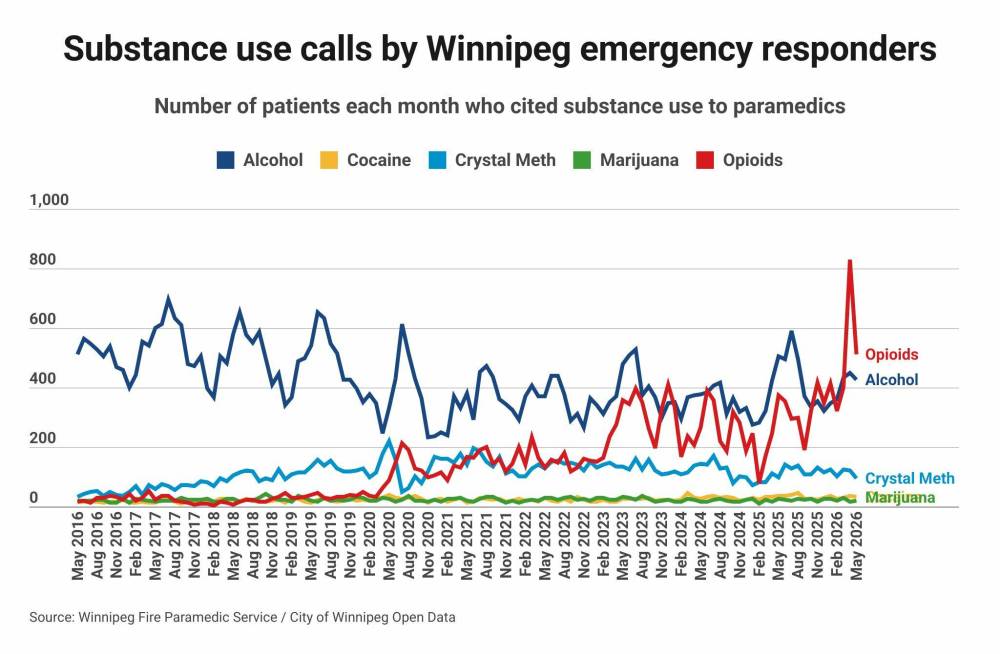
The announcement comes after the city recorded its first sustained period with more opioid-related incidents than alcohol-related ones. It’s a turning point front-line workers say underscores how dramatically the city’s addictions crisis has evolved.
A decade ago, Winnipeg recorded 510 alcohol-related emergency incidents in May, compared with 17 involving opioids. Ten years later, opioid-related calls have climbed into the hundreds each month, surpassing alcohol-related calls in five of the past seven months, Winnipeg Fire Paramedic Service data show.
Fire and paramedic crews responded to 2,447 opioid-related incidents during the first five months of 2026, compared to 2,004 calls linked to alcohol use. The figures also highlight the rapid escalation of the city’s drug toxicity crisis: during the same period in 2025, crews responded to 1,089 opioid-related calls and 1,792 alcohol-related calls.

The numbers of opioid calls so far this year have more than doubled from last year, raising concerns that Manitoba’s addictions and treatment systems have not kept pace with the changing nature of substance use.
Main Street Project executive director Jamil Mahmood said the province’s programs remain largely built around alcohol addiction and is not equipped to respond to the growing demand for opioid treatment.
“We really need to consider that we need a different type of response,” he said Tuesday, prior to the province’s announcement. Mahmood previously told the Free Press that WFPS data on overdoses is only the tip of the iceberg.
Opioid treatment is often more difficult to access and less widely available than services geared toward alcohol addiction, Mahmood said.
“So if the system is not responding in a good way to the needs that we’re seeing in the community, then what does that mean for the likelihood of successful treatment and recovery?”

Opioid-related calls began rising in early 2020 during the COVID-19 pandemic and have climbed steadily since.
In recent months, Winnipeg’s drug-toxicity crisis has intensified, driving more emergency calls as opioids, such as fentanyl, are increasingly being found mixed with non-opioid substances, including medetomidine — a veterinary tranquillizer that cannot be reversed with fast-acting naloxone.
Medetomidine can slow heart rate and breathing, leading to the need for emergency intervention.
The biggest surge in opioid-related calls for service came in April, when they outpaced alcohol calls by 380.
The growing number of overdoses has place significant strain on the WFPS.
“Opioid overdoses are higher acuity than isolated alcohol ingestion,” said Nick Kasper, president of the United Fire Fighters of Winnipeg.
“Patients demonstrating symptoms of isolated alcohol ingestion are often transported to Main Street Project for monitoring, whereas patients who have overdosed on opioids can require critical interventions, such as airway management, Narcan administration, and continued monitoring.”
Kasper said skyrocketing call volumes are reducing the availability of fire apparatus and undermining the ability of crews to respond quickly to fires, rescues and other emergencies.
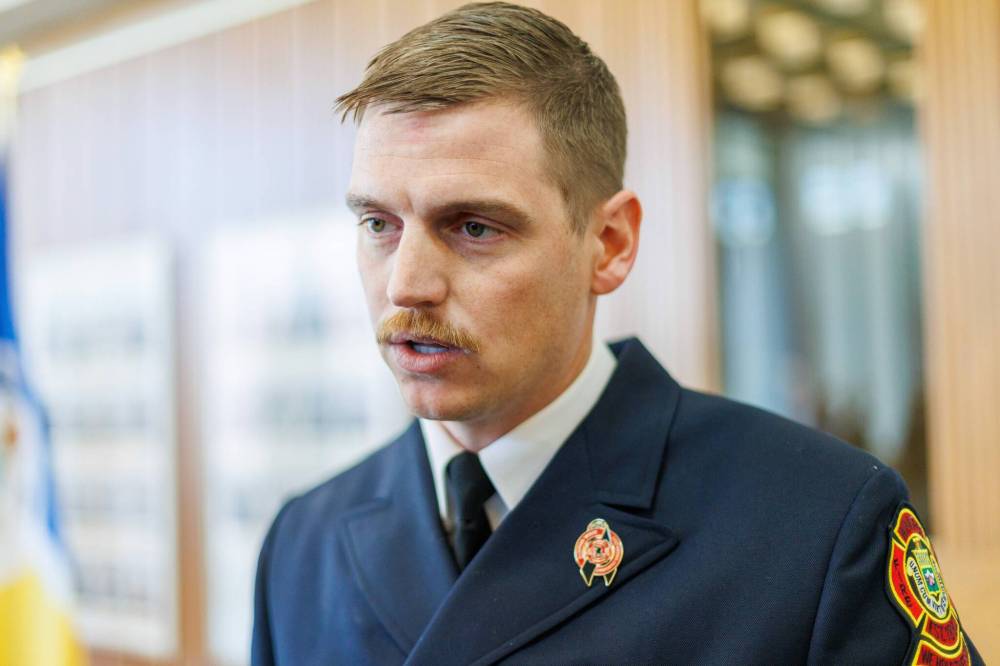
The union has long argued the city needs more resources, citing Winnipeg’s high rates of property and life loss from structure fires, as well as some of the slowest fire response times in the country. The surge in overdose calls, Kasper said, is only compounding those challenges.
Ryan Woiden, president of MGEU Local 911, which represents Winnipeg paramedics and emergency dispatchers, said Tuesday the city is already struggling to staff its existing ambulance fleet and argued the province’s new overdose response pilot does not go far enough to address the crisis.
“You try being two paramedics who come to work and your job is to do CPR on 10 people, maybe 20 in a shift,” he said. “If you’re doing just downtown responses, you’re looking at 10 to 20 calls for sure a day when where you’re going to somebody who is near death or dead. Your mental health will be shot very quickly.”
Woiden said he is also concerned about the safety risks facing paramedics assigned to the two-person overdose response unit, given the environments they are often required to work in.
“We’ve got a tap that keeps pouring and we’re just putting small cups underneath it,” he said. “We need to fix the. This isn’t going to work.”

His comments come as Winnipeg paramedics remain without a collective agreement. Their contract expired in February 2024, and an arbitration hearing is scheduled to begin in September.
“We don’t feel loved by the government,” Woiden said. “We’re waiting to feel loved.”
Last week, outgoing fire chief Christian Schmidt said the WFPS is now responding to an average of 27 overdoses every 24 hours.
He said firefighter paramedics are increasingly being dispatched to overdoses and other medical emergencies, leaving fewer crews available for fires and other calls.
Late Tuesday, Mayor Scott Gillingham said he has consistently asked the province to permanently increase the baseline complement of ambulances and full-time paramedic positions.
In a statement, Gillingham said a dedicated service unit will only be staffed after regular citywide ambulance shifts are covered, and he called the staffing shortage acute.
“In the past week alone, several ambulances were out of service on multiple days because we lacked the staff to operate them.”
He said the drug crisis has put “extraordinary pressure” on responders, and some people need medical support several times in a single day.
The statement ends by saying the city will do its part, “but temporary funding for overtime hours cannot replace the permanent paramedics and ambulances our emergency response system needs.”
Mahmood and other outreach organizations have repeatedly called on the province to declare a public health emergency.
“This speaks directly to that,” he said, adding that while a declaration may not necessarily bring new funding, it could help governments coordinate existing resources while strengthening the case for federal support.
scott.billeck@freepress.mb.ca

Scott Billeck is a general assignment reporter for the Free Press. A Creative Communications graduate from Red River College, Scott has more than a decade’s worth of experience covering hockey, football and global pandemics. He joined the Free Press in 2024. Read more about Scott.
Every piece of reporting Scott produces is reviewed by an editing team before it is posted online or published in print — part of the Free Press‘s tradition, since 1872, of producing reliable independent journalism. Read more about Free Press’s history and mandate, and learn how our newsroom operates.
Our newsroom depends on a growing audience of readers to power our journalism. If you are not a paid reader, please consider becoming a subscriber.
Our newsroom depends on its audience of readers to power our journalism. Thank you for your support.
Related Articles
WFPS stretched to limit by city’s around-the-clock drug OD crisis, retiring chief says








History
Updated on Tuesday, June 2, 2026 5:39 PM CDT: Updated for additional details.
Updated on Tuesday, June 2, 2026 6:34 PM CDT: Final edits
Updated on Tuesday, June 2, 2026 7:24 PM CDT: Adds statement from Mayor Scott Gillingham