

U.S. supreme court tariff ruling brings more uncertainty for Manitoba businesses

Advertisement
Read this article for free:
or
Already have an account? Log in here »
To continue reading, please subscribe:

Digital Subscription
One year of digital access for only $205*
- Enjoy unlimited reading on winnipegfreepress.com
- Read the E-Edition, our digital replica newspaper
- Access News Break, our award-winning app
- Play interactive puzzles
*First annual payment billed as $205.00 + GST for one year. This annual subscription will automatically renew at $233.00 + GST every 52 weeks (10% off the regular annual price of $259.35). Offer available to new and qualified returning subscribers only. Cancel any time.
To continue reading, please subscribe:
Add Free Press access to your Brandon Sun subscription for only an additional
$1 for the first 4 weeks*
- Enjoy unlimited reading on winnipegfreepress.com
- Read the E-Edition, our digital replica newspaper
- Access News Break, our award-winning app
- Play interactive puzzles
*Your next Brandon Sun subscription payment will increase by $1.00 and you will be charged $17.95 plus GST for four weeks. After four weeks, your payment will increase to $24.95 plus GST every four weeks.
Read unlimited articles for free today:
or
Already have an account? Log in here »
Hey there, time traveller!
This article was published 21/02/2026 (205 days ago), so information in it may no longer be current.
There’s uncertainty ahead for Manitoba businesses following the latest developments of United States President Donald Trump’s tariff regime.
The U.S. Supreme Court struck down a set of Trump’s tariffs in a landmark ruling Friday, but that decision didn’t affect all duties on Canadian goods entering the U.S.
Trump on Friday signed an executive order imposing a 10 per cent global tariff, effective Tuesday. On Saturday, he threatened on social media that he would increase it to 15 per cent.

MIKAELA MACKENZIE / FREE PRESS FILES
President and CEO of the Manitoba Chamber of Commerce Chuck Davidson
Chuck Davidson, president and CEO of the Manitoba Chambers of Commerce, said he was pleased with the Supreme Court’s decision but troubled by Trump’s reaction.
“(The ruling) basically solidified what we’d been saying for the past year — that the tariff policy that the U.S. government was going on was unjustified,” Davidson said. “Unfortunately, our concern is (that the ruling) doesn’t actually mean much with the president.”
Trump’s 10 per cent global tariff was “almost to be expected,” added the leader of Manitoba’s largest chamber network.
“He’s very clearly indicated that tariffs are the path that he’s going to go down and (that) it’s going to be difficult to trade with the United States, which is what we’ve seen. And again, the message that we’ve continued to spread is that the United States has become a very unreliable trading partner.”
A problem with the trading relationship between Canada and the U.S. is that it continually changes, Davidson said.
“It was 10 per cent, today it’s 15 per cent,” he said. “Who knows what it’s going to be next week and how long this is going to continue. And it just makes it more challenging for businesses.”
Loren Remillard, president and CEO of the Winnipeg Chamber of Commerce, said he had mixed reactions to the Supreme Court’s ruling.
“It creates a new round of uncertainty and confusion,” he said, alluding to the U.S. president’s response.
“We now find ourselves back in those early days of the Trump presidency where you didn’t know which tariffs were going to come into effect, what the rates were going to be. This just creates a new level of complexity (and) uncertainty for businesses trying to navigate an already uncertain world.”
At the same time, Remillard is pleased that goods compliant with the Canada-United States-Mexico Agreement will not be subject to Trump’s 10 per cent import duty.
“That gives us hope that this administration still understands the value and the importance of CUSMA — primarily to their own economic interest, but as well to the continental economic environment,” he said.
Remillard said he’s spoken with a number of the Winnipeg chamber’s members in recent months who say they’ve settled into a sense that “uncertainty is the new certainty.”
“That’s not to discount the real, tangible impacts on those sectors that are being specifically targeted, like steel, aluminum (and) automobile manufacturing… There’s still some very hard and real impacts from the tariffs. However, I think now that we’re a year into it, people have found their way to navigate these waters.”
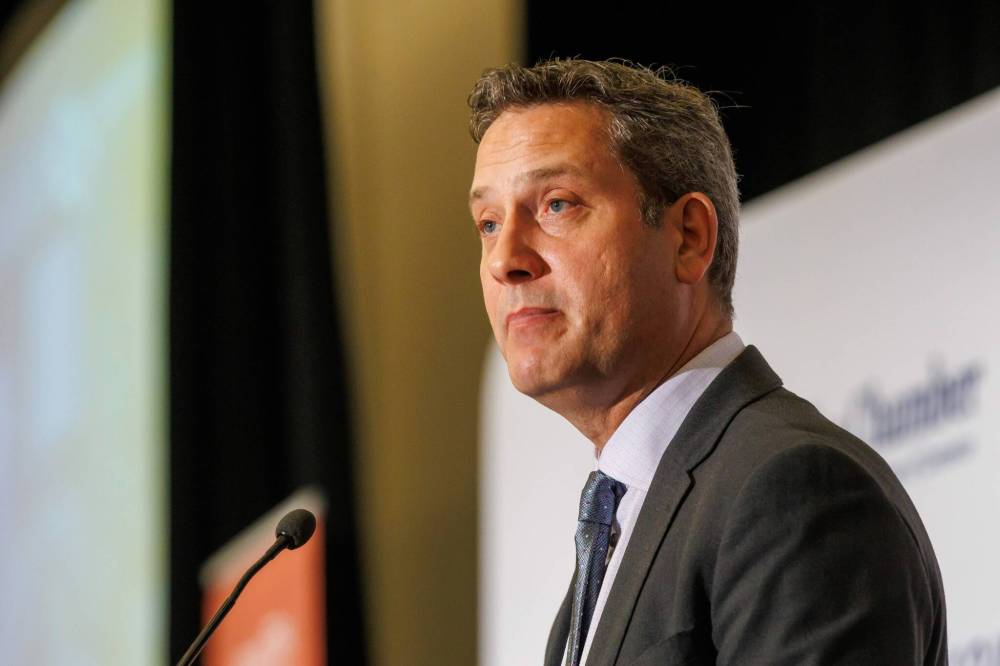
MIKE DEAL / FREE PRESS FILES
Loren Remillard, president and CEO at The Winnipeg Chamber of Commerce
The waters have been especially rough for Imperial Steel, a Winnipeg company that manufactures steel tubing, and it looks like they’ll remain rough.
U.S. tariffs targeting Canadian goods such as steel, aluminum, copper, autos and lumber, which are imposed under a separate authority unaffected by the Supreme Court’s ruling, remain active.
Imperial Steel exported 70 per cent of its products to the U.S. in 2024. The company’s sales were down 60 per cent in 2025, said Richard Bobrowski, Imperial Steel owner. He attributes about two-thirds of that decline to Trump’s tariffs.
The company hasn’t laid off staff, but the drop in business has gotten in the way of growth the company was anticipating at the end of 2024.

“We were looking at buying another building and expanding somewhere in Manitoba just to keep up with orders,” Bobrowski said. “That’s not only disappeared but swung the other direction.”
Imperial Steel has traditionally done business in Canada, the U.S. and Australia. It’s now looking to other countries to do business, Bobrowski said.
“We’re looking into expanding into different markets, trying to follow the trend set by the Canadian government… But it is not a replacement (for the U.S.). It is just diversification.”
— with files from the Canadian Press and the Associated Press
aaron.epp@freepress.mb.ca
Aaron Epp reports on business for the Free Press. After freelancing for the paper for a decade, he joined the staff full-time in 2024. Read more about Aaron.
Every piece of reporting Aaron produces is reviewed by an editing team before it is posted online or published in print — part of the Free Press‘s tradition, since 1872, of producing reliable independent journalism. Read more about Free Press’s history and mandate, and learn how our newsroom operates.
Our newsroom depends on a growing audience of readers to power our journalism. If you are not a paid reader, please consider becoming a subscriber.
Our newsroom depends on its audience of readers to power our journalism. Thank you for your support.
Aaron Epp reports on business for the Free Press. After freelancing for the paper for a decade, he joined the staff full-time in 2024. Read more about Aaron.
Every piece of reporting Aaron produces is reviewed by an editing team before it is posted online or published in print — part of the Free Press‘s tradition, since 1872, of producing reliable independent journalism. Read more about Free Press’s history and mandate, and learn how our newsroom operates.
Our newsroom depends on a growing audience of readers to power our journalism. If you are not a paid reader, please consider becoming a subscriber.
Our newsroom depends on its audience of readers to power our journalism. Thank you for your support.
Related Articles
Manitobans continue to draw line in sand, choose not to cross once-neighbourly line on land


Advertisement Advertise With Us
Advertisement Advertise With Us