Private broadcasters’ group argues CBC is disrupting the market by selling ads

Advertisement

Advertise with us

TORONTO - A review of the CBC's licence renewal applications entered its second phase Monday, with some organizations and individuals presenting their call for greater accountability and transparency from the public broadcaster.

Read this article for free:


or

Already have an account? Log in here »

To continue reading, please subscribe:

Subscribe and receive a limited-edition Free Press branded hat or tote.

Digital Subscription

One year of digital access for only $205*

  • Enjoy unlimited reading on winnipegfreepress.com
  • Read the E-Edition, our digital replica newspaper
  • Access News Break, our award-winning app
  • Play interactive puzzles

*First annual payment billed as $205.00 + GST for one year. This annual subscription will automatically renew at $233.00 + GST every 52 weeks (10% off the regular annual price of $259.35). Offer available to new and qualified returning subscribers only. Cancel any time.

To continue reading, please subscribe:

Add Free Press access to your Brandon Sun subscription for only an additional

$1 for the first 4 weeks*

  • Enjoy unlimited reading on winnipegfreepress.com
  • Read the E-Edition, our digital replica newspaper
  • Access News Break, our award-winning app
  • Play interactive puzzles
Start now

*Your next Brandon Sun subscription payment will increase by $1.00 and you will be charged $17.95 plus GST for four weeks. After four weeks, your payment will increase to $24.95 plus GST every four weeks.

Hey there, time traveller!
This article was published 18/01/2021 (2070 days ago), so information in it may no longer be current.

TORONTO – A review of the CBC’s licence renewal applications entered its second phase Monday, with some organizations and individuals presenting their call for greater accountability and transparency from the public broadcaster.

The Canadian Association of Broadcasters, which represents private broadcasters, expressed concern about the public broadcaster “being market-driven rather than mandate-driven,” arguing it’s focusing too much on attracting more viewers and advertisers.

“CBC/Radio-Canada’s avowed focus on a market-driven strategy comes at a significant public policy cost,” Kevin Desjardins, president of the CAB, said in the virtual hearing run by the Canadian Radio-television and Telecommunications Commission.

The CBC logo is projected onto a screen at The Mattamy Athletic Centre in Toronto, Wednesday, May 29, 2019. A review of the CBC's licence renewal applications enters its second phase today, with presentations from various organizations and individuals, some of whom are calling for greater accountability and transparency from the public broadcaster. THE CANADIAN PRESS/Tijana Martin

Desjardins also said that by selling ads on TV and its digital services, the CBC is disrupting the advertising market negatively for private broadcasters.

“It diverts from its core mandate and disrupts private broadcasters’ ability to meet their regulatory obligations,” he said, noting “the ad market right now is incredibly tight, especially in local advertising.”

The hearingbegan Jan. 11 with the CBC asking Canada’s broadcast regulator for greater “flexibility” as it tries to meet audience needs and makes a bigger push into the digital world.

CBC chief executive Catherine Tait said last week that if the public broadcaster is to remain relevant, it must “embrace change.”

“If we do not move with our audiences, we risk becoming dinosaurs on a melting ice cap,” Tait said.

The CBC is asking that the corporation be free of detailed financial reporting obligations around resources put into online content, such as the CBC Gem streaming platform and CBC Listen app.

The watchdog group Friends of Canadian Broadcasting was among the other intervenors who presented Monday.

In an interview before the hearing, Friends executive director Daniel Bernhard said the CBC’s request for less scrutiny over its digital activities, and its performance at the commission thus far, signals “they don’t fully appreciate that public service media is about public service.”

He expressed concerns about the CBC’s accountability, its declining news expenditures, and its advertising and commercialization initiatives, including the paid-partnership division Tandem.

“Hopefully these critiques from the commission will result in conditions of licence that keep CBC management on the straight and narrow and prevent them from diverting down unhelpful tangents like Tandem or other hyper-commercialization initiatives that betray and undermine CBC’s public purpose,” Bernhard said.

CBC management has stressed a critical need to generate revenue amid big financial pressures, and insisted that editorial and advertising content, such as that produced by Tandem, would remain separate.

CBC/Radio-Canada is asking for a five-year renewal of its current licences, which expire on August 31. The public broadcaster’s last license renewal was in 2012.

In fall 2019, the CRTC invited Canadians to share their views on the CBC as part of its decision-making process. Other groups set to present at the hearing this week include the Indigenous Screen Office and Quebecor Media Inc.

Desjardins called for an ad-free CBC/Radio-Canada at Monday’s presentation.

“At minimum, CBC/Radio-Canada should be prohibited from selling local TV and online advertising in markets where local private radio and TV stations are present,” he said.

The CAB also criticized the CBC’s request that its digital services be exempt from regulatory scrutiny.

“We observe the CBC/Radio-Canada leaning in towards becoming more commercial, and less distinctive,” Desjardins said.

“A mandate-driven public broadcaster can complement our shared broadcasting system well. A market-driven CBC/Radio-Canada negatively disrupts an already challenged private broadcasting sector, and undermines all of our ability to appropriately serve the public.”

The public hearing, which will last nearly three weeks, was originally set to be held in May of 2020 but was delayed due to the COVID-19 pandemic.

The CBC presented in last week’s proceedings, which touched on everything from the corporation’s advertising and obligations, to its digital expenditures and its financial constraints that have grown during COVID-19.

Bernhard said Friends of Canadian Broadcasting also opposes the CBC’s request to operate its digital activities outside of the public eye.

The group wants the CBC to be fundamentally non-commercial, and that the corporation deal “with the massive crisis in journalism that is plaguing the country.”

“These are questions of major national importance,” Bernhard said.

“It’s important for us to remember that this is not really just a regulatory hearing, this has real implications for the CBC, which could be basically the last truly national media organization of consequence within the next couple of years.”

This report by The Canadian Press was first published Jan. 18, 2021.

Report Error Submit a Tip

More Stories

Canada-U.S. trade relationship is broken, but the damage can — and will — be repaired

Tom Brodbeck 5 minute read Preview

Canada-U.S. trade relationship is broken, but the damage can — and will — be repaired

Tom Brodbeck 5 minute read Thursday, Sep. 17, 2026

Canada needs to get serious about diversifying its trade beyond the United States. But at the same time, Canadians should expect relations with the U.S. to normalize after Donald Trump is no longer in the White House.

For generations, Canada-U.S. trade was considered almost a fact of geography. The two countries share the world’s longest undefended border, deeply integrated supply chains and a century of commercial relationships.

Canadian manufacturers depend on American customers. American manufacturers depend on Canadian suppliers. Energy, agriculture, automotive production and countless other industries operate across the border as though it barely exists.

That isn’t going to change dramatically, even in the midst of a bitter trade war unleashed by the U.S. president.

Read
Thursday, Sep. 17, 2026

‘She was looking to destroy me’: convicted harasser faces new charges

Dean Pritchard 6 minute read Preview

‘She was looking to destroy me’: convicted harasser faces new charges

Dean Pritchard 6 minute read Thursday, Sep. 17, 2026

When Agnieszka Ciochon-Newton moved into the 55-plus apartment building on Stradbrook Avenue last year, she came across as “timid, soft-spoken and sensitive,” said building manager Tanya Owen.

Little did Owen know the meek-looking 58-year-old woman would soon turn her life and the lives of many of her tenants upside down and threaten her career and family.

“She was looking to destroy me for a simple tenant disagreement,” Owen said Thursday.

Court records show Ciochon-Newton was arrested earlier this month and charged with seven counts of criminal harassment, two counts of uttering threats and one count each of fraud, breaking and entering, attempting to obstruct justice, intimidation of a justice official, mischief and defamatory libel.

Read
Thursday, Sep. 17, 2026

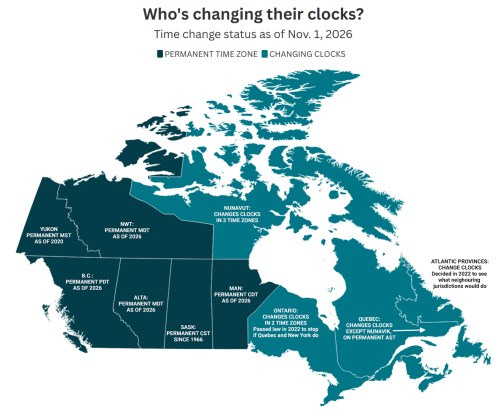
A quick look at where provinces and territories stand on time changes

The Canadian Press 2 minute read Preview

A quick look at where provinces and territories stand on time changes

The Canadian Press 2 minute read Updated: Yesterday at 6:28 AM CDT

WINNIPEG - Manitoba's government said Thursday the province will be sticking with daylight time year-round, making it the latest jurisdiction to move away from twice-annual time changes. Here's a look at where things stand across Canada:

British Columbia said in March that it was moving to permanent Pacific daylight time. The change also means that parts of northeastern B.C., which have been on mountain standard time year round, are now in alignment with the rest of the province.

Alberta also switched to permanent daylight time this year in what it calls Alberta time. The change means it now has the same time as Saskatchewan year round.

Saskatchewan has been on permanent central standard time since 1966.

Read
Updated: Yesterday at 6:28 AM CDT

American Hostage stars recall warmth of Winnipeggers during brutal winter

Randall King 7 minute read Preview

American Hostage stars recall warmth of Winnipeggers during brutal winter

Randall King 7 minute read Yesterday at 6:13 PM CDT

TORONTO — When you stream the eight-part series American Hostage, a sense of familiarity may strike.

That’s because the show was shot in Winnipeg — especially in the Exchange District — from November of last year to the beginning of February, with Winnipeg portraying Indianapolis circa 1977.

The whole world seemed to be watching that midwest American city that year as a hostage crisis unfolded involving one Tony Kiritsis, an angry man who goes ballistic when a mortgage brokerage was poised to foreclose on property he had dreamed of developing into a shopping centre.

Kiritsis kidnapped his mortgage broker, Richard Hall, wiring a shotgun to the back of his head, and demanded a public airing of his grievances, with the reluctant help of popular radio broadcaster Fred Heckman.

Read
Yesterday at 6:13 PM CDT

Manitoba abandoning spring, fall clock changes

Carol Sanders 8 minute read Preview

Manitoba abandoning spring, fall clock changes

Carol Sanders 8 minute read Updated: Yesterday at 8:48 AM CDT

Time’s up for the time change in Manitoba.

Manitobans won’t be setting their clocks back an hour in November. The province has decided to permanently stay on daylight time after surveying residents on the twice annual clock adjustment.

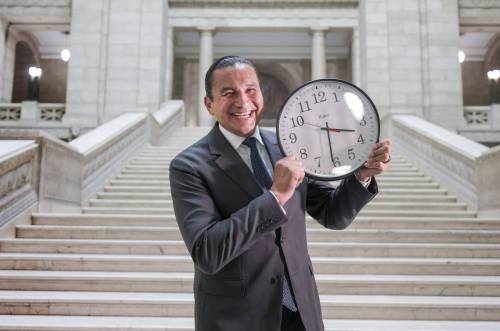
“We heard from Manitobans loud and clear — no more changing the clocks in Manitoba,” Premier Wab Kinew said in a news release Thursday.

Most of the 72,000 votes submitted in an online EngageMB survey — 92 per cent — said they would like to see the practice end. The survey asked if they preferred earlier sunrises in winter with standard time or the later sunsets in summer with daylight time. More than half of survey participants (58 per cent) indicated a preference to stay on permanent daylight time; 34 per cent voted to eliminate the time change but stay on standard time.

Read
Updated: Yesterday at 8:48 AM CDT

Day 1 of Jets training camp in the books with pairings essentially cemented

Ken Wiebe 7 minute read Preview

Day 1 of Jets training camp in the books with pairings essentially cemented

Ken Wiebe 7 minute read Thursday, Sep. 17, 2026

Nearly six minutes into his question-and-answer session, Scott Arniel took a welcome detour from the news of the day.

After exhausting the discussion around the goalie who wasn’t in training camp, the head coach of the Winnipeg Jets finally got a query about the line combinations and defensive pairings that were unveiled in training camp.

And unlike past years, when exhibition games were more frequent and the training camp wasn’t this condensed, Arniel conceded these groupings were intentional and were likely staying together for some time.

The expansion to an 84-game regular season brings with it a reduction to four pre-season games and a much shorter training camp, which could limit the amount of experimentation that Arniel can do during the next two weeks.

Read
Thursday, Sep. 17, 2026