Dredging company to pay $1M for restoration work oil spill

Advertisement

Advertise with us

NEW ORLEANS (AP) — A Houston dredging company has been ordered to pay a $1 million fine for an oil spill that occurred when a subcontractor cut through an oil pipeline during barrier island restoration work off Louisiana in 2016.

Read this article for free:


or

Already have an account? Log in here »

To continue reading, please subscribe:

Subscribe and receive a limited-edition Free Press branded hat or tote.

Digital Subscription

One year of digital access for only $205*

  • Enjoy unlimited reading on winnipegfreepress.com
  • Read the E-Edition, our digital replica newspaper
  • Access News Break, our award-winning app
  • Play interactive puzzles

*First annual payment billed as $205.00 + GST for one year. This annual subscription will automatically renew at $233.00 + GST every 52 weeks (10% off the regular annual price of $259.35). Offer available to new and qualified returning subscribers only. Cancel any time.

To continue reading, please subscribe:

Add Free Press access to your Brandon Sun subscription for only an additional

$1 for the first 4 weeks*

  • Enjoy unlimited reading on winnipegfreepress.com
  • Read the E-Edition, our digital replica newspaper
  • Access News Break, our award-winning app
  • Play interactive puzzles
Start now

*Your next Brandon Sun subscription payment will increase by $1.00 and you will be charged $17.95 plus GST for four weeks. After four weeks, your payment will increase to $24.95 plus GST every four weeks.

Hey there, time traveller!
This article was published 22/06/2022 (1550 days ago), so information in it may no longer be current.

NEW ORLEANS (AP) — A Houston dredging company has been ordered to pay a $1 million fine for an oil spill that occurred when a subcontractor cut through an oil pipeline during barrier island restoration work off Louisiana in 2016.

Great Lakes Dredge & Dock Company, which describes itself as the nation’s largest dredging company, was sentenced last Thursday for violating the Clean Water Act, according to a news release from the U.S. Attorney’s Office in New Orleans.

Great Lakes “recklessly violated regulations designed to protect the environment and then tried to hide their actions,” Kimberly Bahney, special agent in charge of the Environmental Protection Agency’s criminal enforcement program in Louisiana, said Friday in that news release.
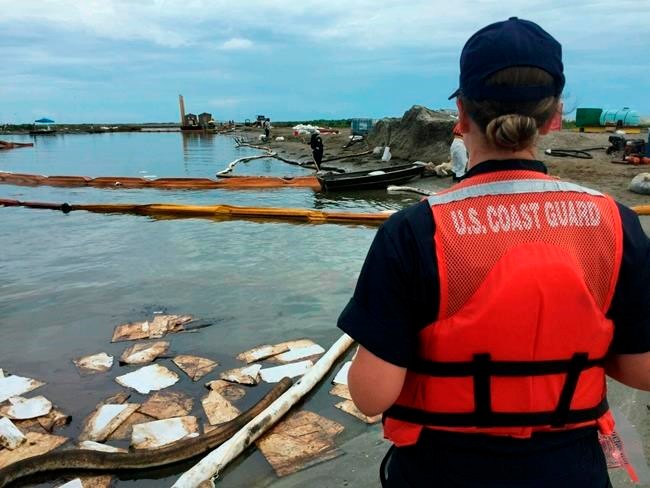
Coast Guard Petty Officer 3rd Class Lyndsey Slabe surveys the cleanup efforts in Bay Long, La., Sept. 10, 2016. A Houston dredging company has been ordered Thursday, June 16, 2022, to pay a $1 million fine for an oil spill that occurred when a subcontractor cut through a pipeline during Louisiana barrier island restoration work in 2016. (Petty Officer 3rd Class Brandon Giles/U.S. Coast Guard via AP)

The spill occurred when a marsh buggy hit a pipeline while digging and moving sediment to create part of the island’s new outline, releasing an estimated 5,300 gallons (20,000 liters) of crude oil and oiling about 200 birds.

The restoration at Chenier Ronquille, a barrier island east of Grand Isle, was paid for by money from the 2010 BP oil spill.

Great Lakes, which was headquartered in Oak Brook, Illinois, in 2016 but has since moved to Houston, pleaded guilty in June 2021. As part of the plea, it said it violated state and federal laws by failing to tell companies about continuing work near their pipelines. A statement filed with the guilty plea also said Great Lakes’ failure to properly supervise James Tassin, whose marsh buggy punctured the pipeline on Sept. 5, 2016, was a cause of the spill.

Tassin, a Shallow Water Equipment LLC employee, pleaded guilty in March 2021 to violating the Clean Water Act. His sentencing is scheduled Aug. 16, according to online court documents.

A Great Lakes employee told him to dig near pipelines even though that area wasn’t in the plan approved by the National Oceanic and Atmospheric Administration, according to the news release.

It said Great Lakes had not gotten pipeline companies’ word that it was safe to dig, and Tassin said a Great Lakes employee told him “not to tell anyone that Tassin had been digging near the site of the spill.” The two Houston companies that owned the pipeline, Harvest Pipeline Company and Arrowhead Gulf Coast Pipeline, LLC, sued for damages including cleanup costs. Prosecutors said Great Lakes agreed to pay nearly $3.2 million and Tassin’s employer agreed to pay it nearly $1.7 million.

U.S. District Judge Greg Guidry last week rejected prosecutors’ request to make Great Lakes pay a total of at least $6 million in restitution for the spill, The Times-Picayune/The New Orleans Advocate reported.

The investigation would be too unwieldly, “while unnecessarily stalling an end to the Chenier Ronquille incident,” he wrote. Besides, he said, the figure probably wouldn’t be far from the figure settled on for the damage suit.

Money to pay the fine is already in a court account. Great Lakes deposited $2 million for possible restitution when it pleaded guilty, and will get the rest back, according to court documents.

Report Error Submit a Tip

More Stories

Canada must not accept another Iranian autocracy

David Matas 5 minute read 2:01 AM CDT

Iran is a state run by a radical government victimizing its citizens and its neighbours. How do we change that? Any regime change that repeats the mistakes of the past is not a solution.

What went wrong in the past which led to the current regime? One answer is the U.K. and American aided coup which led to the ouster in 1953 of a democratically elected government headed at the time by Mohammad Mossadegh and its replacement with an American friendly autocrat, the Shah of Iran, Mohammad Reza Pahlavi.

The Shah imposed his rule through the Iranian National Intelligence and Security Organization — SAVAK, the acronym of its Persian name. SAVAK systematically inflicted torture, arbitrary killings and extra-judicial killings on perceived opponents of the regime. It was only a matter of time before repression of a regime directed to serving foreign interests would be overthrown.

What replaced the regime of the Shah, in 1979, the current regime of the mullahs, is a regime as intolerant and violent as the regime of the Shah and then some. That was not inevitable. But neither was it surprising. The vicious nature of the current regime, following the example set by the Shah, and its hatred for the United States, reacting to the U.S. aided imposition of the Shah, both echoes and reacts to the past. In 1979, the U.S. reaped what it sowed in 1953.

Cabernet Sauvignon star of wine festival

Ben Sigurdson 5 minute read Preview

Cabernet Sauvignon star of wine festival

Ben Sigurdson 5 minute read 3:00 AM CDT

The Winnipeg Wine Festival will celebrate the king of red wine grapes next weekend — the theme of this year’s festival, which takes place Sept. 25 and 26 at the RBC Convention Centre, is Cabernet Sauvignon.

Cab Sauv, as it’s also known, is the world’s most widely planted wine grape of any colour, first coming to prominence in the 1800s in France’s Bordeaux region, where the grape is still popular. Rather than single-variety wines, Bordeaux reds tend to be blends, with those coming from the left bank of the Gironde estuary being Cabernet-dominant, while right-bank wines are Merlot-dominant, with Cabernet Sauvignon playing a supporting role. Cabernet and Merlot work well together and many other countries have followed suit in blending the two.

A team at University of California Davis put Cabernet Sauvignon through a DNA test in 1996 and discovered its parent grapes are Cabernet Franc and Sauvignon Blanc — it’s likely that at some point the two varieties, planted next to each other in some vineyard, crossed and mutated and became the grape we know today. (Someone growing grapes in the 19th century must have had an inkling of what was up, as the grape has been called Cabernet Sauvignon since long before the DNA test.)

Flavour-wise, most Cabernet Sauvignon wines are big and bold, with a core of deep dark berry flavours, some graphite and spice notes and relatively bright acidity. It’s a grape that is well-suited to barrel aging, with most examples seeing at least some time in wood.

Read
3:00 AM CDT

Jets GM insists club’s not working under any deadline in netminder’s trade request

Mike McIntyre 7 minute read Preview

Jets GM insists club’s not working under any deadline in netminder’s trade request

Mike McIntyre 7 minute read Thursday, Sep. 17, 2026

Connor Hellebuyck and his family were subject to so much post-Olympic vitriol that both the Winnipeg Jets security team and even police had to get involved.

Read
Thursday, Sep. 17, 2026

Canada-U.S. trade relationship is broken, but the damage can — and will — be repaired

Tom Brodbeck 5 minute read Preview

Canada-U.S. trade relationship is broken, but the damage can — and will — be repaired

Tom Brodbeck 5 minute read Thursday, Sep. 17, 2026

Canada needs to get serious about diversifying its trade beyond the United States. But at the same time, Canadians should expect relations with the U.S. to normalize after Donald Trump is no longer in the White House.

For generations, Canada-U.S. trade was considered almost a fact of geography. The two countries share the world’s longest undefended border, deeply integrated supply chains and a century of commercial relationships.

Canadian manufacturers depend on American customers. American manufacturers depend on Canadian suppliers. Energy, agriculture, automotive production and countless other industries operate across the border as though it barely exists.

That isn’t going to change dramatically, even in the midst of a bitter trade war unleashed by the U.S. president.

Read
Thursday, Sep. 17, 2026

Grieving child builds backyard rocket ship

Harriet Zaidman 4 minute read 2:01 AM CDT

I Built a Rocket Ship (Kids Can Press, 32 pages, hardcover, $22) by Winnipegger Anna Lazowski is a tender story for children ages 4-8 about a little girl trying to make sense of her mother’s death. The child engages in conversation with her late mom, agreeing and disagreeing about things said as she carries objects (and of course, the cat) to the backyard. There, she is building a rocket ship she will pilot into the skies to find her mom again.

Jennica Lounsbury’s varied perspectives show the range of emotions the little girl experiences.

● ● ●

Northwoods Lullaby by Mary Casanova (University of Minnesota Press, 32 pages, hardover, $25) is a bedtime book for readers up to age eight, perfect to bring a busy, happy day to a close. Just like children who are listening to adults reading the book, all the animal babies are being tucked into their nests and burrows by loving parents: “Thump and scamper,/nimble clover./ Soon it’s time to rest. Baby loon/ nestles in/as Papa floats along.”

Puzzles Palace

1 minute read Monday, Jul. 27, 2026

To solve our puzzles, please subscribe with this special offer: |