‘Making monsters of each other’: Businesses fear impact of Quebec language law
Advertisement
Read this article for free:
or
Already have an account? Log in here »
To continue reading, please subscribe:

Digital Subscription
One year of digital access for only $205*
- Enjoy unlimited reading on winnipegfreepress.com
- Read the E-Edition, our digital replica newspaper
- Access News Break, our award-winning app
- Play interactive puzzles
*First annual payment billed as $205.00 + GST for one year. This annual subscription will automatically renew at $233.00 + GST every 52 weeks (10% off the regular annual price of $259.35). Offer available to new and qualified returning subscribers only. Cancel any time.
To continue reading, please subscribe:
Add Free Press access to your Brandon Sun subscription for only an additional
$1 for the first 4 weeks*
- Enjoy unlimited reading on winnipegfreepress.com
- Read the E-Edition, our digital replica newspaper
- Access News Break, our award-winning app
- Play interactive puzzles
*Your next Brandon Sun subscription payment will increase by $1.00 and you will be charged $17.95 plus GST for four weeks. After four weeks, your payment will increase to $24.95 plus GST every four weeks.
Read unlimited articles for free today:
or
Already have an account? Log in here »
Hey there, time traveller!
This article was published 08/05/2022 (1595 days ago), so information in it may no longer be current.
MONTREAL – As Quebec’s contentious language law heads closer to adoption, the province’s business community is growing increasingly anxious about what it could mean for their bottom line, with some companies considering leaving entirely.
Known as Bill 96, the legislation would impose tougher language requirements on small businesses and companies in federally regulated industries, such as banking and telecommunications, as well as governments and schools. The bill is expected to pass before the legislature breaks for the summer.
On top of strengthening 1977’s Charter of the French Language — the province’s signature language law usually known as Bill 101 — the legislation would apply to tens of thousands of previously exempt businesses.
If it passed, companies with 25 employees or more would be subject to “francization” — government certification that use of French is generalized in the workplace — down from 50 currently. The bill also assigns new powers to the French-language watchdog and sets tighter language rules for professional orders.
The cost for a roughly 50-employee company would range between $9.5 million and $23.5 million, according to estimates from the Canadian Federation of Independent Business. Expenses range from fees for translation and legal services to administrative burdens, such as creating a workplace assessment to ensure French permeates all corners of the company.
An internal or public complaint could trigger an investigation from the provincial Office québécois de la langue française. The watchdog can also demand on its own initiative that a business between 25 and 100 workers form a francization committee, another expense for smaller companies.
Other provisions beef up existing protections of the charter.
One clause bars employers from demanding proficiency in a language other than French unless they can show the job demands it and that all reasonable avenues were explored to steer clear of the requirement. Currently, requiring another language as condition of employment is allowed only if “the nature of the duties requires such knowledge,” Bill 101 states.
The high thresholds risk driving head offices from Quebec and hampering the province’s export economy, trade associations say.
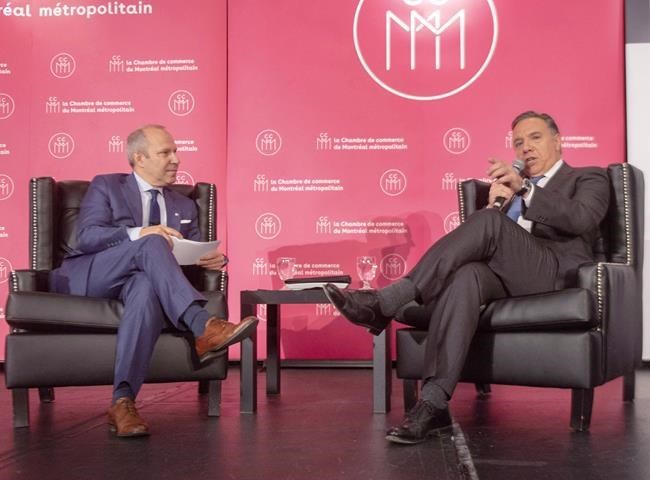
“Companies in Quebec have to be able to have bilingual employees and be able to service outside buyers in English,” Michel Leblanc, CEO of the Chamber of Commerce of Metropolitan Montreal, said in a phone interview.
“We want companies to be able to decide when they should hire bilingual people.”
On top of strengthening the prominence of French on signs and posters, the legislation also requires businesses to draw up employment contracts and other documents in French.
“That’s not doable. We have companies in Quebec doing businesses with companies all over the world,” Leblanc said, adding that French does need some special protections.
Amid a labour shortage in industries like fashion and food services, many stores increasingly look to students — including those from out of province or country — to staff counters and stock shelves, with the possibility that some will stay on and integrate post-graduation. Now that door will largely close, since many of those students do not speak fluent French, he said.
Outfits affected range from retail stores to small, international tech companies as well as big federal firms.
The language office estimates Quebec is home to about 20,000 businesses of between 25 and 49 workers.
Thousands more work for companies that fall under federal jurisdiction. Former Crown corporations such as Air Canada and Canadian National Railway Co. are already subject to the federal Official Languages Act, which requires them to provide services in English or French on request. But most federally regulated companies are not included in that 53-year-old legislation.
As of 2013, nearly 135,000 employees in Quebec worked at 1,760 federally regulated companies not subject to provincial or national language laws, according to a study by the federal Innovation, Science and Economic Development department. Now, all would be.
Even if those companies claim they are not beholden to the provincial legislation, a proposed federal law aims to ensure compliance.
Reintroduced in March after first being tabled last June, the Liberals’ Bill 13 requires companies under federal jurisdiction that are not currently subject to the Charter of the French Language or the federal Official Languages Act to either submit to Quebec’s rules on French in the workplace or to a parallel regime on track for passage in Ottawa.
Litigation is another potential drain on corporate time and accounts.
As it stands, incidents of non-compliance are worked out between the company and the watchdog, with negotiable compliance timelines. Bill 96 would change that process.
“Now any Quebec resident who feels that in an interaction with a business their rights under the Charter of the French Language have not been satisfied … could make a claim for damages,” said Alexandre Fallon, a partner at Osler law firm in Montreal.
“Even if an agreement is reached with the regulator, private litigation could still ensue.”
Customer service encounters, receipts, brochures, product packaging, menus and advertising could all form the basis for a case.
“Businesses small and large are very worried,” Fallon said.
“It upsets the environment of trust,” added Sylvia Martin-Laforge, director general of the Quebec Community Groups Network.
Business groups ranging from the Quebec Retail Council to the Quebec Manufacturers and Exporters and the Council of Canadian Innovators are asking the government to soften its rules — particularly around francization — to offer supports to businesses that undergo it and to extend compliance deadlines.
But Giovanni Bisciglia, leader of the nascent Centrist Party of Quebec, which has applied to the province’s chief electoral officer for authorization, questions whether Premier François Legault’s government hears the concerns of anxious business owners.
“The anglophones are accusing the francophones, the francophones are accusing the anglophones. They’re making monsters of each other and both claiming they’re victims of each other,” he said.
“No one is communicating.”
This report by The Canadian Press was first published May 8, 2022.