Ottawa intends to fill charging-station deserts to encourage EV adoption: Guilbeault
Advertisement
Read this article for free:
or
Already have an account? Log in here »
To continue reading, please subscribe:

Digital Subscription
One year of digital access for only $205*
- Enjoy unlimited reading on winnipegfreepress.com
- Read the E-Edition, our digital replica newspaper
- Access News Break, our award-winning app
- Play interactive puzzles
*First annual payment billed as $205.00 + GST for one year. This annual subscription will automatically renew at $233.00 + GST every 52 weeks (10% off the regular annual price of $259.35). Offer available to new and qualified returning subscribers only. Cancel any time.
To continue reading, please subscribe:
Add Free Press access to your Brandon Sun subscription for only an additional
$1 for the first 4 weeks*
- Enjoy unlimited reading on winnipegfreepress.com
- Read the E-Edition, our digital replica newspaper
- Access News Break, our award-winning app
- Play interactive puzzles
*Your next Brandon Sun subscription payment will increase by $1.00 and you will be charged $17.95 plus GST for four weeks. After four weeks, your payment will increase to $24.95 plus GST every four weeks.
Read unlimited articles for free today:
or
Already have an account? Log in here »
Hey there, time traveller!
This article was published 15/12/2021 (1738 days ago), so information in it may no longer be current.
OTTAWA – When Wilf Steimle makes the 600-kilometre drive from his home near Barrie, Ont., to board meetings in Montreal, he can get there in under seven hours with three 12-minute stops to repower his electric car.
Between the Greater Toronto Area and Montreal, there are at least four dozen high-speed charging stations. Most of them able to charge between two and four vehicles at a time.
But Steimle, president of the Electric Vehicle Society, said it’s nowhere close to enough.
By 2030, the federal government wants half of all new passenger vehicles sold to be zero-emission vehicles. It wants to get to 100 per cent by 2035. In 2020, only 3.5 per cent of new vehicles were battery-only or plug-in hybrids.
Steimle said persuading Canadians to make the switch rests heavily on convincing them that there will be a charging station available when they need it and that it won’t delay their road trips.
“Studies in Europe and slowly the beginnings of studies in North America, seasoned EV owners consistently say range doesn’t matter,” Steimle told The Canadian Press. “What they care about is reliable access to fast charging.”
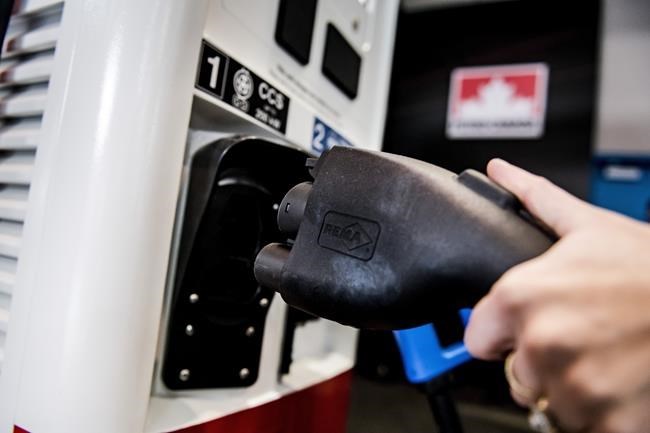
Natural Resources Canada has mapped out more than 15,000 publicly available electric vehicle chargers, in 6,800 locations, countrywide. About 3,000 of the chargers are DC fast, which means they can typically add between 250 and 300 kilometres of battery range in an hour.
The rest are Level 2, capable of adding about 30 kilometres of range in an hour.
For the average Canadian, who drives less than 50 kilometres a day, Level 2 chargers are more than enough. Most people could rely almost entirely on charging overnight at home.
For rural Canadians, those going on longer road trips, urban delivery drivers, taxis and the like, DC fast is the only realistic option.
But the charging network is very uneven.
Almost 85 per cent of the DC fast charging connections publicly available are in Quebec, Ontario and British Columbia. More than 90 per cent of the publicly available Level 2 chargers are in those three provinces.
Cara Clairman, president of the electric vehicle advocacy group Plug’n Drive, said it’s a chicken-or-egg issue. There is not a big business case to build chargers in places where there aren’t enough cars that are going to use them.
More than 204,000 battery-electric and plug-in hybrid cars have been registered in Canada since 2011. All but 8,000 of those were in Ontario, B.C. and Quebec.
“The Montreal-Toronto corridor gets so many cars and so there’s a business case there for the chargers,” she said. “That’s why we need government funding.”
Provincial governments have varying incentives to help drivers install chargers at home. A few have public charging incentives too. Hydro One and Ontario Power Generation just announced they will be adding new public chargers at the highway rest stops known as ONroutes, with all but three of the 23 refuelling stations to be equipped by the end of next year.
Since 2016, Ottawa alone has spent close to $200 million installing more than 17,000 new charging connectors. Many are still under construction and there is nearly $180 million budgeted to double that number of charging connectors over the next three years.
Some of those are public, but others are also in apartment blocks and condo buildings.
The Liberals promised another $700 million during the election campaign to build another 50,000 chargers but haven’t yet detailed how that money will be allocated.
Eighty-two per cent of the new chargers funded to date are also in B.C., Quebec and Ontario, slightly higher than the 75 per cent population share for those provinces.
While Steimle’s drive between the Greater Toronto Area and Montreal has many options for stopping at a DC fast charger, the same can’t be said for other road trips. A similar 600-kilometre drive from Winnipeg to Regina shows only six DC fast options along the Trans-Canada Highway.
Environment Minister Steven Guilbeault said in a recent interview with The Canadian Press that he is well aware of the charging-station deserts that exist.
Guilbeault, who has never owned a personal car, uses a battery-electric Chevrolet Bolt as his ministerial vehicle. Guilbeault’s driver has planned routes and the timing of the frequent commute between the minister’s home in Montreal and Parliament Hill in Ottawa, based on where she could find a fast charging station to power up.
“There are no fast charging stations to speak of in either downtown Ottawa or downtown Montreal,” he said. “So we have to carefully plan our trips and we have to stop in the suburbs or my driver has to stop before she comes to Montreal in the suburbs to charge so we have enough. So, it is clearly an issue.”
Guilbeault said fixing the charging station issue is not rocket science.
“Our goal is to substantially increase the network across the country so that in the very near future this won’t be an issue anymore,” he said. “Frankly, we’re not sending someone to the moon, it’s a very simple technical issue.”
This report by The Canadian Press was first published Dec. 15, 2021.