
Economics and Resources
Please review each article prior to use: grade-level applicability and curricular alignment might not be obvious from the headline alone.
Big Tobacco and Big Oil are eerily similar. One knowingly produces a product that slowly but surely kills its consumers. The other knowingly produces a product that surely but not slowly kills the planet.

Only moratorium can save moose population: MWF
4 minute read Preview Wednesday, Sep. 24, 2025
Message to the U.S. ambassador: we’re disappointed, too
4 minute read Preview Wednesday, Sep. 24, 2025Funding Transit a necessity
4 minute read Wednesday, Sep. 24, 2025While the new Winnipeg Transit network launched in June 2025 has achieved many of its objectives, it’s important to assess what is and isn’t working in order to see Winnipeg Transit reach its full potential.
Overall, the system change gives transit a chance to increase ridership while ensuring Winnipeggers have frequent, reliable access to destinations across the city. This redesign isn’t a final product, but a new frame to give city council many options to improve service across the city, should they choose to turn up the dial.
Previously, our “spaghetti route” system had numerous congestion points — such as Graham Avenue — where buses stacked up.
Adding more buses to a system like this is meaningless as buses inevitably get stuck behind each other. The spaghetti routes also created confusion, especially to those new to the city or trying to reach an area they don’t know well. Telling someone to “hop on the 16” but not that 16, lest they end up in a completely different neighbourhood, didn’t inspire confidence.
A deal that will cost Manitobans dearly
4 minute read Tuesday, Sep. 23, 2025Premier Wab Kinew stood at a podium recently and proudly announced his government’s first major construction initiative: four new schools. But instead of celebrating good news for families and for the men and women who will build them. Manitobans should be alarmed.
Buried in the fanfare was a deal that hands monopoly control of these projects to a select group of building trades unions. This is not about better schools or stronger communities — it’s about rewarding political friends with a sweetheart deal that shuts out most of Manitoba’s construction industry.
Premier Kinew has given union leaders exactly what they wanted: guaranteed work and a stranglehold over projects funded by taxpayers. He is favouring 8,000 traditional building trades union workers and shutting out more than 80 per cent of the workers who work for open shop companies and progressive union workers.
The unfair and discriminatory treatment of the vast majority of construction workers in Manitoba who will be denied opportunities to work on government funded infrastructure is shocking. And Manitobans will bear the cost of this backroom deal. When governments restrict competition, taxpayers always pay more and get less.
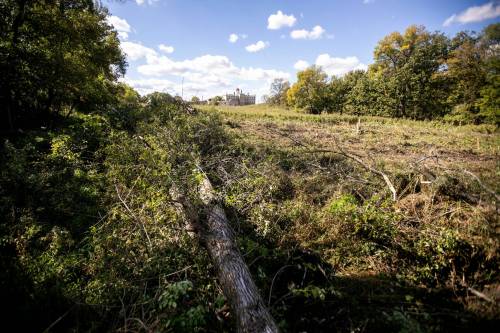
Another subdivision, another city problem
5 minute read Preview Tuesday, Sep. 23, 2025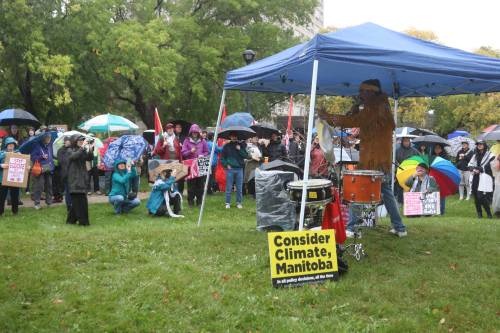
Ralliers decry Kinew’s pro-pipeline policy
4 minute read Preview Saturday, Sep. 20, 2025
Domestic enrolment helped U of W’s fiscal health: president
4 minute read Preview Sunday, Sep. 21, 2025
St. Boniface residents drained after demolition of Happyland pool
4 minute read Preview Friday, Sep. 19, 2025
Hudson’s Bay seeks approval to auction off 1670 charter, court filings show
5 minute read Preview Friday, Oct. 10, 2025
North Dakota missing its Manitobans
6 minute read Preview Friday, Sep. 19, 2025
Will electric tractors gain traction? At a pilot event for farmers, researchers see possibilities
6 minute read Preview Friday, Oct. 10, 2025
Clarity, ‘competitiveness’ key to name change
4 minute read Preview Thursday, Sep. 18, 2025City council threatens rights without delivering safety
5 minute read Wednesday, Sep. 17, 2025As the City of Winnipeg appears poised to implement new rules that target people who live in encampments, questions should be raised about who — if anyone — will be safer as a result.
Winnipeg city council’s community services committee recently unanimously approved a motion, introduced and amended by Coun. Cindy Gilroy and seconded by Coun. Sherri Rollins, to prohibit encampments in and around a wide range of spaces, including playgrounds, pools, schools, daycares, transit stops, bridges and rail lines. It also directs the city to expand enforcement across all other city spaces during daylight hours, which could mean issuing bylaw tickets. The motion will go to council’s executive policy committee before a final vote by council.
While some, including Mayor Scott Gillingham, have described these new rules as a “balanced approach” to deal with encampments, we have seen this type of approach before and it does not work.
The motion is framed around safety, especially for children and families. That concern should not be dismissed — no one disputes that unsafe materials have been found in public spaces, but tying those concerns directly to encampments offers a misleading choice. It suggests that the safety of families must come at the expense of people experiencing homelessness. And with Winnipeg’s child poverty rate the highest in the nation, many of the children and families this ban claims to protect are also among those it targets.
Putting people before politics
4 minute read Tuesday, Sep. 16, 2025Dividing outreach providers won’t solve homelessness. Collaboration and a managed encampment-to-housing site will. As winter closes in, Winnipeg faces a mounting crisis. More people than ever are living unsheltered, exposed to harsh weather, unsafe conditions and the devastating risks of addiction.
Riverbank encampments and makeshift shelters in public spaces have become dangerous not only for residents but also for outreach workers and emergency responders who must navigate snow- and ice-covered terrain just to provide help. Encampment residents, meanwhile, live without even the basic dignity of an outhouse.
The overdose death rate in Winnipeg is among the highest in the country, and too many of those deaths happen in encampments. This cannot continue.
For too long, the conversation has been stalled by a false narrative: that homelessness is solely the result of a lack of subsidized housing. While the housing shortage is real, it is only part of the story. The deeper truth is that Winnipeg is in the grip of a drug-use epidemic that has become the single largest pipeline into homelessness.
Manitoba municipalities and financial controls
4 minute read Tuesday, Sep. 16, 2025Late last month, Manitoba Auditor General Tyson Shtykalo released a report aimed at ensuring the provincial government exercises greater oversight over spending by municipal governments across the province.
Following a yearlong investigation of allegations of financial mismanagement by several local governments, the AG discovered that the province does not currently have a comprehensive process to follow up on complaints regarding municipal governments, review financial submissions made by them, or even monitor the spending of provincial grants they receive.
Shtykalo emphasized that the province provides millions of dollars in funding to municipalities annually and that, “With this funding comes a responsibility — both for municipalities and the Department of Municipal and Northern Relations — to ensure effective stewardship of public resources.”
To many Manitobans, that is likely regarded as nothing more than stating the obvious. All recipients of public funds must handle those monies with care and be both transparent and accountable for how the dollars are spent. And yet, the auditor general found that adequate controls are not currently in place to ensure that is happening.
Missed payments by Manitoba small businesses rise
3 minute read Tuesday, Sep. 16, 2025Missed payments by Manitoba small businesses rose nearly 13 per cent earlier this year, new Equifax Canada data show.
The credit bureau counted 2,005 Manitoba businesses that didn’t meet at least one payment deadline between April and June, when looking at financial trade delinquencies. Construction, mining, transportation and wholesale trades were among the categories to see increased delinquency rates.
“Provinces that have been stable in the past are really showing areas where they’re starting to pull apart,” said Jeff Brown, Equifax Canada’s head of commercial solutions.
Manitoba’s financial trades delinquency rate year-over-year change outpaced the national average of 8.67 per cent.

Bus overhaul leaves gaps in service to Grace Hospital, Assiniboine clinic
5 minute read Preview Tuesday, Sep. 16, 2025
‘As we grow, our roots only grow deeper’: Red River Mutual insurance company celebrates 150 years
6 minute read Preview Monday, Sep. 15, 2025
Liberals, Conservatives talk co-operation but trade jabs as Parliament returns
5 minute read Preview Monday, Sep. 15, 2025
Equatorial Guinea enforces yearlong internet outage for island that protested construction company
6 minute read Preview Thursday, Oct. 16, 2025
Local engineer was a real game changer
5 minute read Preview Saturday, Sep. 13, 2025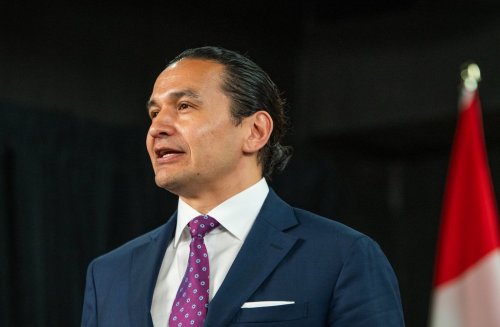
Premier, chiefs question lack of Manitoba First Nation voice on major project council
4 minute read Preview Saturday, Sep. 13, 2025Canadian farmers facing harvest cash-flow crunch, talking support
4 minute read Saturday, Sep. 13, 2025Canadian farmers are understandably disappointed the federal government’s response to China’s punishing import tariffs on canola, pork, peas and seafood hasn’t so far included direct compensation.
After all, the duties are widely seen as retaliation for Canadian tariffs effectively locking Chinese electric cars out of the local market — a policy decision that had nothing to do with agriculture. This is the second time in recent memory China has targeted Canadian farmers to score points on unrelated issues. It’s unlikely to be the last.
While the full impact remains unclear, when Canada’s second-largest canola customer imposes tariffs of 75.8 per cent on seed and 100 per cent on oil and meal, it’s a safe bet demand will be curbed and prices will be lower than they would have been otherwise. Industry estimates place the eventual costs in the range of $2 billion.
However, commodity prices this year are depressed across the board — for a host of reasons. Much of the new-crop canola has yet to be harvested and very little has been sold.