Search Results
Please review each article prior to use: grade-level applicability and curricular alignment might not be obvious from the headline alone.
The decline of the liberal arts
4 minute read Saturday, Jul. 18, 2026At his trial for impiety and corrupting youth, the ancient Greek philosopher Socrates defended himself by justifying his life’s work, famously maintaining that “the unexamined life is not worth living.” Lamentably, he was found guilty of the charges and ironically sentenced to death via drinking poison hemlock.
Yet human life is undeniably worth examining. So how do we best do so?
The liberal arts curriculum in Western post-secondary education — liberal as in “to be free” and art as in “learned skill” — has historically been perhaps the primary means of examining the human condition and experience, in contrast to vocational, professional or technical fields of study in universities.
Today they comprise the humanities, such as history, philosophy and literature, as well as the social sciences, such as anthropology, sociology and political science, with psychology bridging onto the natural sciences.

Reimagined Little House still shot through with the truth
5 minute read Preview Saturday, Jul. 18, 2026
Drug court helps break addiction’s bleak cycle
6 minute read Preview Saturday, Jul. 18, 2026
Birds’ evolution from feathery, winged dinosaurs chronciled in riveting, well-researched account
4 minute read Preview Saturday, Jul. 18, 2026
Cut the number of choices you make each day. Your brain will thank you
5 minute read Preview Monday, Aug. 17, 2026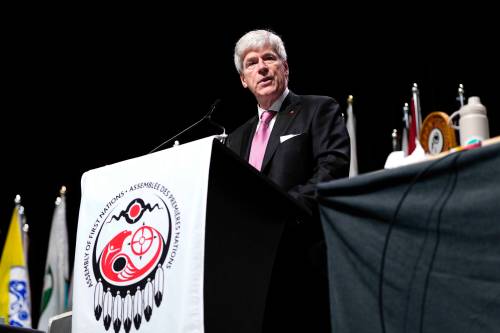
First Nations’ concerns overshadowed by talk of major projects
5 minute read Preview Friday, Jul. 17, 2026
Popular low-price grocery program celebrates first year
5 minute read Preview Friday, Jul. 17, 2026
Winnipeg Beach vinyl boutique helps lake-goers get in the groove
9 minute read Preview Friday, Jul. 17, 2026
Fire-ravaged First Nations community accuses Ottawa of denying it federal aid
7 minute read Preview Wednesday, Jul. 22, 2026
Lettuce at Taco Bell in 5 states confirmed as a source of diarrhea-causing parasite
5 minute read Preview Wednesday, Jul. 22, 2026
City tries to find the right balance in regulating personal e-vehicles
10 minute read Preview Friday, Jul. 17, 2026
What happened to public service?
5 minute read Preview Friday, Jul. 17, 2026
Black, immigrant entrepreneurs seek growth, support at summit
3 minute read Preview Thursday, Jul. 16, 2026
SpaceX Starship launch aborted on the pad at the last moment
3 minute read Preview Thursday, Aug. 6, 2026
Long-held core values of openness, inclusion, empathy set Convalescent Home apart from the personal care home pack
19 minute read Preview Thursday, Jul. 16, 2026
Manitoba documentary focuses lens on environmental defenders, beauty of prairies
4 minute read Preview Thursday, Jul. 16, 2026
The next Duff’s Ditch must be medical
5 minute read Preview Thursday, Jul. 16, 2026Twelve metres of museum space
4 minute read Thursday, Jul. 16, 2026It is striking that one of the smallest exhibitions at the Canadian Museum for Human Rights in Winnipeg has generated one of the largest public controversies in the museum’s history. Palestine Uprooted: Nakba Past and Present occupies only about 12 metres within an existing gallery.
Yet it has prompted protests, political statements, passionate public debate and accusations that the museum has somehow abandoned its mission.
This exhibition matters. But I have come to think that the reaction to it matters just as much. It raises a question that reaches well beyond this particular exhibition.
Why has one small gallery space become such a flashpoint?
Management consultants and the public sector
4 minute read Thursday, Jul. 16, 2026For decades, I have sought to spice up otherwise dull speeches with quotes from Norman R. Augustine’s book Augustine’s Laws, which examined the complexities and conundrums of management and came up with 52 witty and wise laws.
Law Number XXXII reads: “Hiring consultants to conduct studies can be an excellent means of turning problems into gold, your problems into their gold.”
In recent decades, governments have made increasing use of consultants to support both policy development and operational activities. Governments could not function effectively and efficiently without the support of consultants in a wide range of areas. Reliance on consultants, however, involves risks and potential problems. In short, there is a place for consultants in the governing process and consultants should be kept in their place.
A small number of accounting and management firms — Deloitte, PricewaterhouseCoopers, KPMG, Ernst and Young and McKinsey — dominate the consulting industry on a global basis. These firms, along with numerous smaller companies, interact thousands of times annually with different parts of a sprawling public sector and deliver positive results which definitely serve the public interest.

Ottawa invests $3.5M in EMILI growth
4 minute read Preview Wednesday, Jul. 15, 2026