Turbulent family history fascinating, maddening
Advertisement
Read this article for free:
or
Already have an account? Log in here »
To continue reading, please subscribe:

Digital Subscription
One year of digital access for only $205*
- Enjoy unlimited reading on winnipegfreepress.com
- Read the E-Edition, our digital replica newspaper
- Access News Break, our award-winning app
- Play interactive puzzles
*First annual payment billed as $205.00 + GST for one year. This annual subscription will automatically renew at $233.00 + GST every 52 weeks (10% off the regular annual price of $259.35). Offer available to new and qualified returning subscribers only. Cancel any time.
To continue reading, please subscribe:
Add Free Press access to your Brandon Sun subscription for only an additional
$1 for the first 4 weeks*
- Enjoy unlimited reading on winnipegfreepress.com
- Read the E-Edition, our digital replica newspaper
- Access News Break, our award-winning app
- Play interactive puzzles
*Your next Brandon Sun subscription payment will increase by $1.00 and you will be charged $17.95 plus GST for four weeks. After four weeks, your payment will increase to $24.95 plus GST every four weeks.
Read unlimited articles for free today:
or
Already have an account? Log in here »
Hey there, time traveller!
This article was published 15/05/2010 (5971 days ago), so information in it may no longer be current.
What Disturbs Our Blood
A Son’s Quest to Redeem the Past
By James FitzGerald
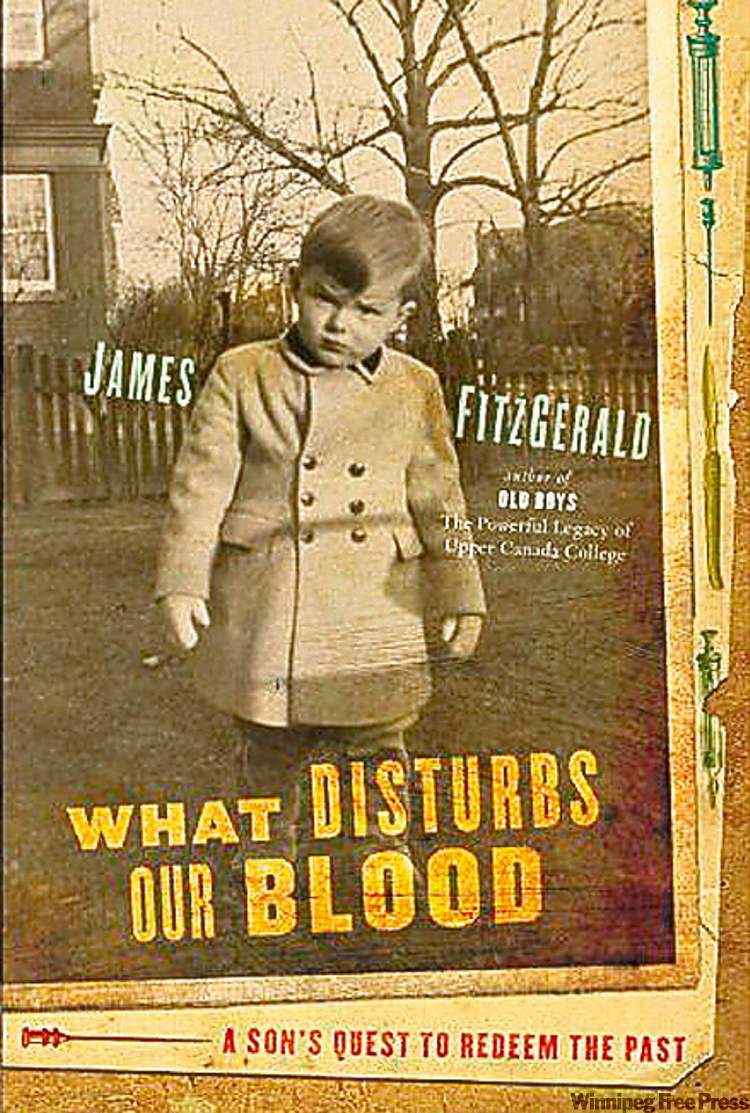
Random House, 482 pages, $35
JOURNALIST James FitzGerald’s father and grandfather were pillars of Canada’s medical establishment.
They developed dramatic new treatments for allergies and mental disorders and promoted the explosive growth of the University of Toronto in the first half of the 20th century.
Yet, because of their suicides — one bloody and dramatic, the other slow and sad — both men are shunned by official history.
That is the argument of What Disturbs Our Blood, a fascinating but maddening family history.
FitzGerald’s first book, Old Boys: The Powerful Legacy of Upper Canada College, revealed the tangled history of abuse over several generations at UCC, the training ground for Canada’s privileged classes, among them the author, his father Jack and grandfather Gerry.
This book is fascinating because of the details it uncovers of the glamorous but troubled lives and the disturbing deaths of Jack, Gerry and other FitzGeralds.
It is maddening because of its digressions into the byways of Freudian and Jungian theorizing and its grandiose linking of FitzGerald family occurrences to world events.
First the good stuff: the author has unearthed a wealth of letters, medical charts and other documents that reveal not only the strain of family madness that he acknowledges, but also the social and medical attitudes on which many of our Canadian values are built.
He employs these details to put himself into the minds of Gerry and Jack, imagining their thoughts and emotions as memorably as Miriam Toews does her father’s in Swing Low, the 2001 memoir that culminates in his suicide.
Among the fruits of FitzGerald’s research is a series of despairing letters in which Gerry, a year before stabbing himself to death, describes himself to a friend as useless. These are interspersed with the emotionless notes of a psychiatrist who was treating him at the time.
Another strength of the book is its skilful use of photos. These include the expected family portraits, many professionally composed. Interestingly, the FitzGerald fathers are often absent here, turning up instead in photos alone or with professional colleagues.
A greater gift to the reader is the range of unexpected pictures: a horse being bled in the development of a diphtheria anti-toxin, a 1919 anti-vaccination rally in Toronto and a page of the regimen of psychiatric drugs with which Jack was treated.
Behind this trove of illuminating detail lies "a Protestant love of facts," which the author proclaims that he and his siblings inherited.
That austere outlook does not prevent FitzGerald from indulging in the occasional passage of gothic writing such as one that features a squalid beast, a ubiquitous Medusa-headed monster and a bottomless source of unresolved grief and pain and guilt.
Problems arise, too, when he asserts that "dreams are a kind of fact," bolstering the claim with citations from his dream diary.
Perhaps they are. But not all readers might be willing to accept the significance he places on some dreams, for example one of a plane crashing into an office tower "almost exactly 10 years" before 9/11.
Such repeated historical approximations are the most annoying aspect of the book. Sigmund Freud, for example, died "exactly one week after" a FitzGerald family wedding.

This obsessive overselling is intrusive and unnecessary. It obscures the book’s thorough research and memorable details.
Sometimes a coincidence is just a coincidence.
Duncan McMonagle teaches journalism at Red River College and writes the Information Tsunami blog at http://duncanmcm.blogspot.com