

Don’t vote? No road for you
Nothing to lose by ignoring Shoal Lake 40's demand for Freedom Road
Advertisement
Read this article for free:
or
Already have an account? Log in here »
To continue reading, please subscribe:

Digital Subscription
One year of digital access for only $205*
- Enjoy unlimited reading on winnipegfreepress.com
- Read the E-Edition, our digital replica newspaper
- Access News Break, our award-winning app
- Play interactive puzzles
*First annual payment billed as $205.00 + GST for one year. This annual subscription will automatically renew at $233.00 + GST every 52 weeks (10% off the regular annual price of $259.35). Offer available to new and qualified returning subscribers only. Cancel any time.
To continue reading, please subscribe:
Add Free Press access to your Brandon Sun subscription for only an additional
$1 for the first 4 weeks*
- Enjoy unlimited reading on winnipegfreepress.com
- Read the E-Edition, our digital replica newspaper
- Access News Break, our award-winning app
- Play interactive puzzles
*Your next Brandon Sun subscription payment will increase by $1.00 and you will be charged $17.95 plus GST for four weeks. After four weeks, your payment will increase to $24.95 plus GST every four weeks.
Read unlimited articles for free today:
or
Already have an account? Log in here »
Hey there, time traveller!
This article was published 10/07/2015 (4097 days ago), so information in it may no longer be current.
OTTAWA — In the last decade, Multiculturalism Minister Jason Kenney has been dispatched to every festival and feast and friendly ethnic forum he could find on a calendar.
He has been the point man on a Conservative effort to micro-target specific ethnic groups and draw their votes into the blue tent.
It worked. In 2011, the Conservatives swept in with a majority government having successfully drawn in many of the South Asian and Chinese voters in Canada’s big cities that used to help deliver seats to the Liberals.
While specific ethnic groups are certainly not uniform in viewpoint or party preference, they are easily targeted with specific promises and easily reached through community events. And they are a large enough force in more than 50 ridings that attracting the majority of those votes can make a party yell “winner, winner, chicken dinner” on election night.
By sheer numbers alone, indigenous Canadians should be a similar target. They are not.
Statistics Canada in 2011 reported there were 1.4 million First Nations people in Canada. By comparison, there were 1.6 million Canadians of South Asian descent and 1.3 million of Chinese descent.
The Assembly of First Nations has identified 51 ridings where there are enough aboriginal voters to make a difference in the outcome of the election and is encouraging people to get involved in this campaign and use their votes.
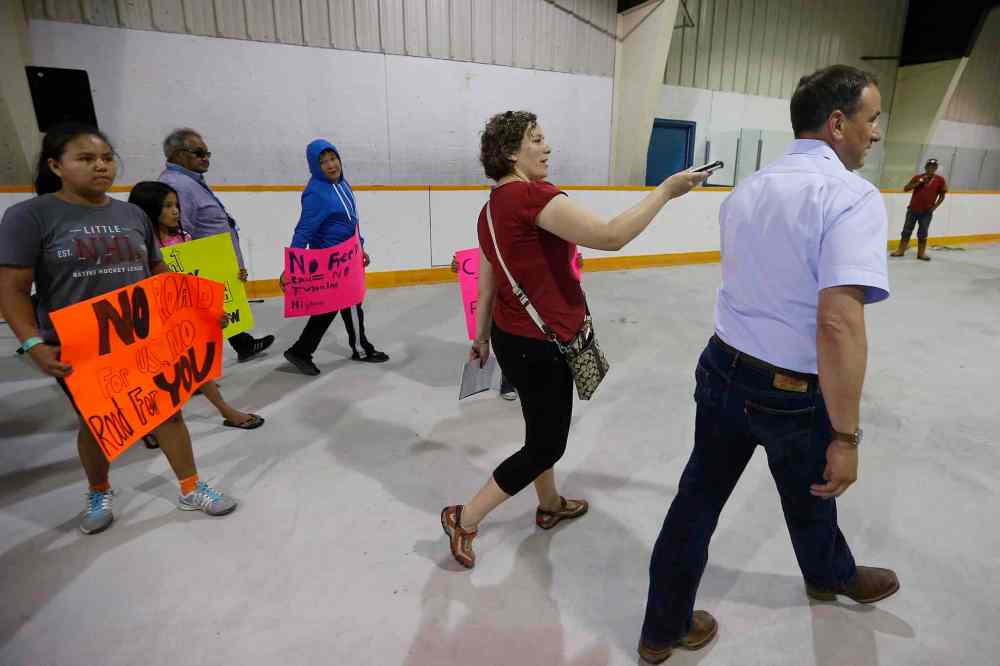
That the Conservatives simply don’t think that will happen has never been more apparent than with the battle to build an all-weather road access onto the Shoal Lake 40 First Nation just east of the Manitoba border.
If there was ever a situation that demonstrated the dichotomy between living standards on and off reserve, it is Shoal Lake 40.
A community of a few hundred people cut off from the mainland a century ago so Winnipeg could get clean drinking water.
A community that can’t drink the water from its own taps because there is no water-treatment plant to clean it.
A community so close to the Trans-Canada Highway it can hear the cars passing as thousands of Winnipeggers head each weekend to their luxury lakefront cottages, yet the community has no all-weather road to get to it.
Six years ago, Prime Minister Stephen Harper went to Kenora to announce his government would join with Ontario to spend $100 million to double the Trans-Canada Highway between the Ontario border and Kenora so those same cottagers can get to their second homes faster. There is still not a dime of federal money on the table to build a road to Shoal Lake 40 so residents there can get to and from their primary homes without boarding a dilapidated ferry or risking their lives on the winter ice.
The community says it would cost about $30 million to give it an all-weather road.
Many think that price tag is too low. But it is still a project which clearly needs to happen.
If this was not a First Nations community, this road would have been built decades ago.
The City of Winnipeg and the province of Manitoba are finally both on board to help. All that’s missing is the federal government.
Had Kenora MP Greg Rickford been in Shoal Lake 40 late last month to announce his government’s commitment to building that road, he could have generated some significant goodwill ahead of the next election.
His colleagues are being dispatched across the country this summer with much smaller announcements to woo voters. But not in Shoal Lake 40.
Instead, he announced $1 million toward an engineering study and dodged questions about whether the government would fund the road itself.
Even in the face of the NDP and Liberals both pledging in recent days to build the road, the Conservative strategy here has not budged.
Rickford and the Conservatives are very aware of two things: First Nations electors are among the least likely in Canada to cast a ballot, and out of those that do, they are also among the least likely to cast a ballot for a Conservative.
More than half the registered electors in the Kenora area — an estimated 25,000 people — are aboriginal, and about one-third of them live on reserves. Only 300 ballots cast on reserves went to Rickford in 2011, still he glided to an easy victory, more than 4,700 votes ahead of his nearest opponent.
He simply did not need their vote to win.

At the same time, tune into to any First Nations story from any media outlet and you will see evidence of an electorate that doesn’t understand indigenous issues and begrudges every dime spent for First Nations’ benefit.
In short, Rickford may have had more to lose by promising to build the road than he did by avoiding the question.
Mia Rabson is the Free Press parliamentary bureau chief.
miarabson@freepress.mb.ca Twitter: @mrabson
Related Articles
Liberals win 4th mandate as NDP vote collapses and Singh announces he will resign





Advertisement Advertise With Us
Advertisement Advertise With Us
History
Updated on Friday, July 10, 2015 6:57 AM CDT: Replaces photo