

Day of Reckoning
The draft is the biggest moment in a CFL prospect's career -- but not so long ago the process was a complete farce

Advertisement
Read this article for free:
or
Already have an account? Log in here »
To continue reading, please subscribe:
Digital Subscription
One year of digital access for only $1.44 a week*
- Enjoy unlimited reading on winnipegfreepress.com
- Read the E-Edition, our digital replica newspaper
- Access News Break, our award-winning app
- Play interactive puzzles
*Billed as $5.77 plus GST every four weeks. After 52 weeks, price increases to the regular rate of $19.95 plus GST every four weeks. Offer available to new and qualified returning subscribers only. Cancel any time.
To continue reading, please subscribe:
Add Free Press access to your Brandon Sun subscription for only an additional
$1 for the first 4 weeks*
- Enjoy unlimited reading on winnipegfreepress.com
- Read the E-Edition, our digital replica newspaper
- Access News Break, our award-winning app
- Play interactive puzzles
*Your next Brandon Sun subscription payment will increase by $1.00 and you will be charged $17.95 plus GST for four weeks. After four weeks, your payment will increase to $24.95 plus GST every four weeks.
Read unlimited articles for free today:
or
Already have an account? Log in here »
Hey there, time traveller!
This article was published 06/05/2016 (3683 days ago), so information in it may no longer be current.
For months leading up to the 2014 CFL Draft, Anthony Coombs was glued to his cellphone. He obsessed over which teams had called and which hadn’t. He tormented himself by scanning social media sites to see what was being said about him and what wasn’t.
“There’s just too many people judging you because that’s their job,” recalled Coombs in a telephone interview earlier this week.
A three-time All-Canadian running back at the University of Manitoba, Coombs, then 21, had done everything possible to prove he was worthy of an early pick: a stellar season the year before, leading the Bisons to the Canada West final, followed by a strong showing in front of scouts and TV cameras at the CFL Combine, where he posted some of the best numbers among backs in his class.
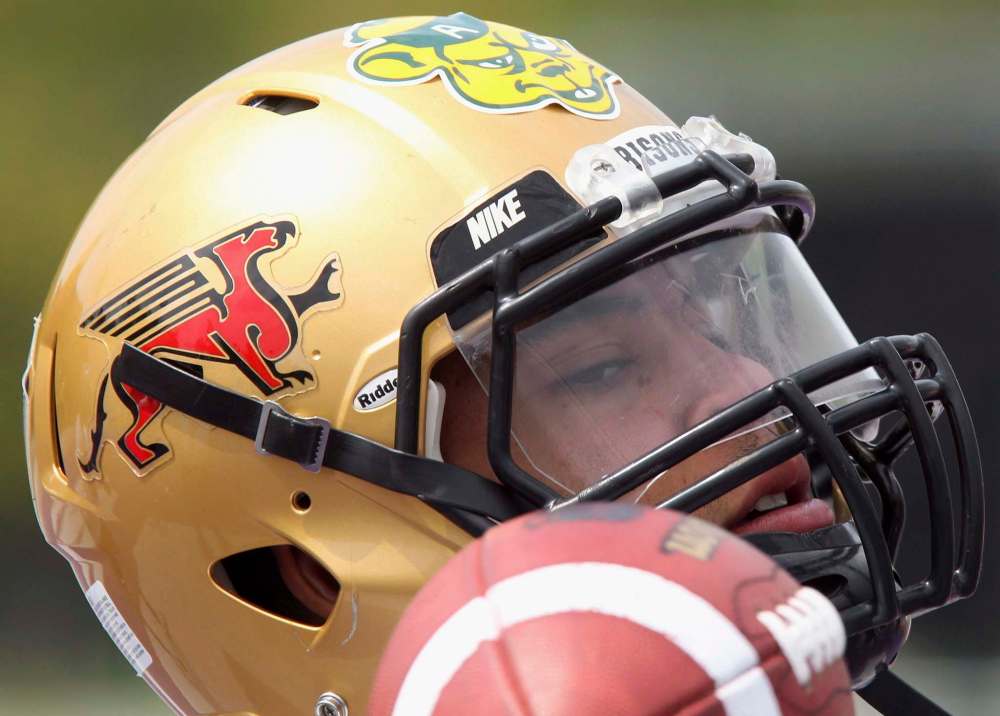
Come draft night, all that was left was that final phone call welcoming him to the CFL. No matter when it came — “Some people had me going in the first round, some as late as the fourth,” he said — it was going to be a dream come true.
When his phone finally did ring, however, Coombs didn’t pick up.
He had heard from all nine CFL teams so many times he had memorized the area codes for each city. When his phone lit up, he knew the call was coming from Toronto, a team that, in his mind, had shown little interest over the past few months, and had conducted an odd interview at the combine.
“They asked some really blunt questions that kind of challenged your manhood,” recalled Coombs.
Confusing matters even more, it was Edmonton, the team that showed the most interest — “Edmonton flat out told me they were looking for a guy exactly like me,” said Coombs — who were on the clock, still deciding what to do with the third overall pick.
So with that in mind, and a small group of family and friends huddled around him at his home in Winnipeg’s west end, Coombs just watched as the call went to voicemail.
With the focus shifted back to the TV screen, it didn’t take long to realize what he had done. He watched on as the league announced Toronto had made a trade with Edmonton for their pick, moving up in the draft to select Coombs with the third overall selection.
The phone rang again. This time he answered. It was general manager Jim Barker, who welcomed Coombs to the Toronto Argonauts.
“Once you hang up your whole family is congratulating you, everyone is texting you, the media is calling you… you’re like, ‘Wow, this is amazing, I can’t believe this happened,’ ” said Coombs, who then joked, “If had any advice for someone going through the draft, it’s don’t ignore any phone calls that day.”
Though sage advice, it really only applies to the modern CFL era, where the draft has developed dramatically since it was first adopted by the league in the early 1950s.
For others, such as Steve Scully, who was chosen as the first-overall pick by the Winnipeg Blue Bombers in the 1975 draft, staying close to the phone wouldn’t have changed anything at all.
A hard-nosed tackle out of Syracuse University, Scully never once had cause for concern over where he would be picked, or by whom. In fact, he didn’t even know he had been selected until someone told him they’d read about it in the newspaper.
“I didn’t even know there was a draft, to be honest,” said Scully, 63, from his hometown of Kitchener, Ont. “We certainly weren’t paying any attention to it.”
There had been no contact — no talks on the phone or in-person interviews from teams showing interest, no combine to impress or scouting reports to gauge — leading to the draft. It would take a visit days later from a Bombers official, who showed up in Syracuse holding a six pack of beer and a contract before Scully knew it was for real.
“He thought I was just going to sign the contract and we’d be done,” said Scully.
Scully told the man he would need to talk to his father first. Together, they decided not to sign the contract, opting instead to train for the 1976 Olympics in Montreal where Scully went as an alternate for the Canadian wrestling team.
It wasn’t until 1978 he finally reported to Winnipeg. He blew out his knee in the first practice, and played just four games that season with the Blue and Gold. The next year he was released during training camp and never played again.
Indeed, the draft has changed dramatically over the years. What was once seen, even to high-ranking league officials, as a running joke has since evolved into today’s nationally televised event.
That’s not to suggest there isn’t work to be done. Unlike the NFL and NHL drafts, events many sports fans in Canada have circled on their calendar months in advance, the CFL Draft remains a relative unknown. Only the first two rounds are televised, with the rest available via webcast online.
It’s been a constant battle for the CFL to improve the draft. In recent years, the league has made some notable steps, including tweaking rules around draft eligibility to accommodate players who have to red-shirt a year down south.
With this year’s draft set for Tuesday night, the league announced earlier this week the addition of an eighth round — a move that should strength numbers for training camp without counting against the cap.
Duane Forde, a TSN football analyst regarded as having one of the most astute football minds in the country, has seen, and helped implement, some of the changes over the years.
A sixth-overall pick by Calgary in 1991, Forde played 12 seasons in the CFL with the Stampeders, Blue Bombers, Hamilton Tiger-Cats and Toronto.
He was drafted at a time the event was hosted in early February, in conjunction with the league’s board of governors meetings. Then, the draft was held live on location at a convention centre in Hamilton, with several players, those expected to be drafted in the first or second round, in attendance.
In somewhat similar fashion to the NFL — though on a much smaller scale — drafted players were greeted by team representatives and posed for a picture wearing the club’s jersey.
As much as Forde would like one day to see it go back to being a live event, with the country’s top prospects in attendance, he understands the struggle the league faces. He also appreciates where the event has come from when he heard his name called.
Most notably, he said, is the kind of focus the draft’s top picks now receive. Saskatchewan, which has the first overall pick Tuesday, flew in half a dozen players this week for one final workout.
“Maybe a coach would ask a couple questions as you were riding an elevator with them in the hotel during the combine,” said Forde. “It’s a completely different world now.”
Though the teams have increased their collective footprint on the draft over the years, recognizing more than ever the value of Canadian talent, Forde credits an increase in media coverage as a main driver of change.
“There’s more scrutiny, more pressure for teams to make the right picks and get it right, to do their due diligence on guys,” he said. “Teams used to get away with mailing it in at the draft, something that is important in terms of charting the course of your team.”
Just how little teams seemingly cared became blatantly clear in the mid-’90s.
When the Las Vegas Posse, a team formed during the league’s short-lived American expansion, closed shop in 1994 after just one season, the Ottawa Rough Riders used a fourth-round pick in the ensuing dispersal draft on Darrell Robertson. Robertson died in a car accident months earlier. The following year, in the 1996 CFL Draft, Montreal selected James Eggink, who had died earlier after a battle with cancer.
Darrell Davis started covering the CFL in the late 1980s. A former reporter with the Regina Leader-Post, he chuckles when recalling just how slowly the flow of information trickled out back then.
“We usually knew who the first guy was, but there were players taken where we had no idea who they were, where they had played,” he said. “If one team would tell the beat writer these are good players, watch for them, they’d feel like they were giving up secrets that no other team in the league had.”
In some ways, that was true. In 1990, Davis recalls Wally Buono, then the Calgary Stampeders GM, choosing an unknown receiver out of the University of Western Ontario named Dave Sapunjis.
“We all kind of looked around and laughed because even all the teams thought, ‘Why would he take Dave Sapunjis?’ ” said Davis. “I guess Wally knew what he was talking about because Sapunjis turned out to be one the greatest receivers in the history of the CFL.”
More often, though, draft strategies backfired, mainly due to poor preparation.

The year before Calgary hit the jackpot, Saskatchewan had failed miserably. Holding three of the first four picks in the 1989 draft, the Roughriders chose two players from Boston University in running back Kevin Smellie and cornerback Andrew Thomas.
“As soon as I phoned, their agent said there’s no way in the world these guys will ever play in Saskatchewan,” said Davis, adding moments like those were what gave the CFL a special charm. “It was like a mom and pop operation all the time.”
Still a fan of the league — Davis co-hosts a radio show called the Green Zone that focuses mainly on the Roughriders — he admits he’s out of suggestions for making the draft better. But he does plan to keep a close eye Tuesday.
“I don’t know how they can do it,” said Davis. “I wish it would become a bigger deal because that’s how the good teams do it. Canadian talent, they’re the glue to building good franchises.”
jeff.hamilton@freepress.mb.ca|twitter: @jeffkhamilton
Jeff Hamilton
Multimedia producer
Jeff Hamilton is a sports and investigative reporter. Jeff joined the Free Press newsroom in April 2015, and has been covering the local sports scene since graduating from Carleton University’s journalism program in 2012. Read more about Jeff.
Every piece of reporting Jeff produces is reviewed by an editing team before it is posted online or published in print — part of the Free Press‘s tradition, since 1872, of producing reliable independent journalism. Read more about Free Press’s history and mandate, and learn how our newsroom operates.
Our newsroom depends on a growing audience of readers to power our journalism. If you are not a paid reader, please consider becoming a subscriber.
Our newsroom depends on its audience of readers to power our journalism. Thank you for your support.
2016 CFL Draft
Who: 72 players in eight rounds
When: Tuesday, 6 p.m. on TSN2 and RDS2
Where: Toronto
Bombers at the Draft: (No first-round pick)
Round 1: Forfeited pick (Garrett Waggoner — 2015 supplemental draft)
Round 2: 9th (via Saskatchewan), 10th
Round 3: 19th
Round 4: 28th
Round 5: 37th
Round 6: 46th
Round 7: 55th
Round 8: 63rd
WINNIPEG’S last 10 FIRST-round picks:
(Year, Name, Position, School, Pick)
2015: Sukh Chungh, OL, Calgary (second overall)
2014: Matthias Goossen, OL, Simon Fraser (second overall)
2013: Andy Mulumba, DE, Eastern Michigan (second overall)
2012: Tyson Pencer, OL, Washington State, (third overall)
2011: Henoc Muamba, LB, St. Francis Xavier (first overall)
2010: None (second overall traded to Sask, traded to Toronto)
2009: None (third overall traded to Hamilton)
2008: Brendon LaBatte, OL, Regina (sixth overall)
2007: None (Traded to Calgary)
2006: None (second overall traded to B.C.)
Jeff Hamilton
Multimedia producer
Jeff Hamilton is a sports and investigative reporter. Jeff joined the Free Press newsroom in April 2015, and has been covering the local sports scene since graduating from Carleton University’s journalism program in 2012. Read more about Jeff.
Every piece of reporting Jeff produces is reviewed by an editing team before it is posted online or published in print — part of the Free Press‘s tradition, since 1872, of producing reliable independent journalism. Read more about Free Press’s history and mandate, and learn how our newsroom operates.
Our newsroom depends on a growing audience of readers to power our journalism. If you are not a paid reader, please consider becoming a subscriber.
Our newsroom depends on its audience of readers to power our journalism. Thank you for your support.
Related Articles
Blue's Waggoner worth the risk
Advertisement Advertise With Us
Advertisement Advertise With Us