

Project shows diagonal parking works

Advertisement
Read this article for free:
or
Already have an account? Log in here »
To continue reading, please subscribe:
Monthly Digital Subscription
$1 per week for 24 weeks*
- Enjoy unlimited reading on winnipegfreepress.com
- Read the E-Edition, our digital replica newspaper
- Access News Break, our award-winning app
- Play interactive puzzles
*Billed as $4.00 plus GST every four weeks. After 24 weeks, price increases to the regular rate of $19.95 plus GST every four weeks. Offer available to new and qualified returning subscribers only. Cancel any time.
Monthly Digital Subscription
$4.99/week*
- Enjoy unlimited reading on winnipegfreepress.com
- Read the E-Edition, our digital replica newspaper
- Access News Break, our award-winning app
- Play interactive puzzles
*Billed as $19.95 plus GST every four weeks. Cancel any time.
To continue reading, please subscribe:
Add Free Press access to your Brandon Sun subscription for only an additional
$1 for the first 4 weeks*
- Enjoy unlimited reading on winnipegfreepress.com
- Read the E-Edition, our digital replica newspaper
- Access News Break, our award-winning app
- Play interactive puzzles
*Your next Brandon Sun subscription payment will increase by $1.00 and you will be charged $17.95 plus GST for four weeks. After four weeks, your payment will increase to $24.95 plus GST every four weeks.
Read unlimited articles for free today:
or
Already have an account? Log in here »
Hey there, time traveller!
This article was published 14/08/2017 (3186 days ago), so information in it may no longer be current.
There’s something counterintuitive about adding cars to a street to make it a better place for pedestrians, but that’s what happened in downtown Winnipeg when an old idea recently became new.
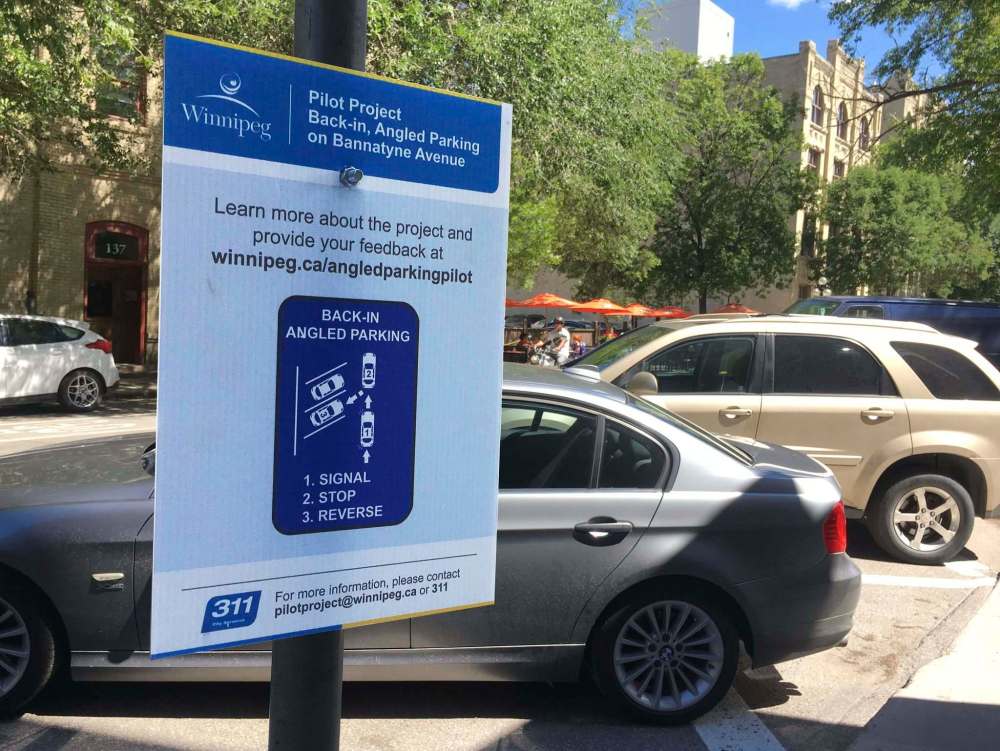
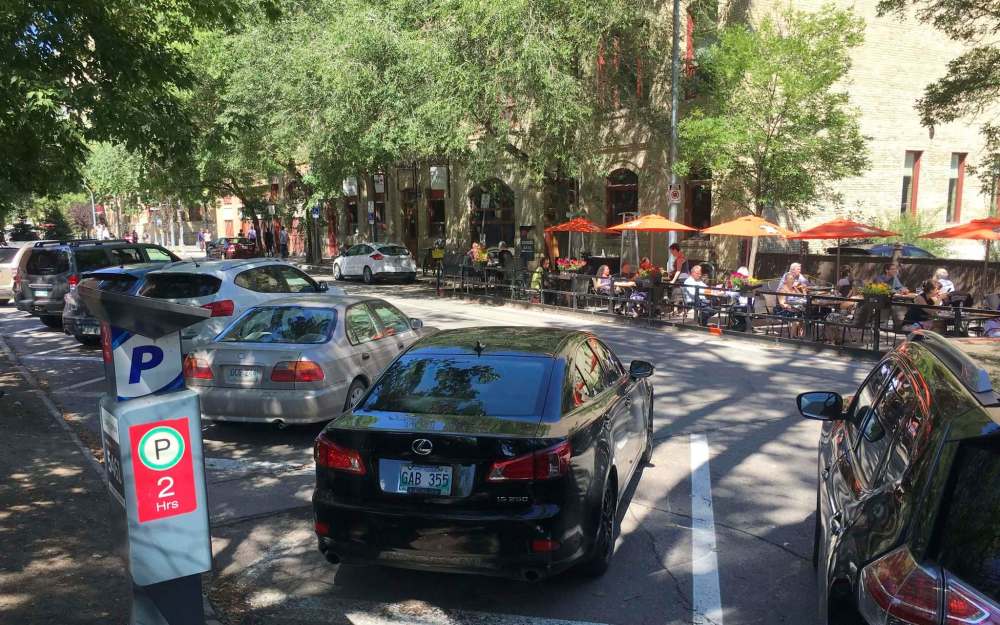
Three weeks ago, the city implemented an eight-month pilot project on Bannatyne Avenue in the Exchange District. Using paint and temporary planters, existing parallel parking was re-oriented into diagonal parking stalls, like something you might see in a small town or on an old photograph. The goal of the project is to increase the amount of on-street parking, something businesses and area residents have been asking for. While 10 new spaces have been created, the new configuration has had a much broader effect. It has changed the way people drive and has transformed the character of the street.
Modern diagonal parking is part of a phenomenon that began in Germany in the 1970s, called “vekehrsberuhigung” — a great word if you are ever playing German Scrabble, but more easily remembered as “traffic calming.” The strategy introduces design elements to a street that intuitively slow traffic and make drivers more aware. The intent is not to cause congestion, but to create urban streets that are safe and comfortable for all users — drivers, cyclists and pedestrians. Traffic calming attempts to match the physical environment with desired traffic speed, instead of relying on signage and police enforcement.
Some important traffic calming measures include eliminating one-way streets, making tighter radius corners, raised plateau crosswalks and, most importantly, narrowing roads and a driver’s field of vision. This last point is part of the success of diagonal parking as a traffic calming tool. When a driver’s field of vision expands, speeds intuitively increase. We instinctively drive faster on Pembina Highway than on Albert Street, regardless of posted limits.
The first morning that cars began angled parking on Bannatyne Avenue, it was striking how much narrower and more intimate the street instantly felt. A day earlier, drivers would routinely travel at speeds far beyond the posted limit on the wide road, but with the street narrowed by parked cars, speeds have been reduced and with new traffic movements introduced, drivers have become more cautious.
Every day, a fascinating real-world study of driver behaviour — and its relation to road width — plays out. In the morning, before cars are parked, speeds are high. In the afternoon, with a reduced field of vision, speeds are lower and the street feels safer and more comfortable for pedestrians, people on restaurant patios, cyclists and even skateboarders. The narrower street has the added effect of allowing pedestrians to cross more easily, with a shorter distance between safe zones.
The parking installation is also an important demonstration of the value of temporary pilot projects as a method of public engagement. With low implementation costs, new ideas such as this can be easily tested and evaluated, shifting public feedback from a hypothetical perception to an observed experience. When the angled parking idea was announced, immediate public reaction was negative, with many people expressing fears that back-in parking would be difficult and dangerous, creating traffic congestion and causing accidents.
The pilot-project strategy allowed trained, professional planners and engineers to study experiences from other cities and carefully design a layout, with reasonably predictable results. The nose-out angled parking configuration is not new, and it could be reasonably assumed that its function here would be similar to that in other cities. By backing in, the parker controls the speed of traffic behind them, while maneuvering into place. Experience has proven that this is much safer than trying to back into the traffic flow when exiting the space. Without experiencing it firsthand, however, people instinctively felt back-in diagonal parking would be dangerous.
In the end, the transition has been reasonably seamless. The manoeuvre is in some ways easier than backing into a parallel parking spot. Drivers have quickly gotten used to it and the street has become a better place for everyone.

The pilot project system also allows unexpected issues to be observed and corrected before they become expensive permanent installations. On Bannatyne, the narrow road is creating a tendency for drivers to crowd the existing painted bike lane, an issue that can be addressed with a proper curb in the final configuration.
Diagonal parking is an example of a new idea that met initial resistance, but has worked as designed, making downtown a better place for everyone. It has created more parking and has helped to develop a street that is safer and more intimate. Expansion of diagonal parking across downtown and the use of pilot projects as a method of implementation could play an important role in creating broader change in the city centre.
Other cities have used pilot projects to explore such ideas as seasonal pedestrian streets, closing vehicle lanes to create public space and the wildly successful implementation of instant downtown bike lane networks in Calgary and Edmonton. Many of the public concerns about diagonal parking were similar to those expressed over the opening of Portage and Main to pedestrians. Temporary pilot projects could be used as a tool to test and observe these new ideas, helping to relieve public concerns over their effects on traffic.
Hopefully, the success of the diagonal parking initiative will inspire its use in areas across downtown and help to establish temporary pilot projects as a valuable tool to ease public resistance to change and bring new, progressive ideas to our city.
Brent Bellamy is chairman of CentreVenture’s board and the creative director at Number Ten Architectural Group.
Brent Bellamy is creative director for Number Ten Architectural Group.
Our newsroom depends on a growing audience of readers to power our journalism. If you are not a paid reader, please consider becoming a subscriber.
Our newsroom depends on its audience of readers to power our journalism. Thank you for your support.
Brent Bellamy is creative director for Number Ten Architectural Group.
Our newsroom depends on a growing audience of readers to power our journalism. If you are not a paid reader, please consider becoming a subscriber.
Our newsroom depends on its audience of readers to power our journalism. Thank you for your support.
Advertisement Advertise With Us
Advertisement Advertise With Us