

Rogue league creating chaos in CJHL
Prairie super league a possibility after AJHL defections to B.C.
Advertisement
Read this article for free:
or
Already have an account? Log in here »
To continue reading, please subscribe:

Digital Subscription
One year of digital access for only $205*
- Enjoy unlimited reading on winnipegfreepress.com
- Read the E-Edition, our digital replica newspaper
- Access News Break, our award-winning app
- Play interactive puzzles
*First annual payment billed as $205.00 + GST for one year. This annual subscription will automatically renew at $233.00 + GST every 52 weeks (10% off the regular annual price of $259.35). Offer available to new and qualified returning subscribers only. Cancel any time.
To continue reading, please subscribe:
Add Free Press access to your Brandon Sun subscription for only an additional
$1 for the first 4 weeks*
- Enjoy unlimited reading on winnipegfreepress.com
- Read the E-Edition, our digital replica newspaper
- Access News Break, our award-winning app
- Play interactive puzzles
*Your next Brandon Sun subscription payment will increase by $1.00 and you will be charged $17.95 plus GST for four weeks. After four weeks, your payment will increase to $24.95 plus GST every four weeks.
Read unlimited articles for free today:
or
Already have an account? Log in here »
Hey there, time traveller!
This article was published 29/01/2024 (988 days ago), so information in it may no longer be current.
There’s a crisis shaking junior A hockey in Canada to its core.
Last summer, the B.C. Hockey League went rogue and announced its independence from Hockey Canada and the national governing body’s rules and regulations. Hockey Canada responded by declaring the BCHL a non-sanctioned league and made its players ineligible to play in national championships or transfer to other leagues in Canada.
Then, earlier this month, news leaked that five wealthy Alberta Junior Hockey League franchises — the Brooks Bandits, Blackfalds Bulldogs, Okotoks Oilers, Sherwood Park Crusaders and Spruce Grove Saints — had decided to pull up stakes and join their B.C. brethren in time for the 2024-25 season.
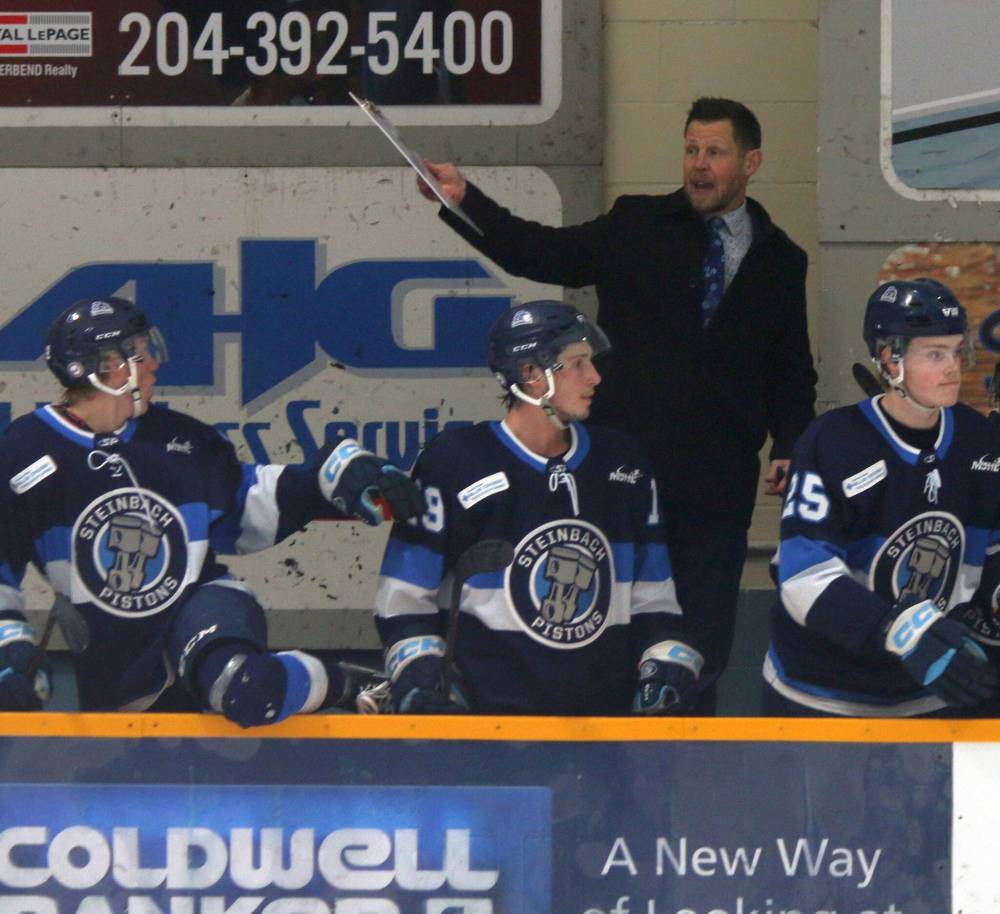
CASSIDY DANKOCHIK / THE CARILLON FILES
The possibilty of losing players to the unsanctioned B.C. hockey league is a concern for coaches such as Steinbach Pistons’ bench boss Paul Dyck.
The AJHL immediately suspended the rebel clubs, throwing the fate of their current season into chaos.
Those seismic shifts in the hockey landscape have left operators of franchises in the MJHL and Saskatchewan Junior Hockey League wondering what the future holds.
Rumblings about the potential creation of a Prairie super league, combining the remaining 11 AJHL clubs with all or some of 13 existing MJHL teams and 12 SJHL franchises, have been gathering steam.
“I think the interest has gone up,” one MJHL general manager said, speaking on the condition of anonymity. “But I think what everyone wants to do now, because of what’s unfolded, is let’s just wait and see how this all plays out with those five teams joining the BCHL. If it looks like it’s successful, well then maybe we need to ramp things up.”
However, there might not be much time for careful deliberation.
“I mean, financially it could be a flop,” said the MJHL GM, referring to the soon-to-be 22-team BCHL. “There’s a lot of travel added, right? I know that they’re not going to be going from Victoria to Brooks to play every other weekend but at some point, I’m sure they’re gonna go from Brooks to Victoria and play a (road) swing and it’s not cheap.”
The rebel AJHL clubs have an edge not available to most junior A franchises.
“Most of them are owned by millionaires and those people have a lot of disposable income that a community owned and operated team would not have,” said SJHL commissioner Kyle McIntyre. “And so I think in addition to some of the restrictions that Hockey Canada has, people with money and resources and people who’ve been successful in business typically don’t accept no for an answer.”
Under one scenario, a potential Prairie super league would operate a three-division format for the purposes of geographic convenience with the AJHL teams combining with teams close to Saskatchewan’s western border in one division, Manitoba teams uniting with SJHL clubs in Flin Flon, Yorkton and Estevan in another division comprising the remaining Saskatchewan clubs.
“I think it’s an insane idea,” said SJHL commissioner Kyle McIntyre. “But having said that, I know this week, (MJHL commissioner) Kevin (Saurette) and I will find some time to discuss what our relationship with the MJHL looks like and maybe talk about ways that we might invite the AJHL, once it stabilises, to be part of that. We’re discussing ways to help one another…
“There’s lots of opportunities, I think, for collaboration,” added McIntyre. “But I don’t think that any league is really in the financial position to expand travel and combine to make a super league. Although if you did and you think about the possibilities — if you took the six strongest teams from Manitoba or Saskatchewan or even Alberta, you would have one heck of a league, that’s for sure.”
As representatives of the MJHL and SJHL gather in Winnipeg Tuesday and Wednesday for their annual joint player showcase at the Seven Oaks Arena, McIntyre and Saurette will be discussing the possibility of some form of interlocking play.
McIntyre acknowledges rules controlling the recruitment of players — the non-sanctioned BCHL can currently poach players for free from anywhere in Canada — are a big issue. There are other key concerns for the nine leagues and 116 teams that currently operate under the umbrella of the Canadian Junior Hockey League.
The feeling is Hockey Canada treats junior A like it does minor hockey. For instance, CJHL clubs do not receive development money from the NHL while major-junior clubs in the WHL, OHL and QMJHL reap healthy fees for every player drafted by an NHL club.
“Leadership from the CJHL has been meeting with Hockey Canada, and is trying to redefine and recreate the partnership that should be junior A hockey,” said McIntyre. “But I think Hockey Canada as an institution — there has been some reluctance to accept and embrace that the hockey landscape is changing, especially the governance and the coexistence with the non-sanctioned world…
“Junior A has never been recognized by Hockey Canada as a pathway for player development,” he added, suggesting it’s been viewed as second class. “We have to step up and show some leadership and some professionalism and we have to demonstrate that we’re capable of taking this thing on. We’re trying to get our house in order and we’re trying to be partners and there’s nothing like a crisis to really accentuate the conversations that have to occur that should have occurred previously.”
The movement of players is a crucial concern for all clubs. Hockey Canada currently restricts 16- and 17-year-old players to junior A clubs in their home province while major-junior players are free to join clubs in other provinces or U.S. states. Adjusting the framework for 16- and 17-year-olds as well as the status of players returning from unsanctioned leagues such as the BCHL needs to be resolved.
“Part of our conversations at the CJHL level is how do we protect the kids that (GM and head coach) Paul Dyck is developing with the Steinbach Pistons?” said McIntyre, offering an example of a strong junior A operation. “How do you keep those kids in your program? How do you keep them interested? Well, you run a heck of a program that develops the whole player, both on and off the ice, and at the centre has to be the player experience. When you have a guy like (Flin Flon GM and head coach) Mike Reagan or Paul Dyck, those guys are developing kids and they’re putting them onto U.S. colleges or Canadian colleges and universities.”

The possibility of further player defections to the unsanctioned BCHL is an ongoing concern.
“Teams leaving are unsanctioned and that’s going to make people nervous for sure because your players are wide open, right?” said Jason Tatarnic, GM and head coach of the SJHL’s Estevan Bruins. “We saw what happened with BCHL and we saw players leave like (Jagjeevan Phangura) to Surrey. He was a very impactful player for us. You’re aware now that you have more teams pursuing that avenue, so does that mean more players are gonna leave? Possibly.”
Tatarnic said there’s another twist coming. The NCAA is expected lift its ban on the eligibility of major-junior (Western Hockey League, Ontario Hockey League, Quebec Major Junior) players sometime in the next few years.
“I think that’s going to happen at some point and when it does, I think it’s important to make sure that the remaining junior A teams have a real good relationship with the Western Hockey League and CHL because I think we might see those top-end young players that opt out of the Western Hockey League now staying,” said Tatarnic. “Now, is every kid going to do that? I don’t know but I think a number of kids would do that because they’ll have an opportunity to get drafted early. And if they don’t, they’ll have options after that.”
mike.sawatzky@freepress.mb.ca