Winnipeg’s transit system has changed. Here’s your survival guide.

Winnipeg Transit's bus network underwent a complete transformation on June 29.

Read this article for free:

or

Already have an account? Log in here »

To continue reading, please subscribe:

Subscribe and receive a limited-edition Free Press branded hat or tote.

Digital Subscription

One year of digital access for only $205*

  • Enjoy unlimited reading on winnipegfreepress.com
  • Read the E-Edition, our digital replica newspaper
  • Access News Break, our award-winning app
  • Play interactive puzzles

*First annual payment billed as $205.00 + GST for one year. This annual subscription will automatically renew at $233.00 + GST every 52 weeks (10% off the regular annual price of $259.35). Offer available to new and qualified returning subscribers only. Cancel any time.

To continue reading, please subscribe:

Add Free Press access to your Brandon Sun subscription for only an additional

$1 for the first 4 weeks*

  • Enjoy unlimited reading on winnipegfreepress.com
  • Read the E-Edition, our digital replica newspaper
  • Access News Break, our award-winning app
  • Play interactive puzzles
Start now

*Your next Brandon Sun subscription payment will increase by $1.00 and you will be charged $17.95 plus GST for four weeks. After four weeks, your payment will increase to $24.95 plus GST every four weeks.

Hey there, time traveller!
This article was published 27/06/2025 (400 days ago), so information in it may no longer be current.

Winnipeg Transit’s bus network underwent a complete transformation on June 29.

The network switched from a hub-and-spoke system — where buses travel between downtown and outlying neighbourhoods — to a spine-and-feeder concept, where frequently serviced spines along major corridors are supported by a network of feeder routes.

As virtually every route in the city has changed, the Free Press has created a survival guide to help you navigate the new system.


Why are routes changing?

City officials say the spine-and-feeder concept allows buses to arrive more frequently, travel more directly and provide an overall more reliable Transit service, in part because most feeder buses don’t have to navigate downtown traffic.

Under the new network, a bus is expected to arrive every five to 15 minutes along each of the most frequent routes during peak periods, while connector route buses would come every 15 to 30 minutes.

More transfers are required and community routes end earlier in the evening.
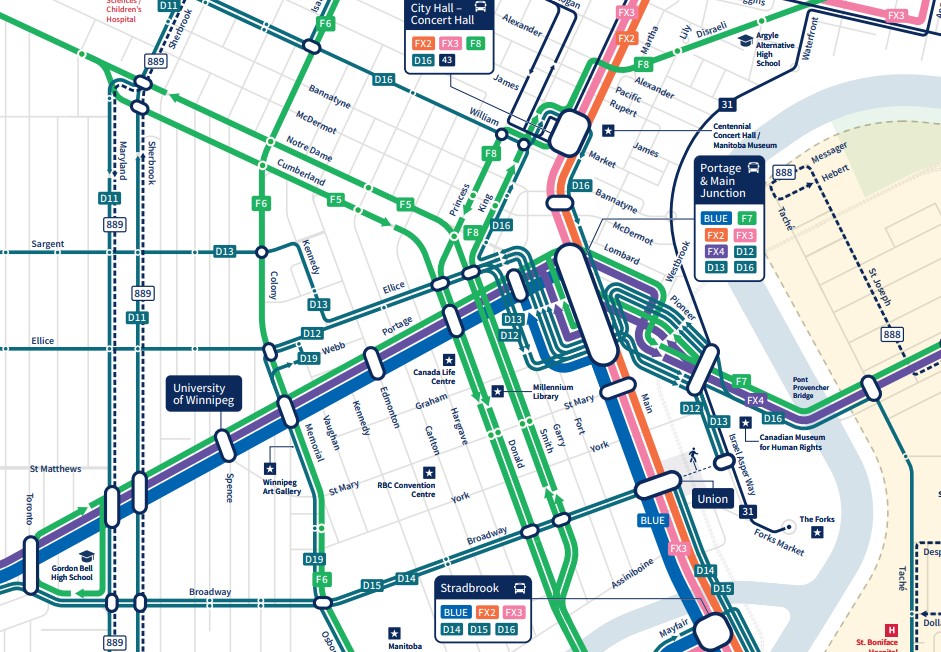
A close-up of the downtown section of the new transit system map.

When will routes change?

Winnipeg Transit launched its new routes on Sunday, June 29.

Seven or eight “travel trainers” and 30 other Transit staff are posted along main routes and stops to help travellers find their way.


Will my bus stop change?

It is possible one of the bus stops you usually use has been moved, replaced or removed.

Under the new system, the total number of bus stops will be reduced to 4,000 from 5,200.

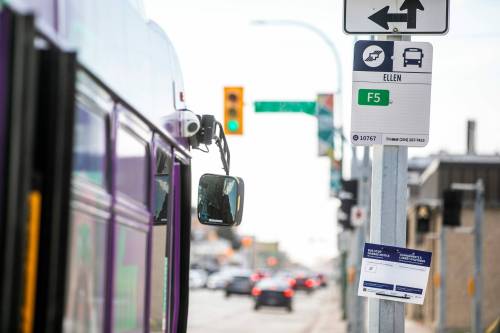
Over the last few weeks, signage has appeared showing new route information at existing stops, and providing information on stops that are being removed or moved.
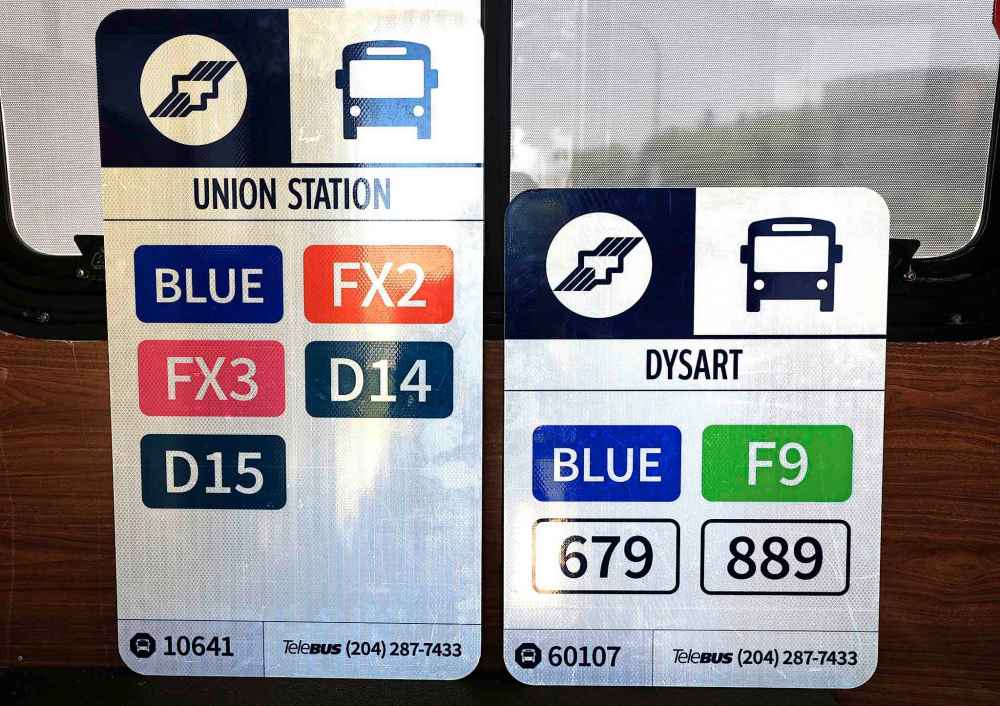
Every bus stop sign in the city has changed, and the number and location of stops has also changed. (Ruth Bonneville / Free Press)

How do I get where I need to go?

Bus riders can plan routes they’ll need to take in the new network using Transit’s trip-planning website, Navigo.

Navigo lets you choose your starting point, your destination, and the time you wish to leave or arrive by. The site will generate a selection travel plans.

Using Navigo, riders can enter their starting point, destination and time of arrival/departure and review possible routes.

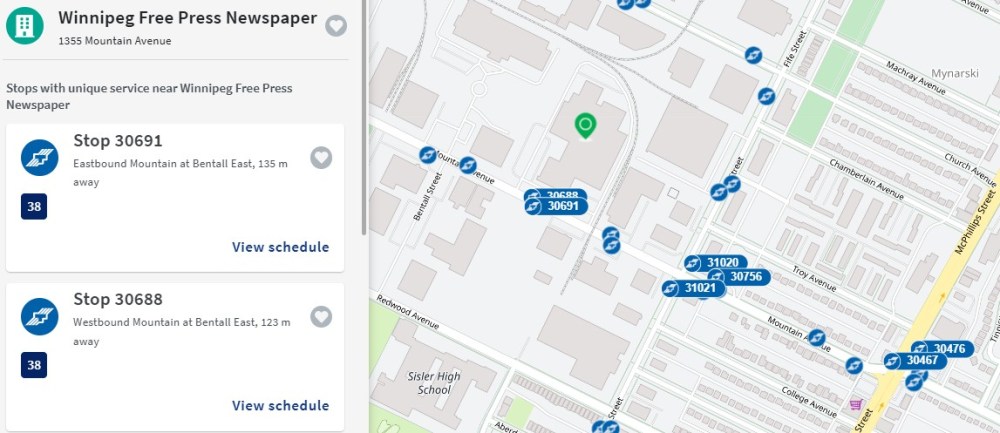
The Navigo website can also help you locate stops and their respective schedules and specific routes.

Winnipeg Transit’s website also offers:

Navigo also allows users to search for stops and routes near an address or landmark.

Riders can also use the Winnipeg Transit app or the Transit app. Winnipeg Transit has partnered with the Transit app for one year. The Transit app uses a different algorithm for planning trips and may suggest different routes than Navigo.

Both apps allow users to plan an immediate or future trip.

The Winnipeg Transit app also lets you find stops and schedules, explore routes and “go live” using an “On the Go” feature to follow the route you are riding on.

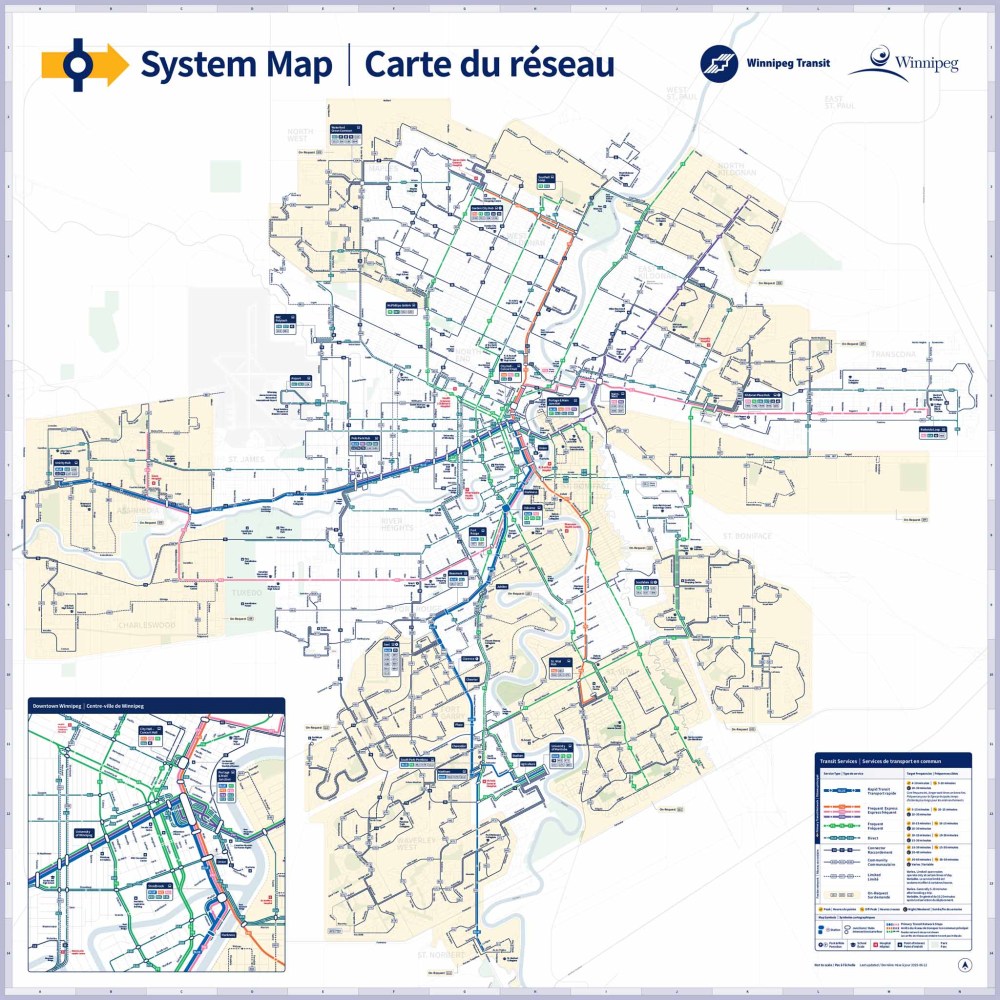
Printed route maps are also available at Transit customer service centres. Riders can also call 311 for assistance.

System maps are available online and at Winnipeg Transit customer service centres. (Ruth Bonneville / Free Press)

What this about “on-request” transit?

The new transit network has expanded the on-request system to 12 zones in the city (areas shaded in yellow on the system map):

  • Charleswood
  • Meadows North
  • North East
  • North West
  • Riverview/Fort Garry
  • Sage Creek/Windsor Park
  • St. Boniface
  • St. Boniface Industrial Park
  • South St. Vital
  • Waverley West
  • Westwood/Murray Park
  • Whyte Ridge/West Fort Garry

In these areas, when feeder bus routes are not in service, would-be ridersmust hail a bus using the on-request system.

The schedule of on-request hours of operation for each zone is available on the city’s website; generally speaking on-request operates on evenings and weekends.

Rides can be booked using the Winnipeg Transit+ On-Request app (Here for Apple devices, here for Android), or booked on the city’s website, or by calling 311 and following teh prompts for booking on-request transit.

After requesting a ride, passengers receive directions on where to meet the bus, which may be an existing bus stop or an unmarked “virtual stop.”

Winnipeg Transit expects wait times to be between 10 and 20 minutes for on-request rides. If you use the Winnipeg Transit+ On-Request app, you can track your bus in real time.

What if I have a problem?

If want to report an issue or request an enhancement to a bus stop, you can complete this form on the City of Winnipeg’s website.

History

Updated on Monday, June 30, 2025 6:25 PM CDT: Updates tense, adds section on on-request rides.
Report Error Submit a Tip

More Stories

Culture minister’s pledge sends officials on hunt for money to fix Islamic centre after apparent hate crime

Carol Sanders 5 minute read Preview

Culture minister’s pledge sends officials on hunt for money to fix Islamic centre after apparent hate crime

Carol Sanders 5 minute read Yesterday at 7:07 PM CDT

Government officials were left scrambling Friday to explain why the province is paying for repairs at a mosque recently targeted in a potential hate crime after a $1 million security enhancement fund was fully allocated in June.

Read
Yesterday at 7:07 PM CDT

Rollins becomes fifth councillor to bow out of fall election

Malak Abas 5 minute read Preview

Rollins becomes fifth councillor to bow out of fall election

Malak Abas 5 minute read Updated: Yesterday at 5:24 PM CDT

Sherri Rollins says she’s withdrawing her bid to keep her city hall seat after eight years, citing her concerns about the “gradual erosion of the role played by council” and the struggle to work co-operatively with the mayor’s office.

Read
Updated: Yesterday at 5:24 PM CDT

As wildfire season rages, new book explores the frontlines of battling Canadian blazes

Reviewed by GC Cabana-Coldwell 4 minute read Preview

As wildfire season rages, new book explores the frontlines of battling Canadian blazes

Reviewed by GC Cabana-Coldwell 4 minute read 2:02 AM CDT

Mother Nature’s talking but we haven’t been listening, according to Jesse Winter, author of Wild Fire: Dispatches from a Country Ablaze, a book, released earlier this summer detailing Canada’s wildfire woes.

Currently, almost 1,000 wildfires across Northwestern Ontario, British Columbia, the Prairies, Northwest Territories and eastern provinces are burning in Canada. Forest fires also continue to wreak havoc in France, Spain and other European countries, and in the U.S. states of Oregon, California, Florida and Texas. While 2023 still rates as the world’s worst wildfire season, 2026 is hot on its heels.

Winter, a Vancouver-based, award-winning climate disaster photojournalist, spent more than two years on Wild Fire, his first book. In-depth research included working with firefighting crews and environmentalists as well as talking to researchers, politicians and evacuees. He says we need to rethink our views on wildfires or be prepared to watch more land go up in flames.

Canada, Winter writes, is “a country almost perfectly designed to burn.” At least 70 per cent of boreal forests, which cover one-third of the country, are stuffed with highly flammable spruce, fir, pine and tamarack trees as well as aspen, poplar and birch. With a wealth of available fuel, it’s no surprise, he writes, that an area twice the size of Vancouver Island burns every summer in Canada.

Read
2:02 AM CDT

Kreviazuk, in her own voice

Eva Wasney 7 minute read Preview

Kreviazuk, in her own voice

Eva Wasney 7 minute read Yesterday at 4:00 PM CDT

Chantal Kreviazuk is in the midst of a very busy year.

In May, the Winnipeg-born singer-songwriter released her 11th studio album, In My Own Voice — a project that reclaims and reimagines a selection of hit songs she’s written for some of the world’s biggest artists.

The 12-track album features Kreviazuk performing ethereal covers of Pitbull’s Feel This Moment, Drake’s Over My Dead Body and Gwen Stefani’s Rich Girl, among others.

But she didn’t stop there.

Read
Yesterday at 4:00 PM CDT

Crop storage headaches loom on horizon

Laura Rance-Unger 5 minute read Preview

Crop storage headaches loom on horizon

Laura Rance-Unger 5 minute read 2:01 AM CDT

A sense of calm descends over Prairie fields this time of year — at least on the surface.

Activities become more limited in the weeks leading up to harvest. There’s not much farmers can do now to support this year’s crop, other than monitor and protect it from diseases such as sclerotinia in canola and leaf stripe and fusarium head blight in wheat and barley.

July is when you might see farmers wading into a thick stand of canola, conducting a so-called “wet pants test” to get a low-tech read on how much disease-inducing moisture is lurking in the canopy.

Disease pressure is high in a humid, hot summer like this one and it’s kept aerial applicators busy applying fungicides. Sclerotinia spores live on plant residues in the soil and blossom into a mould that destroys the canola stem, starving the maturing pods.

Read
2:01 AM CDT

Downtown Keg closes… to reopen nearby

Free Press staff 2 minute read Preview

Downtown Keg closes… to reopen nearby

Free Press staff 2 minute read Yesterday at 7:28 PM CDT

Downtown Winnipeg is without a Keg restaurant — for a couple of months, anyways.

The Keg Steakhouse and Bar vacated 115 Garry St. on Wednesday, after more than five decades at the location. It will open in a new Donald Street apartment tower this fall.

Its move comes after years of waiting. The DSM, at 185 Donald St., sat as a partially started apartment block after its developer stopped operating and sought creditor protection in April 2023. The developer began the project in 2019.

Carrington Real Estate took over in 2024. Part of the 14-storey site’s initial plans — pre-Carrington — was for the Keg to occupy the main floor.

Read
Yesterday at 7:28 PM CDT