

Newcomer school to close amid immigration clampdown

Advertisement
Read this article for free:
or
Already have an account? Log in here »
To continue reading, please subscribe:

Digital Subscription
One year of digital access for only $205*
- Enjoy unlimited reading on winnipegfreepress.com
- Read the E-Edition, our digital replica newspaper
- Access News Break, our award-winning app
- Play interactive puzzles
*First annual payment billed as $205.00 + GST for one year. This annual subscription will automatically renew at $233.00 + GST every 52 weeks (10% off the regular annual price of $259.35). Offer available to new and qualified returning subscribers only. Cancel any time.
To continue reading, please subscribe:
Add Free Press access to your Brandon Sun subscription for only an additional
$1 for the first 4 weeks*
- Enjoy unlimited reading on winnipegfreepress.com
- Read the E-Edition, our digital replica newspaper
- Access News Break, our award-winning app
- Play interactive puzzles
*Your next Brandon Sun subscription payment will increase by $1.00 and you will be charged $17.95 plus GST for four weeks. After four weeks, your payment will increase to $24.95 plus GST every four weeks.
Read unlimited articles for free today:
or
Already have an account? Log in here »
Hey there, time traveller!
This article was published 09/03/2026 (216 days ago), so information in it may no longer be current.
English-language teachers are warning the consequences will be far-reaching when a school for newcomers — called “a beacon of hope”— closes its doors.
Winnipeg’s Enhanced English Skills for Employment is shutting down March 31.
“It’s sad for the students. It’s sad for the teachers, but it’s also sad for the community, Manitoba at large,” said Allyn Franc, a longtime teacher at the school that rents space on the Canadian Mennonite University campus at 500 Shaftesbury Blvd.
MAGGIE MACINTOSH / FREE PRESS Winnipeg’s Enhanced English Skills for Employment is closing its doors at the end of the month after losing the bulk of its funding.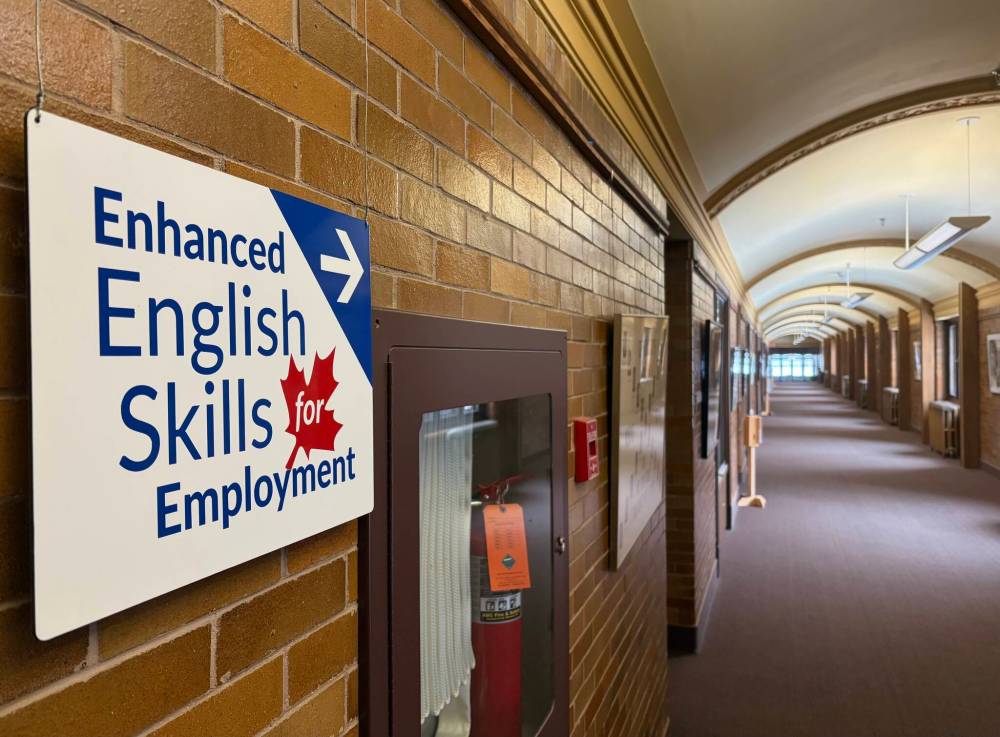
For more than 20 years, the school has been running free intermediate-level language classes on literacy and workplace etiquette.
Its 10-week courses, which served about 800 students during a typical year, were designed with input from employers.
They were targeted at immigrants who needed to improve their English to obtain Canadian credentials to resume a professional career, be it in law, medicine or otherwise.
Executive director Louise Giesbrecht said the small school’s operations have become unsustainable due to unpredictable funding.
The loss of multi-year funding and uncertainty surrounding competitive provincial grants has made it impossible to plan, she said.
The shutdown, the latest in a sector grappling with changes to how settlement services are funded, reflects a shift in national immigration policy.
“You don’t open your door and invite people in, and then not show them to the table,” Giesbrecht said. “But that’s what’s happened.”
Ottawa will stop funding all intermediate and advanced language classes — also known as Canadian Language Benchmark Level 5 to 8 or Stage 2 programs — for permanent residents by the fall.
A spokesperson for Immigration, Refugees and Citizenship Canada said the department is focusing on basic Level 1 training to assist “the most recent newcomers with the highest level of need.”
“You don’t open your door and invite people in, and then not show them to the table… But that’s what’s happened.”
“IRCC is making adjustments to settlement service funding to help keep the program sustainable over the long term, while continuing to protect services for those who need them most, including new arrivals, refugees and francophone communities,” they said in an email.
Red River College Polytechnic plans to continue operating its Centre for Newcomer Integration, which also provides free specialized language classes that prepare clients for employment and post-secondary education, but training will be scaled back significantly due to funding cuts.
The unit will go from teaching about 6,700 students annually to 1,300.
Seid Ahmed of the Manitoba Association of Newcomer Serving Organizations called the path for internationally educated professionals “really dark.”
Ahmed said there will be many missed opportunities for professional advancement, community connection and civic participation.
Newcomers and employers will both suffer, he said, adding that “survival English” is far from what’s required to obtain credential licensure, which is required for newcomers to legally work in some professions.
We did what we had to do to keep our doors open. It’s just not sustainable.”
“Businesses aren’t aware of how much more responsibility they will have to take on because their employees have been supplementing and growing in their English because of programs they’re taking on evenings or weekends,” said Trevor Pfahl, president of Teaching English as a Second Language Manitoba.
Pfahl said it’s going to take more time for newcomers to become proficient in English, so they will rely on social services and be stuck in lower-income jobs longer.
The size of his professional organization, which represented approximately 400 teachers several years ago, has shrunk in half. Pfahl anticipates there will be dozens more job losses in the coming months.
Many of the consequences of these funding cuts, however, won’t be immediate or obvious, he said.
“That place was a beacon of hope,” he said about Giesbrecht’s school, which employs about a dozen people.
The school learned in late 2024 that its agreement with the federal government, worth $643,000 a year, wouldn’t be renewed after March 31, 2025.
RRC Polytech’s agreement ends at the end of this month.
The announcement prompted panic and a temporary closure last spring as Giesbrecht scrambled to find alternative funding sources.
There was no shortage of demand; at the time, about 400 people were on its wait list.
Classes have continued over the last year, albeit far fewer than in years past, with $420,000 in provincial grants.
MAGGIE MACINTOSH / FREE PRESS Chinese newcomers Arya Wang (left) and Lu Dong (right) are among the final students who will graduate from Enhanced English Skills for Employment before it closes on March 31.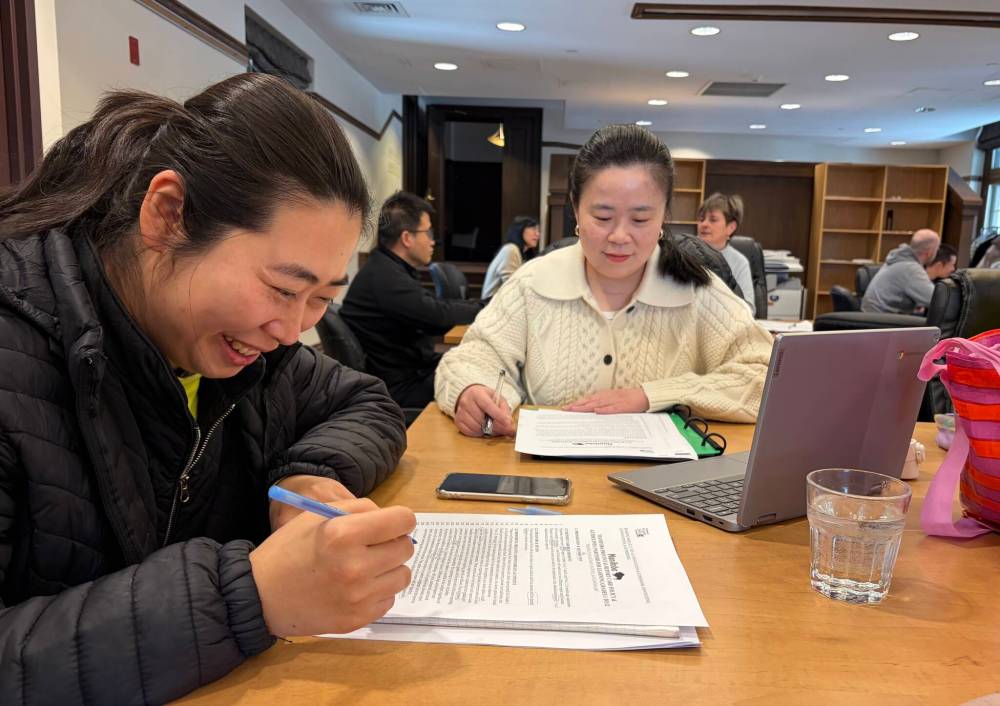
Giesbrecht also secured $45,000 via the Winnipeg Foundation to continue teaching permanent residents, as well as provincially funded work- and study-permit holders and other temporary residents.
“We cut down our classes. We cut down our hours, each of us. Even though we’re working more, we’re paying ourselves less. We did what we had to do to keep our doors open. It’s just not sustainable,” Giesbrecht said, sitting in her barren-walled office on a recent weekday.
The executive director and her colleagues have started giving away resources and taking down posters in recent weeks.
“I feel like I won the lottery,” Arya Wang said about having the opportunity to attend the school before it closes.
“Coming to a foreign country is a lot of stress, stressful. This kind of class provide us opportunities to learn the language and the culture and build our confidence.”
Wang moved to Canada from China with her two daughters in 2023 on a work permit.
One of the key things she has learned is to be aware of Canadians’ tendency to give “sandwich feedback,” she said.
“It was very short-sighted of the federal government to knee-cap newcomers in this way.”
For instance, managers often give an employee compliments between inserting comments about what they need to improve, Wang said.
The school was unique in that it didn’t group literacy lessons together like other English-language schools. Each of its courses focused on a different skill, including speaking, listening, reading, pronunciation and presentation.
Manitoba Immigration Minister Malaya Marcelino said it was “very well run” and boasted impressive outcomes.
That’s why the province provided about $880,000 in funding between 2023-24 and 2025-26, Marcelino said.
“We need more supports, not less supports,” she said about recent changes to Level 2 language funding. “It was very short-sighted of the federal government to knee-cap newcomers in this way.”
The minister suggested the province has been doing its part to support integration, citing the fact the NDP has doubled funding for settlement services since 2023.
As far as Franc is concerned, it’s just as important for newcomers to learn about grammar as it is to study how to be polite, professional and politically correct in-person and via email.
“It’s not just about teaching culture. It’s also about preserving Canadian culture. A lot of people don’t realize how much culture we have,” she said.
Culture is about far more than popular foods and clothing styles, Franc said, noting that it encompasses small talk and “softeners” — for example, “may I” versus “I want” — in Canada.
Knowing these nuances can make the difference when it comes to landing a job or promotion, she said.
maggie.macintosh@freepress.mb.ca
Maggie Macintosh
Education reporter
Maggie Macintosh reports on education for the Free Press. Originally from Hamilton, Ont., she first reported for the Free Press in 2017. Read more about Maggie.
Funding for the Free Press education reporter comes from the Government of Canada through the Local Journalism Initiative.
Every piece of reporting Maggie produces is reviewed by an editing team before it is posted online or published in print — part of the Free Press‘s tradition, since 1872, of producing reliable independent journalism. Read more about Free Press’s history and mandate, and learn how our newsroom operates.
Our newsroom depends on a growing audience of readers to power our journalism. If you are not a paid reader, please consider becoming a subscriber.
Our newsroom depends on its audience of readers to power our journalism. Thank you for your support.
Maggie Macintosh
Education reporter
Maggie Macintosh reports on education for the Free Press. Originally from Hamilton, Ont., she first reported for the Free Press in 2017. Read more about Maggie.
Funding for the Free Press education reporter comes from the Government of Canada through the Local Journalism Initiative.
Every piece of reporting Maggie produces is reviewed by an editing team before it is posted online or published in print — part of the Free Press‘s tradition, since 1872, of producing reliable independent journalism. Read more about Free Press’s history and mandate, and learn how our newsroom operates.
Our newsroom depends on a growing audience of readers to power our journalism. If you are not a paid reader, please consider becoming a subscriber.
Our newsroom depends on its audience of readers to power our journalism. Thank you for your support.
Related Articles
MITT to close, administration blames crackdown on international students




Advertisement Advertise With Us
Advertisement Advertise With Us
History
Updated on Monday, March 9, 2026 7:07 AM CDT: Changes headline