

Playing with fire
Award-winning metalhead makes a living out of the lost art of blacksmithing

Advertisement
Read this article for free:
or
Already have an account? Log in here »
To continue reading, please subscribe:
Monthly Digital Subscription
$1 per week for 24 weeks*
- Enjoy unlimited reading on winnipegfreepress.com
- Read the E-Edition, our digital replica newspaper
- Access News Break, our award-winning app
- Play interactive puzzles
*Billed as $4.00 plus GST every four weeks. After 24 weeks, price increases to the regular rate of $19.95 plus GST every four weeks. Offer available to new and qualified returning subscribers only. Cancel any time.
Monthly Digital Subscription
$4.99/week*
- Enjoy unlimited reading on winnipegfreepress.com
- Read the E-Edition, our digital replica newspaper
- Access News Break, our award-winning app
- Play interactive puzzles
*Billed as $19.95 plus GST every four weeks. Cancel any time.
To continue reading, please subscribe:
Add Free Press access to your Brandon Sun subscription for only an additional
$1 for the first 4 weeks*
*Your next subscription payment will increase by $1.00 and you will be charged $16.99 plus GST for four weeks. After four weeks, your payment will increase to $23.99 plus GST every four weeks.
Read unlimited articles for free today:
or
Already have an account? Log in here »
Hey there, time traveller!
This article was published 18/02/2017 (3307 days ago), so information in it may no longer be current.
At some point during the Festival du Voyageur, a visitor will approach Matt Jenkins, an award-winning blacksmith whose deftness with a hammer and tongs will be on full display at Fort Gibraltar for the length of the 10-day winter fête, and ask how long it took him to fashion a particular bracket or hinge, affixed to the wall behind him.
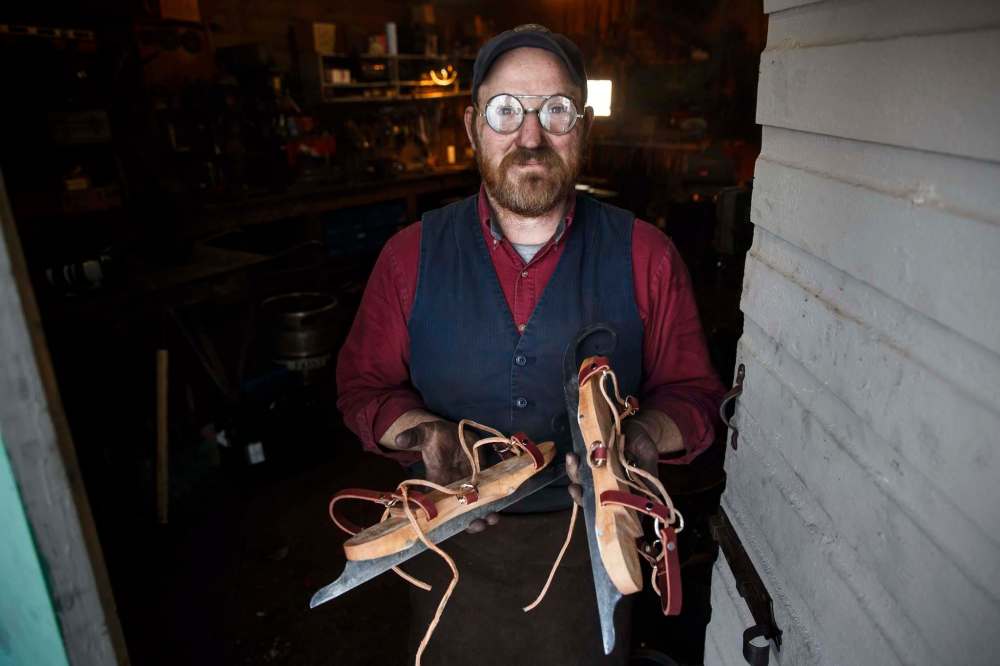
As he’s done in the past when he’s fielded similar queries at events such as Nuit Blanche and the Winnipeg Folk Festival, the barrel-chested 40-year-old, who, with his whiskers and round, Edwardian specs, looks like he just stepped out of an issue of the Saturday Evening Post, circa 1890, will lay down his implements, turn towards his inquisitor and respond, with a twinkle in his eye, “Over 20 years.”
“I get that question a lot and as soon as people hear what’s become my stock answer, they give me a puzzled look, as if to say, ‘Huh?’” says Jenkins, the founder of Cloverdale Forge, an old-world blacksmith shop situated on a generous parcel of land bordering Cloverdale Road in the RM of St. Andrews that has been in his family for four generations.
“It never fails, though; after I go into a bit more detail, explaining how I took up blacksmithing in my late teens, and how I continue to learn something new every time I step into the forge and pick up a hot piece of metal, they go, ‘Ah, now I get it.’”
• • •
In May 1976, the month Jenkins was born, his father Tom decided he’d had enough of life as a travelling salesman specializing in agricultural machinery. The married father of three visited a job bank to see if there were any postings that would keep him closer to home — home being a picture-perfect log dwelling he and his wife Pam built from scratch on his grandfather’s property, in the early 1970s.
The first advert that caught his attention was for a blacksmith at nearby Lower Fort Garry.
He applied for the position and was beside himself when, a few weeks later, a Parks Canada official got in touch to arrange an interview. Just one problem: Despite the fact there was a forge steps away from his front porch, it hadn’t been operational in years, which meant the next piece of wrought iron he struck with a ball-peen hammer would also be his first.
“The guy Dad met with was like, ‘So you’ve made lots of things?’” Jenkins says, seated in the kitchen of his mother’s two-story abode (his father died in 2004), which also functions as a year-round bed-and-breakfast. “Dad was like, ‘Oh, yeah, tons and tons,’ without admitting the only things he’d ever used an anvil for was to straighten nails and squish wood ticks.
“Anyways, to make a long story short, after basically BS-ing his way through the rest of the interview, he got the job, which meant — surprise — he had to learn how to blacksmith.”
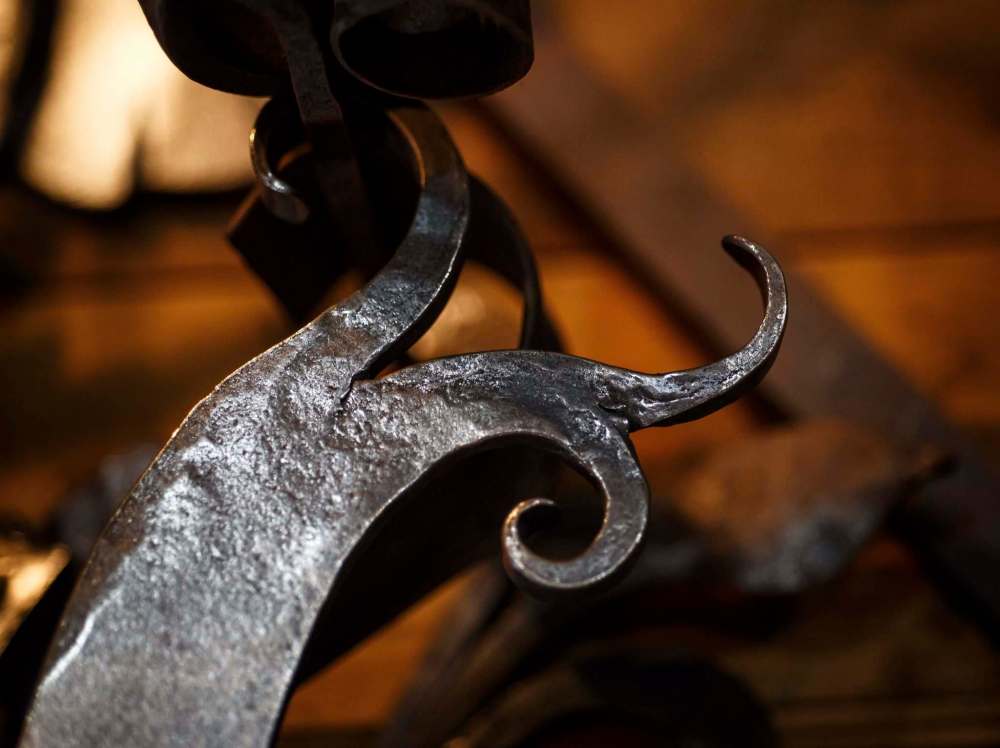
Fast-forward to June 1995; Matt Jenkins, by then an engineering student at McGill University in Montreal, was home for the summer, eager to find a job that would pad his dwindling bank account. Taking a page out of his dad’s book, he applied for a vacant blacksmith position at Lower Fort Garry, despite having as much experience in that trade as his father had when he got his start at the national historic site 19 years earlier.
“Maybe because they knew my dad, or maybe because it sounded like I knew what I was talking about, they ended up hiring me, too,” Jenkins says, taking a second to boast he was the first student at Lockport School to score a perfect, 100 per cent score on a Grade 7, name-that-tool quiz.
“I worked there for the next four summers and the funnest part was learning all these old ways of doing things, then going back to university to take materials science classes and be like, ‘Wait, you guys are applying the same principles I learned qualitatively, and you’re quantifying them.’”
Jenkins graduated from McGill in 2000. Instead of entering the labour force right away, he decided to “take a bit of a break.” He enrolled in a couple of blacksmithing courses at the John C. Campbell Folk School — a 92-year-old academy located on the outskirts of Brasstown, N.C. that teaches a variety of traditional arts, such as quilting, soap-making and woodcarving. He eventually caught on with an engineering firm in Atlanta but every summer, as soon as it was time to take his vacation, he hopped in his car and headed back to North Carolina to sharpen his skills.
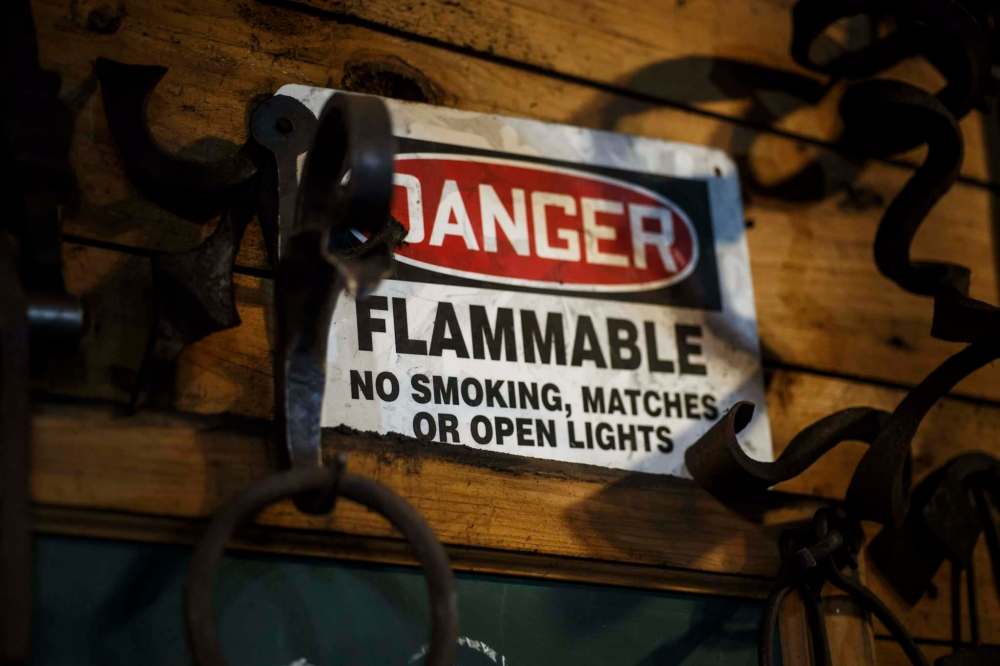
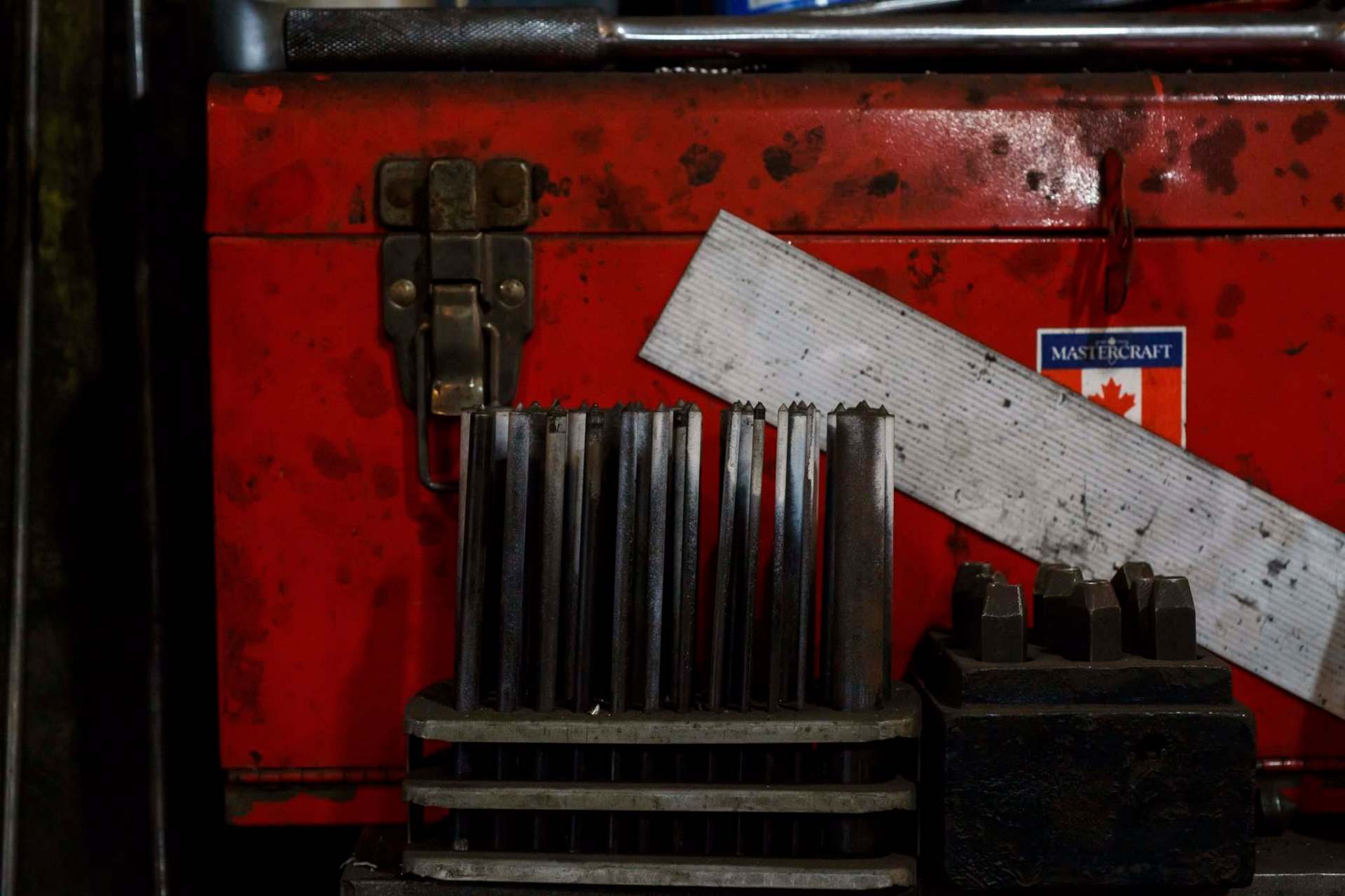
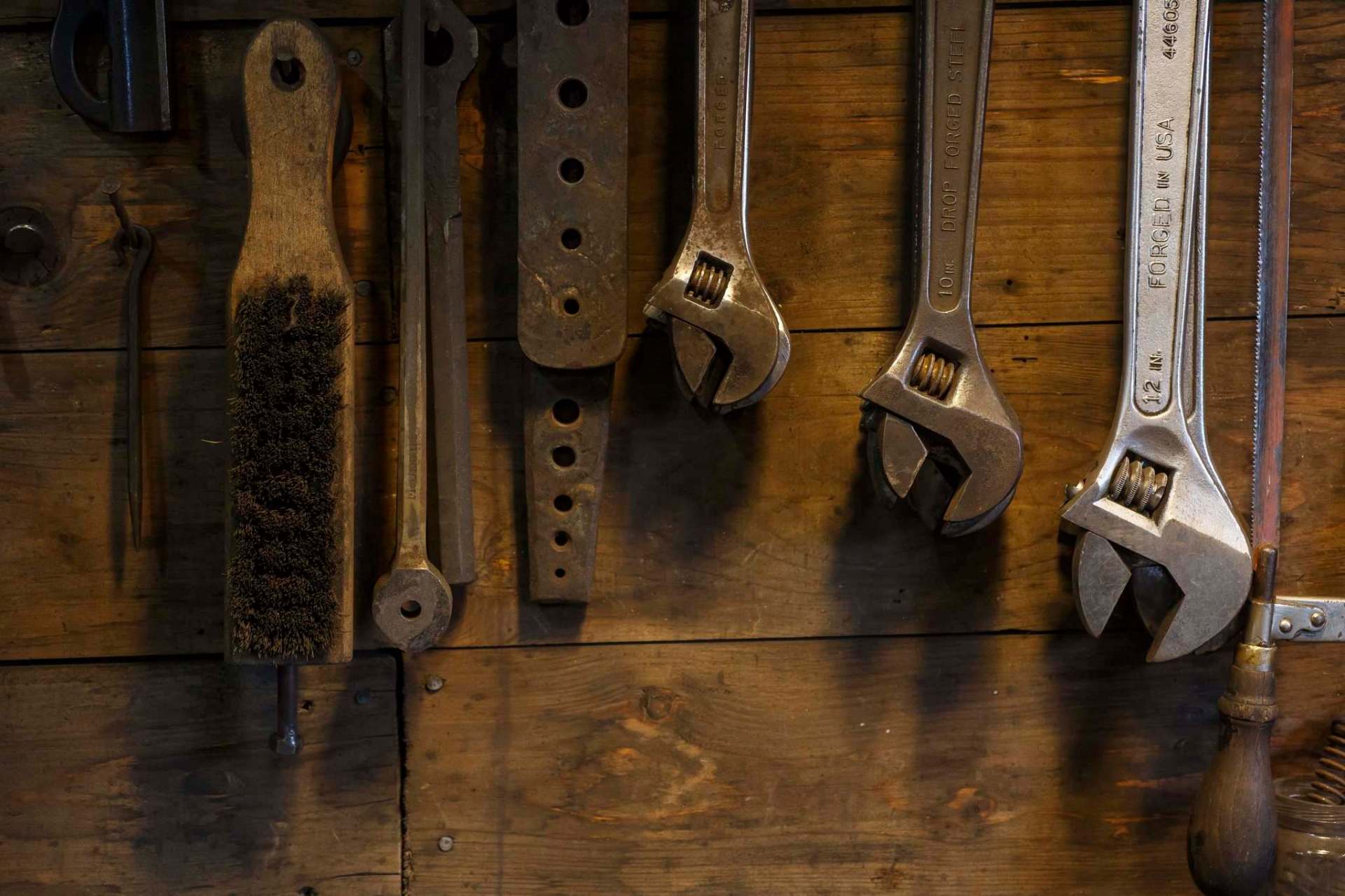
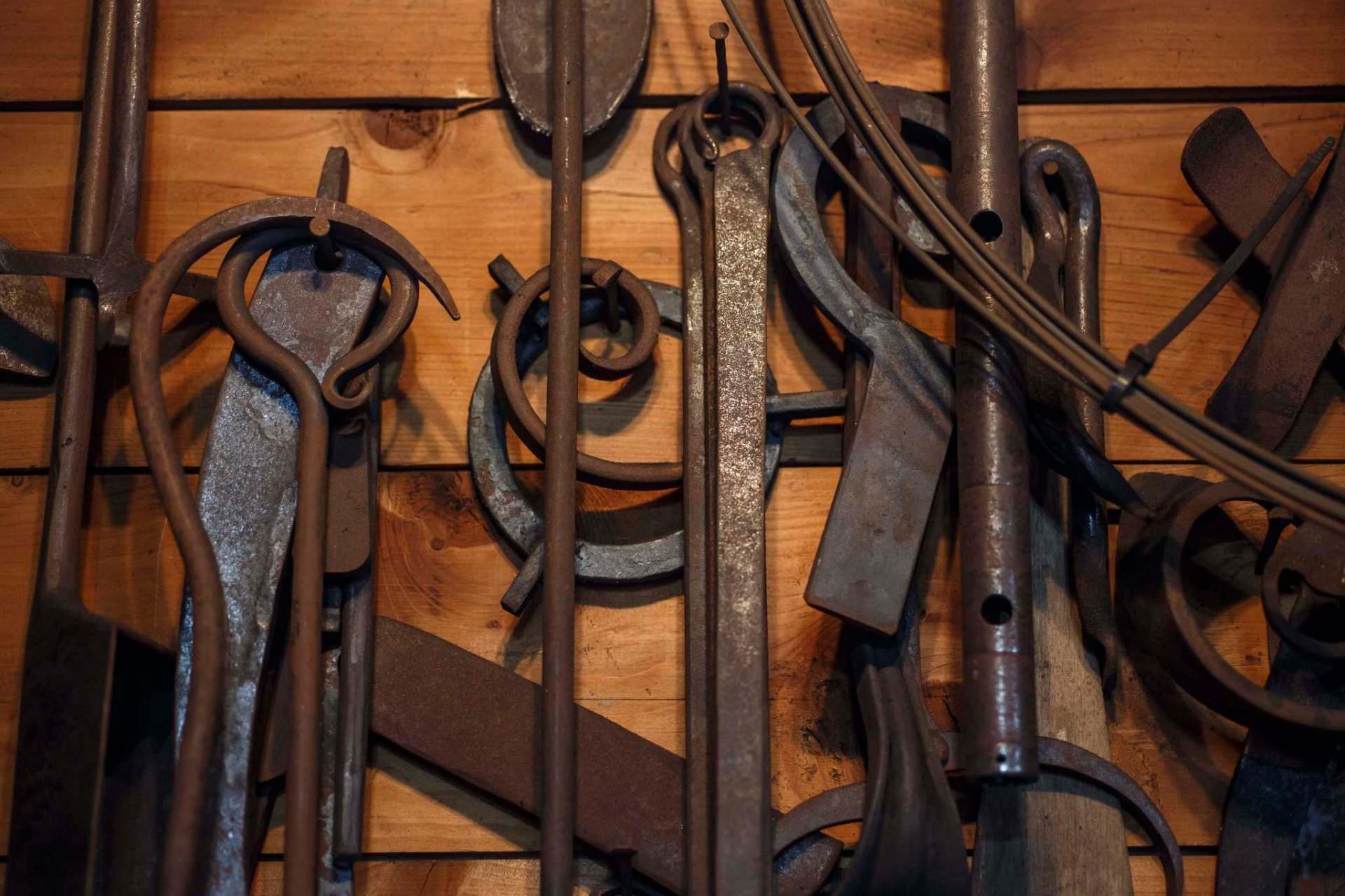
Jenkins returned to Manitoba in June 2006. He purchased a home in Elmwood and went to work as an engineer specializing in computer-aided design (CAD). Metal was still in his blood, mind you; three or four nights a week, he’d make the 45-minute trek to his mother’s place, where he would toil away in a converted, 400-square-foot garage until sundown, moulding everything from candlesticks to wine holders to dinner bells.
“As time went by and more and more people either heard I was a blacksmith or saw me in action somewhere, orders started coming in,” he says, crediting his father for coining his catchphrase, “Give me 200 pounds of steel wool and I can knit you a Volkswagen.”
“But because I had a full-time job, every so often I’d piss off a customer who wondered what was taking me so long to make him his hat rack or whatever.”
In 2016, one year after he placed first in a design competition at the World Forging Championship in Stia, Italy, Jenkins was hired to do the majority of the iron work associated with The Common, the craft beer and wine kiosk at The Forks Market that has since replaced the downtown attraction’s original food court. It turned out to be enough of an undertaking, he says, to give him the push he needed to turn Cloverdale Forge, the tag he chose for his biz in 2007, into a full-time venture.
“Believe me, it wasn’t an easy decision giving up a regular paycheque,” he admits, “but it had definitely gotten to a point where one job was starting to get in the way of the other.”
• • •
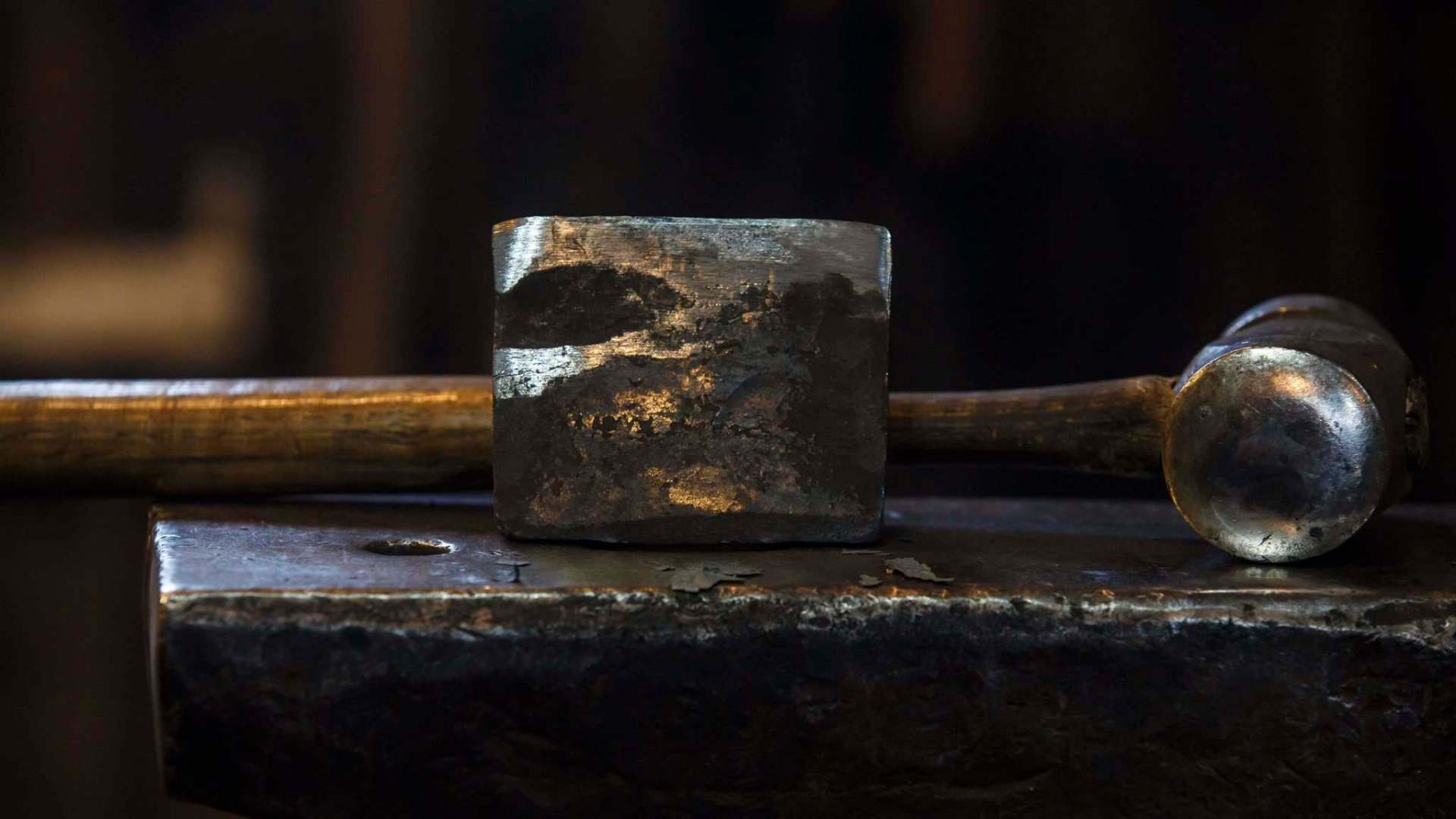
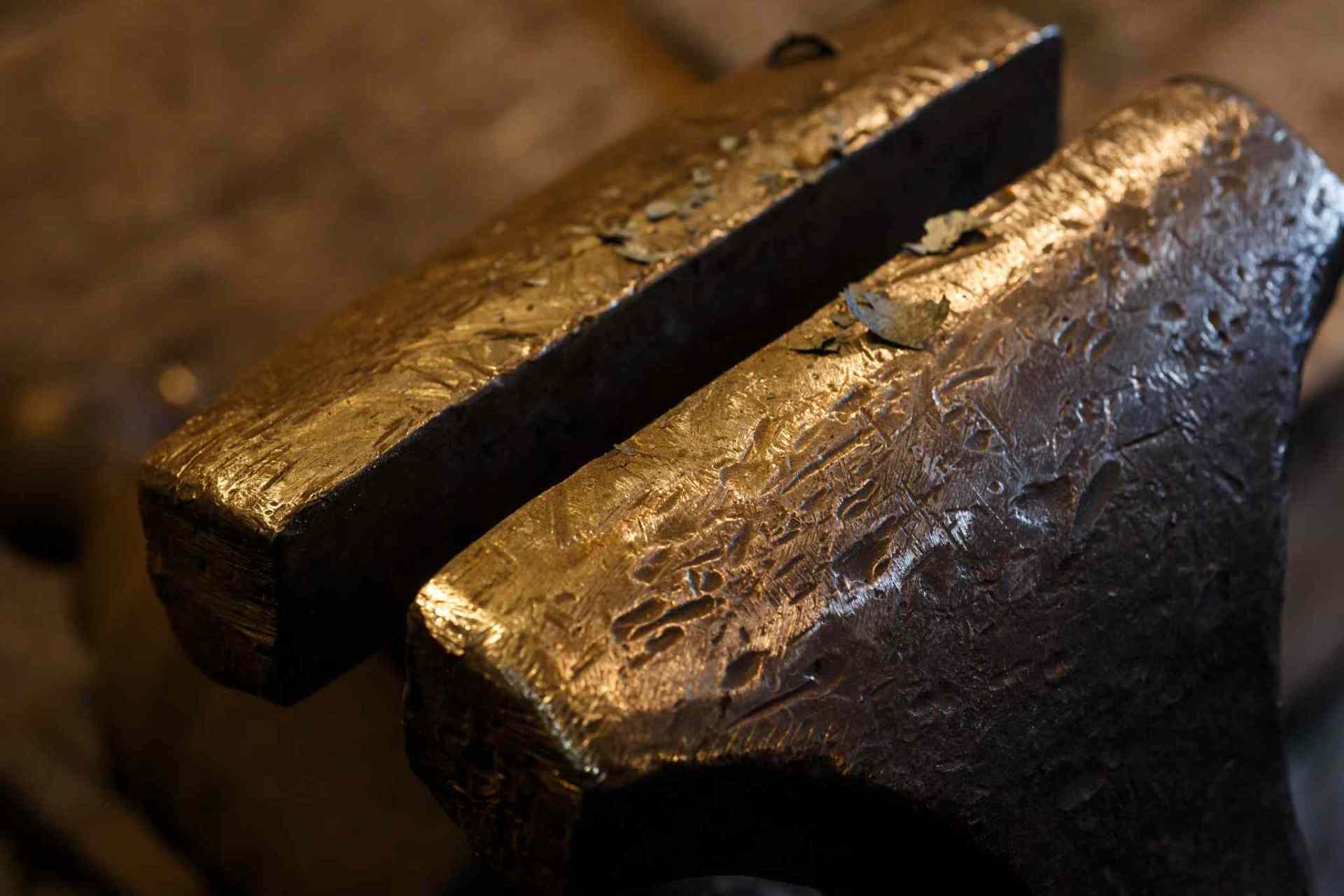
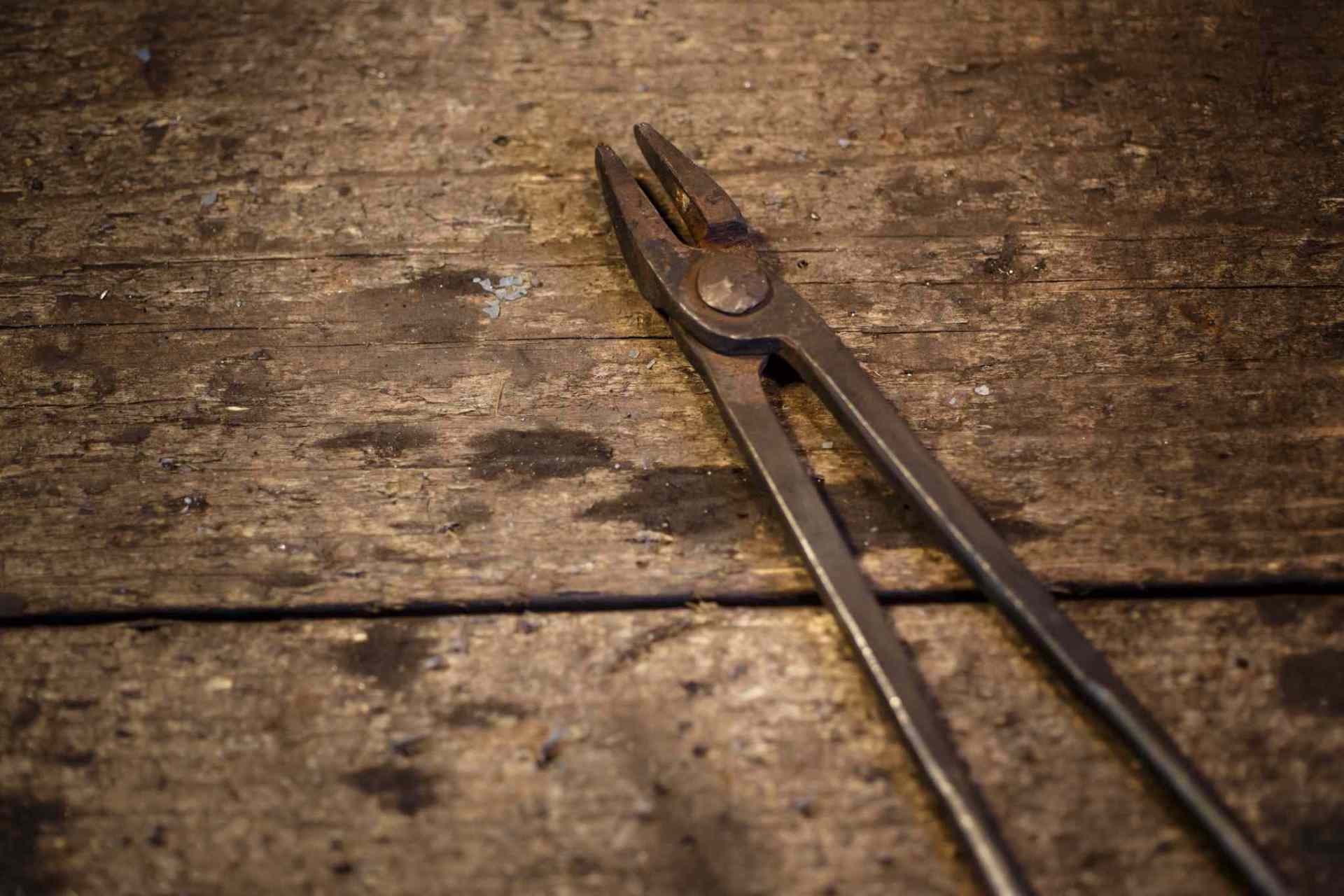
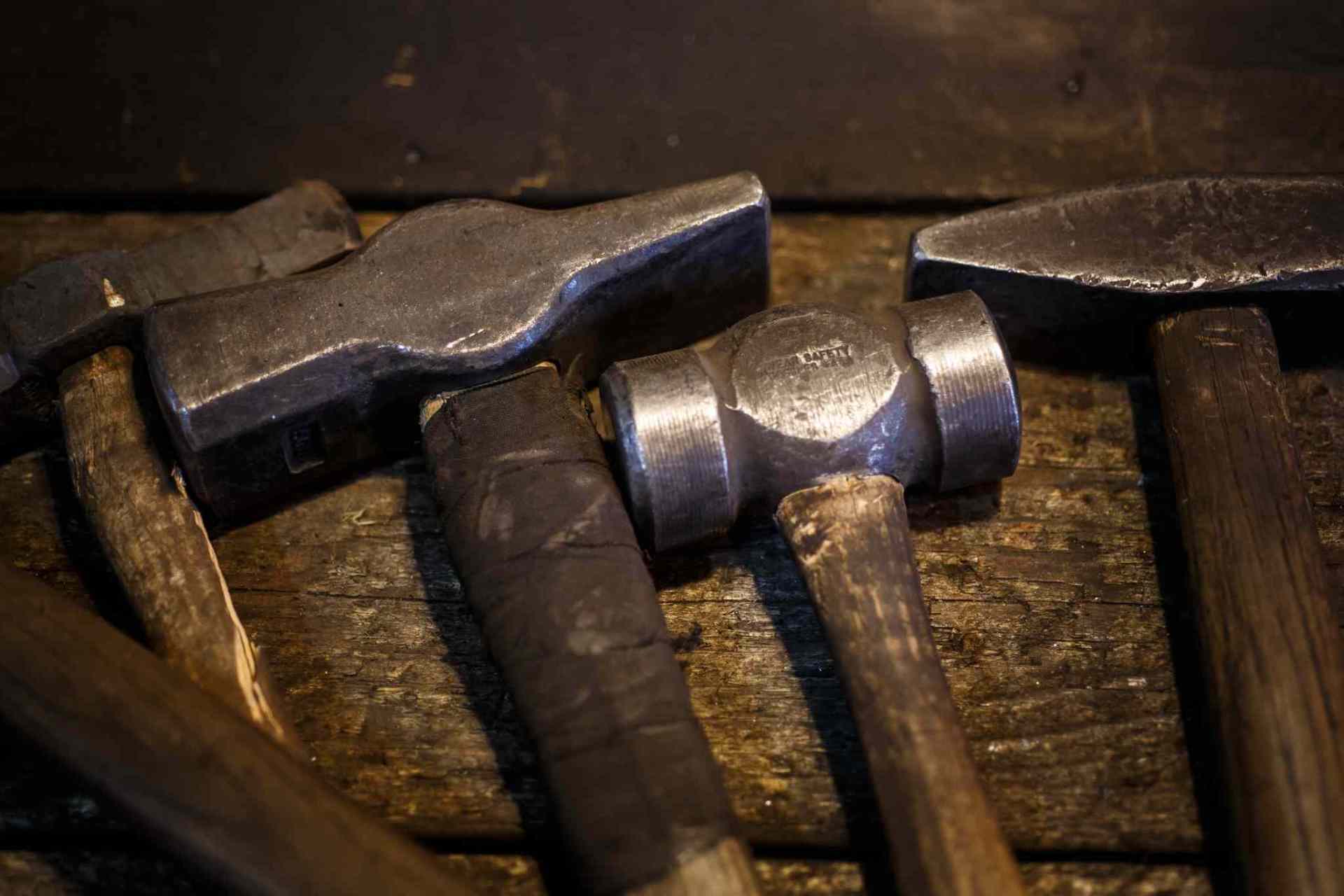
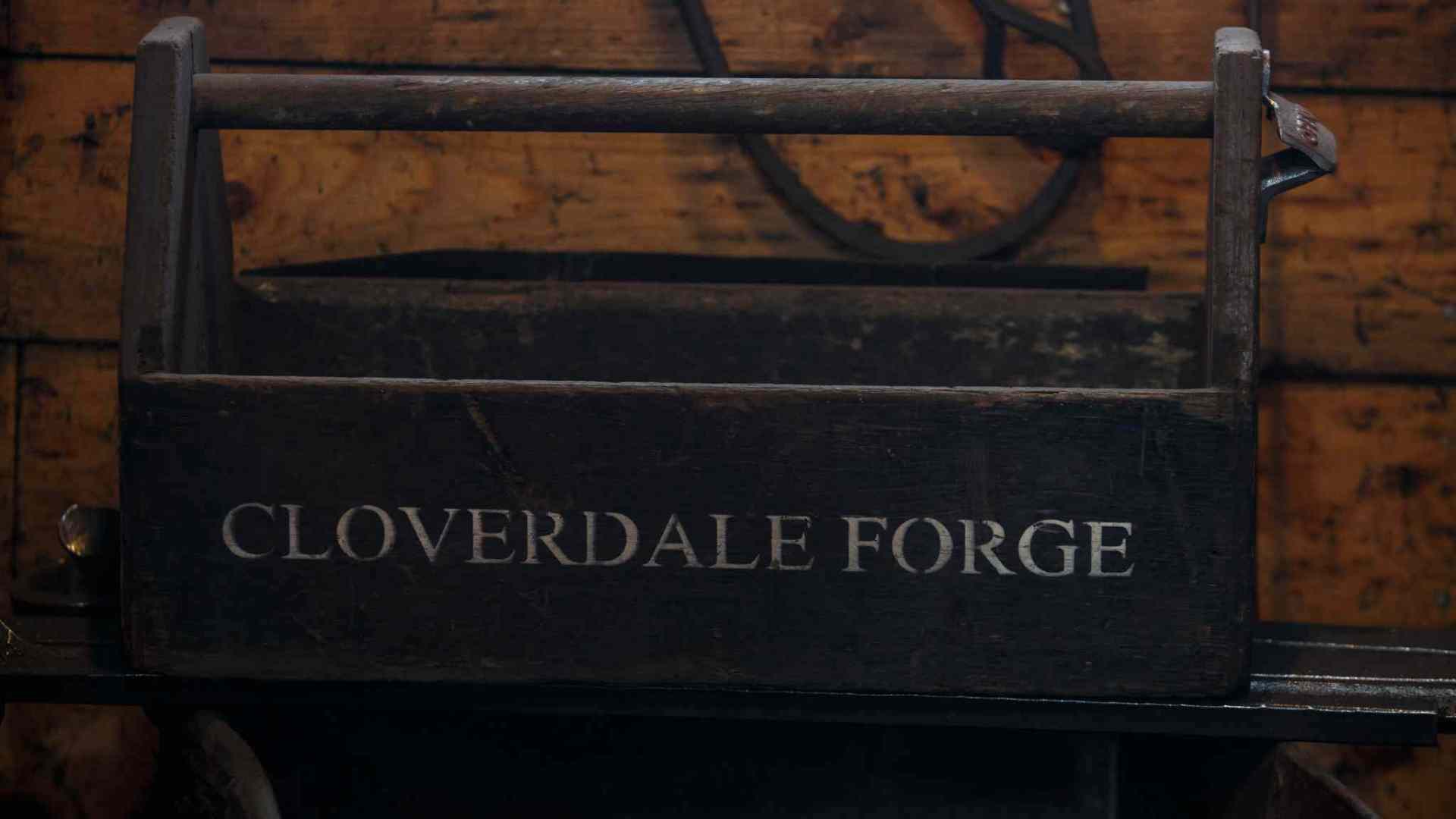
According to Statistics Canada, there were close to 20,000 blacksmiths in Canada in 1881. That number didn’t deviate much during the following decades — in 1921, there were still 18,000 blacksmiths, according to a census report — but by 2006 (the most recent year with available statistics), only 870 Canadians listed “blacksmith” as their primary occupation.
“While I’m not aware of any full-time blacksmiths in Winnipeg, I do know that Henry Avenue Forge does some blacksmithing. But my understanding is they are primarily a welding/fabricating shop, which uses some forged elements in their work,” Jenkins says, when asked how prevalent — or non-prevalent, as the case may be — blacksmithing is in Manitoba, in 2017.
“In certain parts of the States, there are (blacksmith) clubs that get together once or twice a month but here at home, we don’t have that same, close, blacksmith family, which, in my opinion, is probably our greatest barrier when it comes to sales or job opportunities. Over time, it seems, the general populace has pretty much forgotten what it is we do.”
About that; Jenkins’s personal revenue is derived from three primary streams. First, on an almost daily basis, he spends an hour or two churning out a sizable number of standardized items — his greatest hits, for lack of a better term — that can be bought online, through his Etsy shop. Those include rustic belt buckles, fireplace pokers, light switch plates and toilet-paper holders.
Second, he does a fair bit of commissioned work, tackling projects as large as stair railings and as small as door latches.
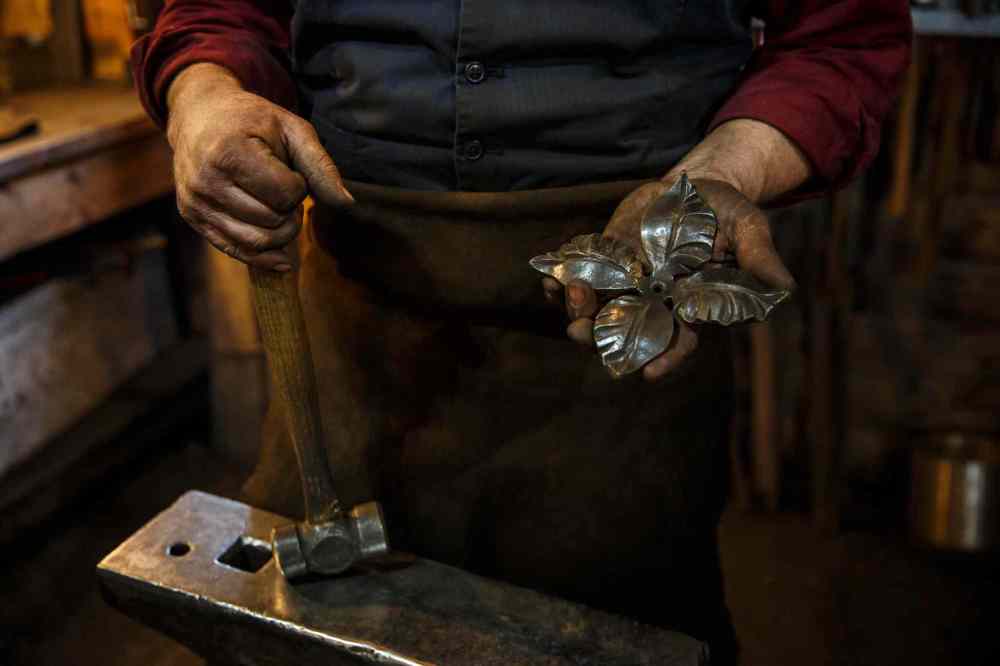
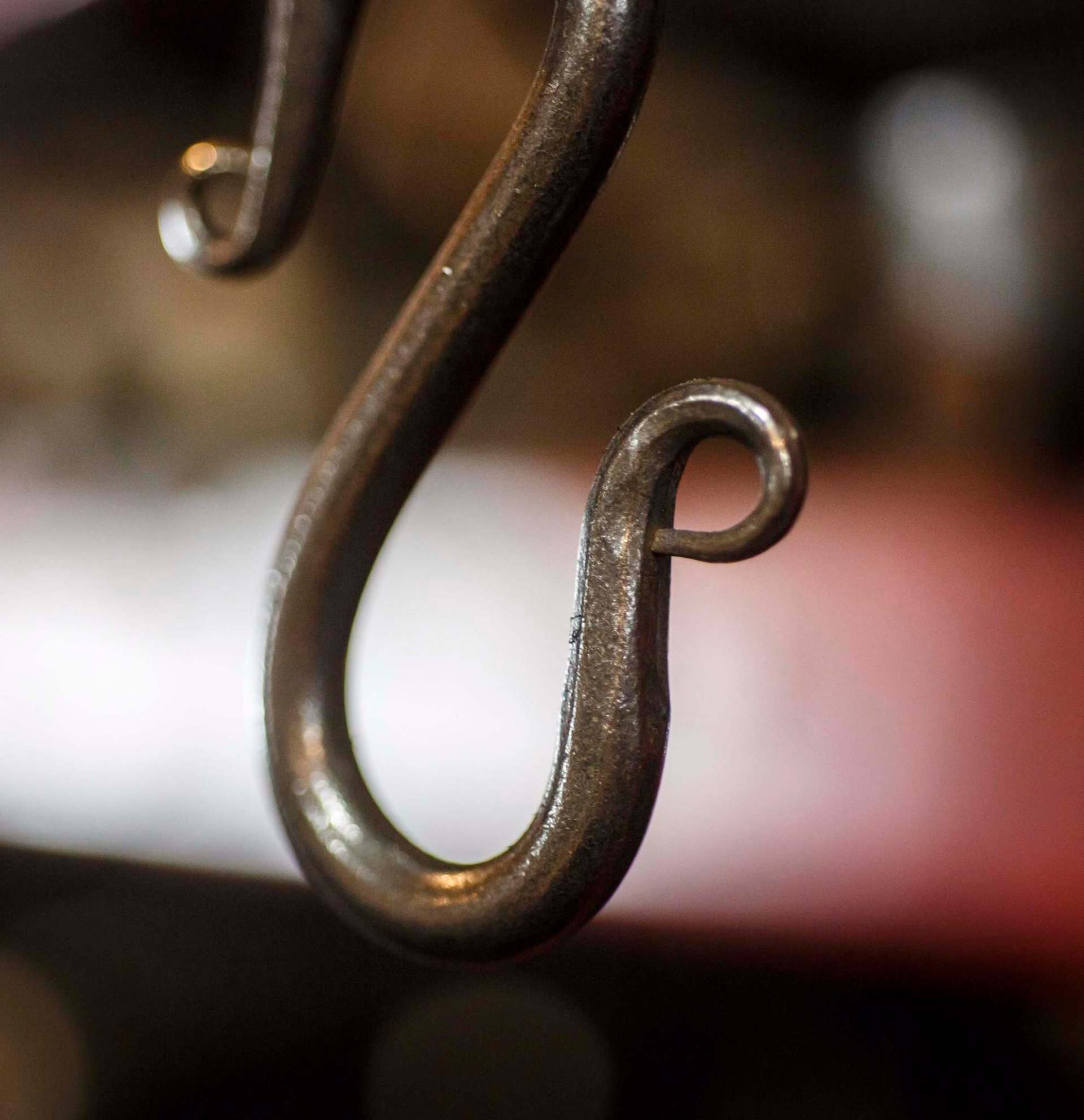
“My custom work always starts with a conversation,” he says, explaining he accesses his raw material from distributors such as Russell Metals on St. James Street and Brunswick Steel on Bismarck Street. “Somebody will tell me they need a hook and I’ll come back with, ‘Well, what kind of hook do you want?’ They’ll answer, ‘I don’t know… a hook-hook.’ To which I’ll respond, ‘Look, last year, I made over 300 types of hooks, so we’re going to have to narrow this down a bit.” (He’s not kidding; in 2016, a leap year, Jenkins undertook a “hook project,” which involved coming up with a different hook for every date on the calendar.
So, where did the inspiration for 365 dissimilar hooks come from, exactly?
“My ass,” he says with a loud guffaw.
Jenkins’ third source of income is teaching. During the summer months, he and his wife — fellow “smith” Karen Rudolph, whom he affectionately refers to as Rudy — host a series of workshops on his mother’s property.
While Jenkins downplays his classroom technique — “I can be a bit of an arsehole; my students will want me to fix something for them and I’ll flat-out refuse, saying, ‘Fix it yourself’” — Rudolph, who used to be the resident blacksmith at John C. Campbell Folk School, is happy to toot her hubby’s horn for him.
“For two years, I co-ordinated all the teacher hires at (John C. Campbell), and I definitely witnessed my share of instructor styles,” she says, noting although she and Jenkins met for the first time in 2003, they didn’t officially start dating, albeit long-distance, until 2007, when she was living in Tennessee.
“I’m definitely biased, but for sure, Matt is a phenomenal teacher,” she continues, noting in the past, the two of them have taught blacksmithing to people as young as 18, and as old as 80. “He’s definitely able to reach his students on multiple levels.”
Meghan Menzies, 30, took their beginners’ course in May 2016.
“Friends of mine are in a band that recorded at the Cloverdale farm, and I think that’s how I heard about the classes in the first place,” says Menzies, who, in her “real life,” practises law. “Even though I had zero experience when it came to blacksmithing, I’ve always been a curious person and, after looking into it a bit more with my dad, we signed up, along with a few other members of our family.”
Menzies recalls one of the first things Jenkins asked everybody was whether there was a specific object they were hoping to go home with at the end of the two-day session.
“I really wanted to make a knife, which I’m proud to report is fully functional,” she says with a laugh. “I also made barbecue utensils, which have definitely been put to good use. And for sure, you can’t crack open a bottle of beer in the Menzies household, without one of us telling you, ‘I forged that (opener).’”
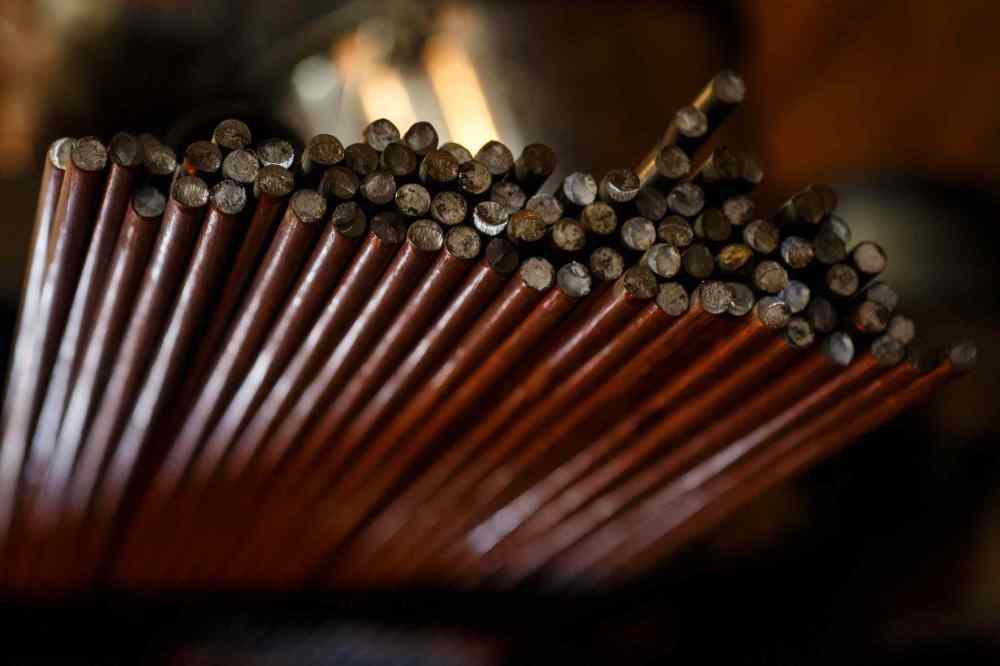
Ted McLachlan, a retired professor who taught landscape architecture at the University of Manitoba for 35 years, is looking forward to his third trip to Cloverdale Forge, scheduled for June. After attending an introductory course in 2015, he returned the following summer for a three-day advanced program. His next session will focus exclusively on tool-making, he says.
“About 15 minutes into the first class, I knew (blacksmithing) was something I really wanted to get into it,” says McLachlan, who, last summer, built a forge in his backyard, which faces the Red River. “I have very good design skills, having been a design critic for over 30 years. I’d also worked with wood and stone, so had good technical skills in terms of craftsmanship, but working with metal is completely different. It’s a reductive process where you start with something that’s not at all the shape you want, and you have to malleably move the metal to make what it is you’re after. There’s a huge amount of effort involved, even though when you watch somebody like Matt, you tend to think, ‘Yeah, that looked easy.’”
McLachlan, whose current project is a base for one of his coffee tables, says it’s reassuring to know there is somebody with Jenkins’ experience and talent available so close to home.
“What I’ve found over the last three decades is the skill level of people you can hire has catastrophically gone down,” he says. “It’s almost impossible to find somebody who isn’t pushing a power piece of equipment, or making things only out of square material. If you wanted a (metal) fence that had flowing, wavy lines that interlocked, for example, there was maybe one company before Matt came along, that could have done it, but even they were limited in terms of what they could actually accomplish.”
• • •
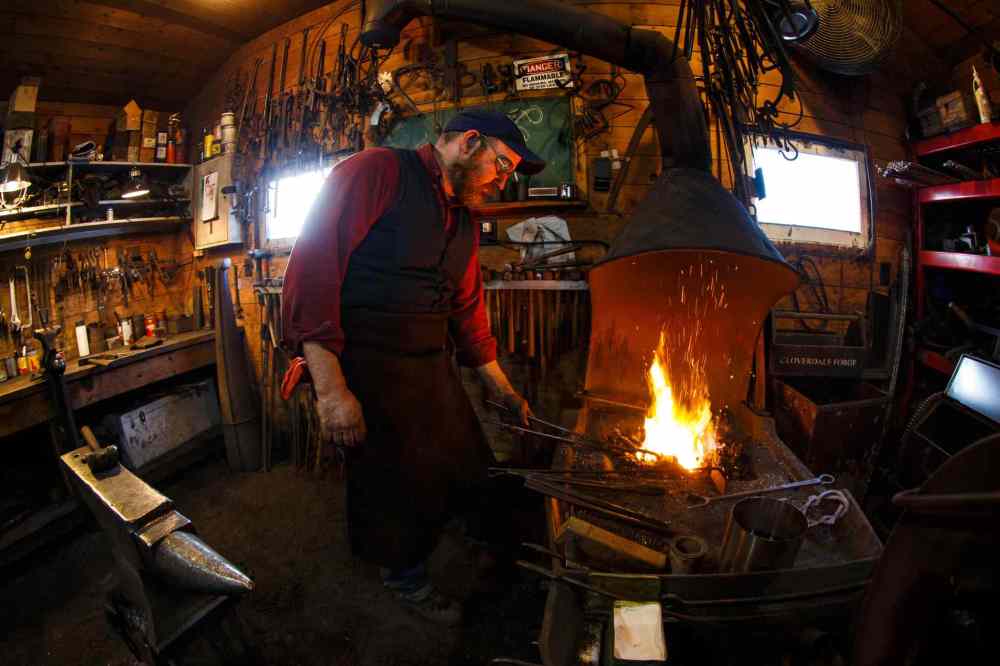
“The 1970s was probably the last time a true, craft resurgence occurred,” Jenkins says, escorting a reporter into his “office,” a toasty, dirt floor facility that houses two hearths, one heated by gas, the other by coal. “One of my instructors at the folk school summed it up rather eloquently when he said the aesthetic in the 19th century was, ‘Look at what I have — it’s unique, it’s beautiful’ only to have that change to, ‘Yeah, I have one of those, too. Only mine’s blue.’
“But that’s beginning to swing back, I think, to where people are again proud to say, ‘You can’t have one of these, because this was made just for me.’”
With that, Jenkins instructs his guest to put down his notepad and pick up a hammer, explaining that idiom about striking while the iron is hot is about to be put to the test.
When a scribe puts up a bit of a struggle, clarifying he’s going to need all 10 of his fingers when it comes time to type this profile, Jenkins chuckles then says in an encouraging tone.
“You have nothing to worry about. Blacksmithing is simple. All you have to remember is, get it hot, hit it hard and quit when you’re done. Of course in my case, there are no plans to quit.”
For more information on Cloverdale Forge, and to see a 2017 course schedule, go to www.cloverdaleforge.com.
david.sanderson@freepress.mb.ca
Dave Sanderson was born in Regina but please, don’t hold that against him.
Mike Deal started freelancing for the Winnipeg Free Press in 1997. Three years later, he landed a part-time job as a night photo desk editor.
Our newsroom depends on a growing audience of readers to power our journalism. If you are not a paid reader, please consider becoming a subscriber.
Our newsroom depends on its audience of readers to power our journalism. Thank you for your support.