

Premier schooled for encouraging teachers to spend own money on supplies

Advertisement
Read this article for free:
or
Already have an account? Log in here »
To continue reading, please subscribe:

Digital Subscription
One year of digital access for only $205*
- Enjoy unlimited reading on winnipegfreepress.com
- Read the E-Edition, our digital replica newspaper
- Access News Break, our award-winning app
- Play interactive puzzles
*First annual payment billed as $205.00 + GST for one year. This annual subscription will automatically renew at $233.00 + GST every 52 weeks (10% off the regular annual price of $259.35). Offer available to new and qualified returning subscribers only. Cancel any time.
To continue reading, please subscribe:
Add Free Press access to your Brandon Sun subscription for only an additional
$1 for the first 4 weeks*
- Enjoy unlimited reading on winnipegfreepress.com
- Read the E-Edition, our digital replica newspaper
- Access News Break, our award-winning app
- Play interactive puzzles
*Your next Brandon Sun subscription payment will increase by $1.00 and you will be charged $17.95 plus GST for four weeks. After four weeks, your payment will increase to $24.95 plus GST every four weeks.
Read unlimited articles for free today:
or
Already have an account? Log in here »
Hey there, time traveller!
This article was published 08/04/2021 (1987 days ago), so information in it may no longer be current.
Teachers were taken aback this week when the premier encouraged them to spend their own money on school supplies, following the announcement of a new tax credit for such expenses.
One elementary school educator called Premier Brian Pallister’s comments “disgusting” and the credit “insulting” — so much so, she said she likely won’t use it, despite spending $500 on teaching material every year.
“I actually laughed when I heard his comments because it is so on brand. To be encouraged to spend our own money, all the while freezing our wages… it’s a slap in the face. Again. Sadly, we’re used to it by now, being disrespected by this government,” said Sarah Martens, a Grade 4-5 teacher in Winnipeg.
The teaching expense tax credit, which was unveiled as part of the 2021 budget, will allow any educator in a child-care or K-12 setting to claim a 15 per cent refund for up to $1,000 on eligible teaching supplies every year; the maximum rebate is $150. The credit mirrors a federal one introduced in 2016.
Teachers can claim funds for teaching material, ranging from stationery to seeds and baking soda required for science experiments. Games, puzzles, books, storage and educational support software are also covered. Computers, tablets and rugs are not.
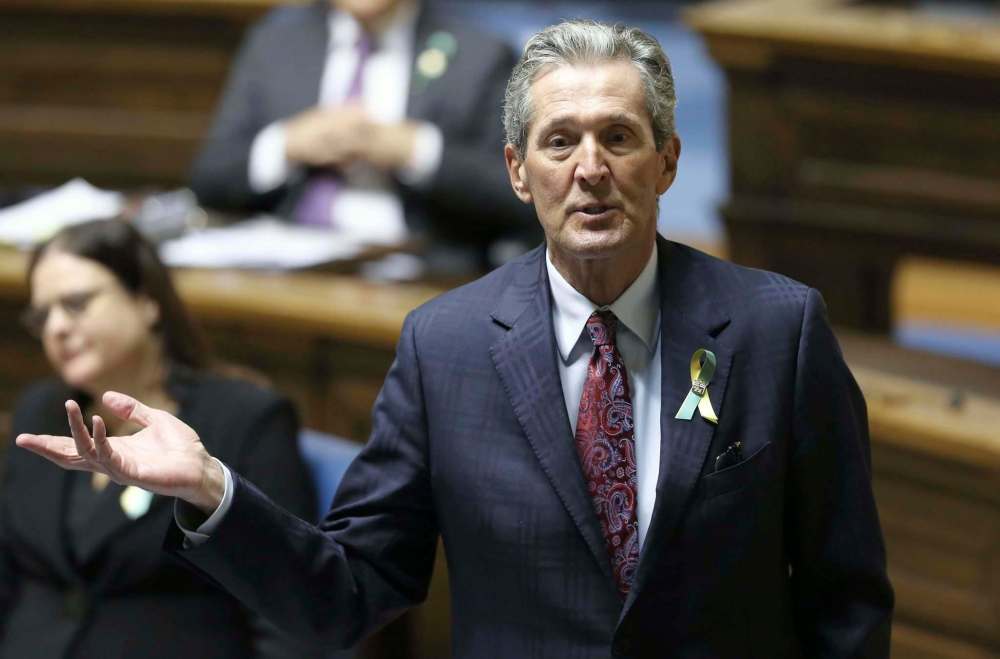
On Wednesday, Pallister was asked whether it bothers him that teachers spend their own money on classroom purchases. “It doesn’t bother me at all,” Pallister responded.
“As a former teacher, as the son of one, as the brother of one, as one who believes in public education, I’ve watched teachers invest their own money out of their own pocket for decades now. I just think (the tax credit) is a good, fair incentive to encourage other teachers to do the same. There’s lots of room for initiative.”
Just because something has always been done a certain way does not mean it’s the right way, said Fiona Cook, a Grade 2-3 teacher in Winnipeg. She often spends $1,500 or more on out-of-pocket school purchases annually.
Eleven per cent of respondents in a fall 2019 poll of 801 Manitoba teachers reported spending $1,000 or more of their own money on supplies in 2018-19. Only five per cent of respondents to the survey — which was commissioned by the Manitoba Teachers’ Society and conducted by Viewpoints Research — indicated they spent none of their own money on material.
Citing the fact that annual operating funding for public education continues to fall short of inflation, the president of MTS said the province is underfunding education and offloading expenses onto teachers.
“How would the public respond if nurses were asked to provide their own surgical equipment in a hospital? How is it different? Because we’re talking about the things that need to be done for students to succeed,” said James Bedford, who represents 16,000 public school teachers.
Meantime, Education Minister Cliff Cullen defended the credit during a news conference at the legislature Thursday: “What we’re doing here is we’re recognizing the teachers that go above and beyond in the classroom.”

Cullen added proposed education reforms should see $40 million in school board administrative costs redirected to front-line services — in turn, increasing school budgets.
While math teacher Will Penner said the premier’s tone during his remarks about educator expenses irritated him, given teachers already take initiative, he welcomes the small refund. “Fifteen per cent is not very much when you consider how much teachers are spending — but I think 15 per cent is at least something,” said Penner, who teaches Grade 8 students in Winnipeg.
Manitoba Education said 2,500 Manitoba teachers applied for the federal education expense credit during the 2019 tax year.
maggie.macintosh@freepress.mb.ca
Twitter: @macintoshmaggie
Maggie Macintosh
Education reporter
Maggie Macintosh reports on education for the Free Press. Originally from Hamilton, Ont., she first reported for the Free Press in 2017. Read more about Maggie.
Funding for the Free Press education reporter comes from the Government of Canada through the Local Journalism Initiative.
Every piece of reporting Maggie produces is reviewed by an editing team before it is posted online or published in print — part of the Free Press‘s tradition, since 1872, of producing reliable independent journalism. Read more about Free Press’s history and mandate, and learn how our newsroom operates.
Our newsroom depends on a growing audience of readers to power our journalism. If you are not a paid reader, please consider becoming a subscriber.
Our newsroom depends on its audience of readers to power our journalism. Thank you for your support.
Maggie Macintosh
Education reporter
Maggie Macintosh reports on education for the Free Press. Originally from Hamilton, Ont., she first reported for the Free Press in 2017. Read more about Maggie.
Funding for the Free Press education reporter comes from the Government of Canada through the Local Journalism Initiative.
Every piece of reporting Maggie produces is reviewed by an editing team before it is posted online or published in print — part of the Free Press‘s tradition, since 1872, of producing reliable independent journalism. Read more about Free Press’s history and mandate, and learn how our newsroom operates.
Our newsroom depends on a growing audience of readers to power our journalism. If you are not a paid reader, please consider becoming a subscriber.
Our newsroom depends on its audience of readers to power our journalism. Thank you for your support.
Related Articles
Pallister's tax rebate puts $4,000 into his own pocket
Advertisement Advertise With Us
Advertisement Advertise With Us
History
Updated on Thursday, April 8, 2021 7:10 PM CDT: Removes word "impromptu"
Updated on Thursday, April 8, 2021 8:26 PM CDT: Corrects spelling of stationery