

Sixties Scoop apology just a start
Advertisement
Read this article for free:
or
Already have an account? Log in here »
To continue reading, please subscribe:
Monthly Digital Subscription
$0 for the first 4 weeks*
- Enjoy unlimited reading on winnipegfreepress.com
- Read the E-Edition, our digital replica newspaper
- Access News Break, our award-winning app
- Play interactive puzzles
*No charge for 4 weeks then price increases to the regular rate of $19.95 plus GST every four weeks. Offer available to new and qualified returning subscribers only. Cancel any time.
Monthly Digital Subscription
$4.99/week*
- Enjoy unlimited reading on winnipegfreepress.com
- Read the E-Edition, our digital replica newspaper
- Access News Break, our award-winning app
- Play interactive puzzles
*Billed as $19.95 plus GST every four weeks. Cancel any time.
To continue reading, please subscribe:
Add Free Press access to your Brandon Sun subscription for only an additional
$1 for the first 4 weeks*
*Your next subscription payment will increase by $1.00 and you will be charged $16.99 plus GST for four weeks. After four weeks, your payment will increase to $23.99 plus GST every four weeks.
Read unlimited articles for free today:
or
Already have an account? Log in here »
Hey there, time traveller!
This article was published 19/06/2015 (3850 days ago), so information in it may no longer be current.
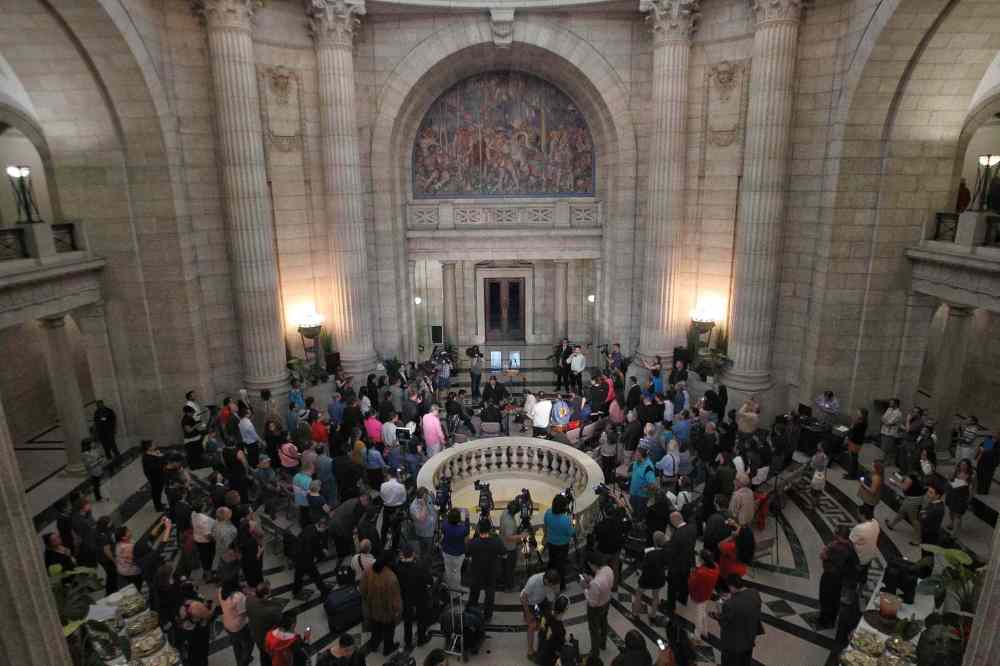
At moments, in the crowd that came to hear Premier Greg Selinger’s apology Thursday to the aboriginal children taken during the Sixties Scoop, you could feel a bit of their pain.
The hurt that sets in and trickles down the generations.
I read some of that on Edna Elma Jawbone’s face. Jawbone was among the families at the legislature’s rotunda, where Aboriginal Affairs Minister Eric Robinson declared the apology was just a start to redress.
Jawbone, 63, is looking for more than recognition of the pain that flowed from her brother Danny’s adoption out of province. He needs help, and money to get it, she said.
Jawbone is Sayisi Dene, the hunter-gatherers from Duck Lake who were moved in 1956 by Ottawa to a shantytown at the edge of Churchill. Sometimes reduced to living off the town dump, as many as a third of the Dene died before they packed up again in 1973 and left for Tadoule Lake.
Danny was taken by a social worker in 1959. “They just said they were going to send him away for medical (care),” recalls Jawbone, who was in residential school at the time in Birtle. Her parents were bewildered. “The didn’t speak or read English.”
That was the last they saw of Danny, who lived in a Montreal orphanage until a nurse there adopted him. When he was 21, he caught a peek at his files and made his way to Thompson. The band helped him get “home” to meet his mom. It was not an easy reunion.
“He was speaking French.”
I ask if her brother was at the legislature, to see this first-hand. Jawbone hadn’t seen him for two days. Danny is staying in an old truck somewhere.
“Right now he’s homeless, he stays at my house now and again. He usually comes for a while, for a shower and to change.” He doesn’t do well in shelters. “He’s very anti-social.”
More than 20,000 First Nations, Métis and Inuit children across the country were taken by child-welfare agencies from the 1960s, as residential schools were closing, to the mid-1980s, when Manitoba placed a moratorium on out-of-province adoptions. How many kids? No one seems to have a good idea.
In 1985, provincial judge Edwin Kimelman wrote a scathing condemnation, declaring the Scoop a cultural genocide that “has been taking place in a systematic, routine manner.”
He reviewed the 1981 adoption files and debunked the agencies’ assertion that out-of-province adoptions were a “valuable” option for “hard-to-place” children.
He found there were ample Manitoba homes willing to adopt, and social workers rarely tried to keep the kids in their own communities.
Some want a truth and reconciliation commission to right this wrong, to dig out the facts. Explain why, when beaten children ran to authorities, they were returned to abusive homes. Answer why so many were put in the hands of private American agencies that charged thousands of dollars to their new parents.
Selinger called it a tragedy Thursday. But where do we go from here?
Edna Jawbone says somehow the apprehensions have to stop. She voluntarily put a child into CFS care; one daughter, who has addictions, has had three babies taken at birth. She also has a 14-year-old niece living on the street, having run from a foster home. Another daughter voluntarily put two sons into care and went through years of treatment and therapy to get them back.
Meanwhile, Danny Jawbone has registered with a local law firm, hoping for a class-action suit to be certified as one has in Ontario.
Canada can write this script, how these lawsuits will end.
But that will be years in the making, as we saw with the 2006 settlement that created the Indian Residential School TRC.
In the meantime, it’s time to shake the dust off the Kimelman recommendations.

Find the kids. Go through the archived CFS files and find where they ended up, how they fared. Ask them what they need to make their lives right again, regain their Indian status and treaty rights. Reunite them with their birth families and help them reclaim their culture.
That, then, would start us down the road to reconciliation.
Catherine Mitchell is a Free Press editorial writer.
catherine.mitchell@freepress.mb.ca Twitter: @wfpcmitchell
Related Articles
Sixties Scoop apology just a start



Advertisement Advertise With Us
Advertisement Advertise With Us