

Whistling Straits isn’t your typical Ryder Cup test: ‘There is a lot of eye candy out there’
Advertisement
Read this article for free:
or
Already have an account? Log in here »
To continue reading, please subscribe:

Digital Subscription
One year of digital access for only $205*
- Enjoy unlimited reading on winnipegfreepress.com
- Read the E-Edition, our digital replica newspaper
- Access News Break, our award-winning app
- Play interactive puzzles
*First annual payment billed as $205.00 + GST for one year. This annual subscription will automatically renew at $233.00 + GST every 52 weeks (10% off the regular annual price of $259.35). Offer available to new and qualified returning subscribers only. Cancel any time.
To continue reading, please subscribe:
Add Free Press access to your Brandon Sun subscription for only an additional
$1 for the first 4 weeks*
- Enjoy unlimited reading on winnipegfreepress.com
- Read the E-Edition, our digital replica newspaper
- Access News Break, our award-winning app
- Play interactive puzzles
*Your next Brandon Sun subscription payment will increase by $1.00 and you will be charged $17.95 plus GST for four weeks. After four weeks, your payment will increase to $24.95 plus GST every four weeks.
Read unlimited articles for free today:
or
Already have an account? Log in here »
Hey there, time traveller!
This article was published 21/09/2021 (1797 days ago), so information in it may no longer be current.
It’s a funny thing about the Ryder Cup. It is golf’s biggest spectacle and likely the event fans look forward to more than any other, but in recent years the venues chosen for the biennial U.S.A. versus Europe matches have not been the list-toppers that we see host most U.S. and British Opens.
In Europe, it’s largely been parkland and resort courses since the mid-1980s. Places such as Ireland’s K Club, Celtic Manor in Wales, Gleneagles in Scotland and Le Golf National in France. All of them fine, none of them particularly inspiring. Of the last four U.S. clubs to host, only Michigan’s Oakland Hills falls in Golf Magazine’s ranking of the top 100 U.S. courses, although it should be noted that Bethpage Black and Olympic Club are on the horizon.
Which is to say that the host course hasn’t been a central storyline. Sure, the difficulty of Le Golf National in 2018 played a part in the proceedings, but you’d likely have a hard time picturing the vivid details of any Ryder Cup course of the last three decades. The Ocean Course at Kiawah Island, the host 30 years ago, is probably the one that sticks out the most.
Because the Ryder Cup is big business and money talks and all that jazz.
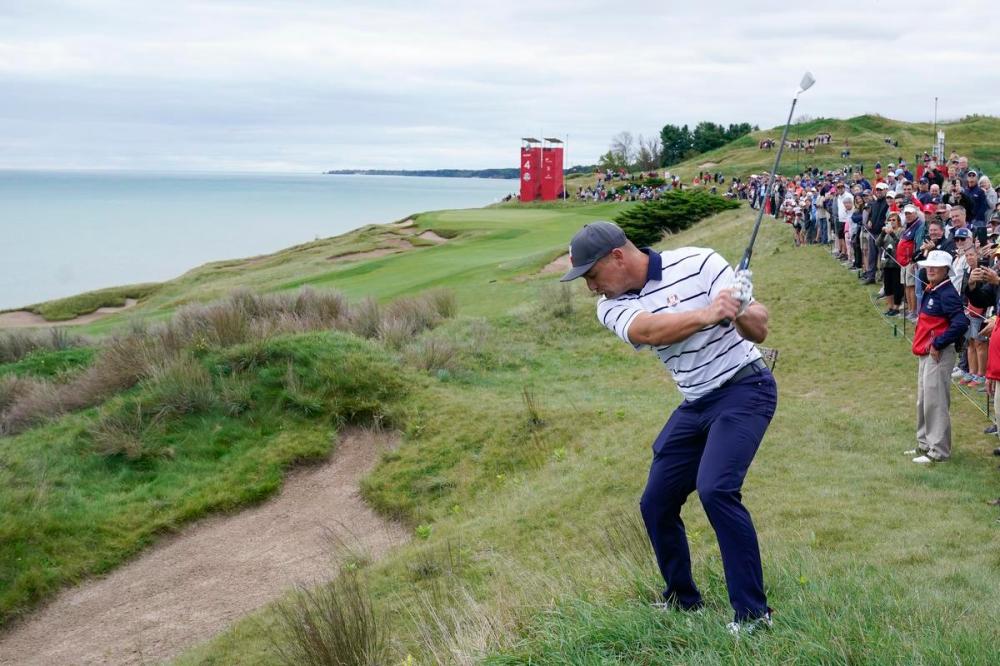
Things should be different this weekend. Wisconsin’s Whistling Straits, a modern-day design of the late Pete Dye, has its pros and cons, its defenders and detractors. But it is, without question, different — a wild-looking course with several holes atop precipices overlooking Lake Michigan. Others weaving through massive man-made dunes, with more bunkers than one can count and imported sheep grazing a part of the property. Wind often whipping hard off the water. A massive place that the PGA of America fell head over heels in love with upon first sight, such that it immediately appointed Whistling Straits the host of three future PGA Championships and the 2020 Ryder Cup. Which, because of you know what, has been delayed by a year.
“There is a lot of eye candy out there,” said U.S. assistant captain Jim Furyk on this week’s SCOREGolf podcast, “Next Round’s on Me.” “You look at the periphery and you see bunkers that are 200 yards off the fairway.
“Pete Dye was kind of a master of deception,” continued Furyk. “To focus on the task at hand and the fairway in front of you, the green in front of you, the shot at hand, is very difficult because there is a lot going on outside of basically the hitting area.”
I can attest to that. I visited Whistling Straits in 2009 and played the course with my father on a lovely September morning. Just the two of us with just the right amount of chill in the air. It was a very memorable experience and while the course is not the best I have played by far, it is the most dramatic. A spectacular canvas built to resemble the great links of Scotland and Ireland, except it doesn’t play like a links course at all. There are too climbing fairways to raised greens with cavernous bunkers fronting them for the ground to be used on approach shots, something of a lost art anyway.
“Make no mistake about it, this is not a links golf course just because there is not trees,” said Furyk, who’s played in all three PGAs (2004, 2010, 2015) at Whistling Straits. “I think it all depends on your definition of links, but this golf course does not remind me of any courses that we play, say, on a British Open-type venue. It’s a Pete Dye course, which means it’s an aerial attack. You have to put the ball in the air to play this golf course.”
Upon returning from my visit I called Herb Kohler, now executive chairman of the Kohler Company. He’s the man who brought golf to the eponymous Wisconsin village in which his grandfather established what became a plumbing fixture behemoth. The land he gave Dye to work with was an abandoned airfield, meaning it was dead flat. A monster amount of earth was moved to shape the course and three lines of dunes were constructed, not only to provide the look and esthetics the men were after but also to protect the property against erosion.

“One of the amazing things about Straits is that each of the holes is very distinctive,” Kohler boasted. “There’s not a hole out there that looks like any other. They just have a marvellous character. When you design a course you have to have so many doglegs right and left, and you have to have holes into the wind and away from the wind and what not, and those are the basic mechanics of golf course design. And in doing so many designers develop look-alikes. Not with Pete. One of the wonderful attributes of Pete Dye is that he can never describe what he’s going to give you. He just gives it.”
One hole that Dye gave that will play a factor in the proceedings this weekend is the 17th. A scary par-3 right on the water that can play up to 250 yards, and even longer if it’s into the wind. Players standing on that tee all square will surely have wobbly knees, no matter how accomplished they’ve been in their careers. It’s easy to foresee both heroism and heartbreak there.
On the day my dad played we faced a four-club wind on 17. In front of a gaggle of golfers, because resort play always backs up on that hole given its difficulty, we both hit three-woods onto the green to a smattering of applause. Then my dad two-putted for par and I didn’t. So he won the hole.
But not the match.
Jason Logan is the editor of SCOREGolf Magazine and is based in Toronto. He is a contributor to the Star’s Sports section. Follow him on Twitter: @jasonSCOREGolf
Related Articles
Column: Uncertain future for Europe and Ryder Cup team




Advertisement Advertise With Us
Advertisement Advertise With Us