

The wonders of wandering a new city

Advertisement
Read this article for free:
or
Already have an account? Log in here »
To continue reading, please subscribe:

Digital Subscription
One year of digital access for only $205*
- Enjoy unlimited reading on winnipegfreepress.com
- Read the E-Edition, our digital replica newspaper
- Access News Break, our award-winning app
- Play interactive puzzles
*First annual payment billed as $205.00 + GST for one year. This annual subscription will automatically renew at $233.00 + GST every 52 weeks (10% off the regular annual price of $259.35). Offer available to new and qualified returning subscribers only. Cancel any time.
To continue reading, please subscribe:
Add Free Press access to your Brandon Sun subscription for only an additional
$1 for the first 4 weeks*
- Enjoy unlimited reading on winnipegfreepress.com
- Read the E-Edition, our digital replica newspaper
- Access News Break, our award-winning app
- Play interactive puzzles
*Your next Brandon Sun subscription payment will increase by $1.00 and you will be charged $17.95 plus GST for four weeks. After four weeks, your payment will increase to $24.95 plus GST every four weeks.
Read unlimited articles for free today:
or
Already have an account? Log in here »
Hey there, time traveller!
This article was published 22/07/2023 (1158 days ago), so information in it may no longer be current.
I start sorting a small but growing collection of Winnipeg index cards in my head now, each one a marker for its own short film of memory.
At the moment, everything is wonderfully half a story: unjaded by regular experience of this place, I see fragments of things in progress and my imagination makes its own beginnings and endings for them, because I’m able to simply let my mind wander.
Later, I know, routine will begin to trump wonder.
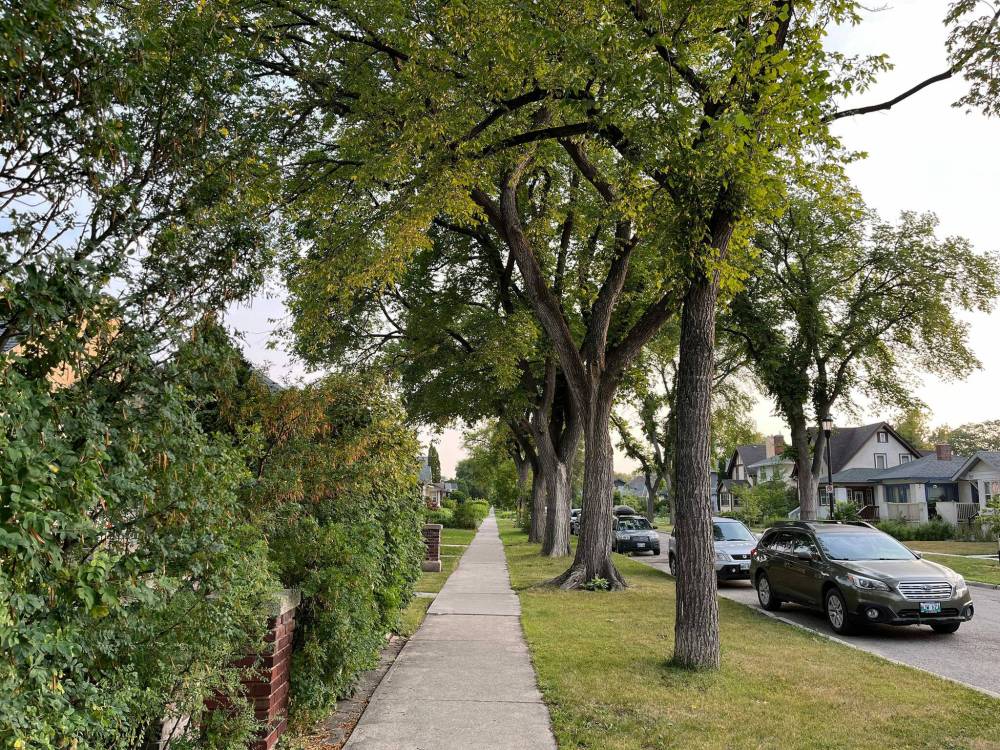
Russell Wangersky / Winnipeg Free Press
A new story unfolds with every step in a new city.
Routine is a gradual force, but an effective one, its steady grind also its own form of entropy.
● ● ●
The man across the street from us is his own perfect one-act play — he enters from stage right, lit suddenly bright-white by his own motion detector security lights. He tries the driver’s-side front door of his car, then the passenger-side front door, then circles around the back of the car, brushes his hands together and goes back into the house.
A minute’s wait.
Then the lights cut sharply to darkness.
Fin.
The same play is performed almost every night, always just after dark.
Admission is free.
● ● ●
Bicyclists sweep by on our street in the mobile bubbles of their own sound systems, sharing a verse or two with everyone as they pass. One particularly enterprising pair of cyclists early one Saturday evening had a trailer hooked up behind one bike, just to haul the speakers for their sound system. Big speakers, the rich bass chasing them down the road like a large, friendly, loping dog.
The couple can’t be older than their late 20s, but the singer they are hauling around behind themselves is Marty Robbins, singing El Paso, a song Robbins released in 1959.
Somehow, for a brief moment, it isn’t just someone else’s noise intruding into your evening: somehow, for the length of a verse or maybe two, it is like the neighbourhood has gained a soundtrack. Maybe, I think, a movie is about to begin. Maybe it has already started.
Later, a brief glimpse, the light almost faded to dark, something almost impossible to believe: a pod of cyclists pass, at least two of them dressed as giant squid.
Did I really just see that?
● ● ●
On Arlington north of St. Matthews, the early morning 71 bus slows for its next stop, and almost every day I notice the house that burned.
The fire vented straight out through the peak of the roof, giving the building a surprised look, as if it was unable to accept that strong winds had blown the permanent fixture of its hat away.
The house is for sale — or, at least, the land is for sale. The house has to be demolished; its race has been run. A sales feature on the realty sign? “Zoned for a fourplex.”
Three bedrooms and one bathroom for each unit.
The lot hardly looks large enough for a house of that size, let alone that many families and their intertwined histories.
The family that was there left few signs, even through the regular time lapse of captured Google Street View images. You can see a small carpet hung over the front railing of the house last year, a riot of what look like pink peonies blooming in the garden 12 years before that. Curtains move back and forth in the individual photographs; little else changes before the fire.
Most of the windows and front door are now boarded up with white-painted plywood.

● ● ●
There are padlocks threaded through the wire mesh on the outside of the pedestrian part of the rail bridge over the Assiniboine again, just past Halter Park. Love locks are now a global phenomenon — as a concept, their attempt at signalling permanence has never made much sense to me. A lock is for something you need to hold by sheer mechanical force when it’s out of your sight. Still, it’s hard not to read the names — or even just the initials — on the locks and not get a smile from the sheer hopefulness on display. I discover later that Winnipeg has the dubious honour of being one of the few places where such a lock actually caused an injury — 21 stitches to a passerby in 2015. Love hurts.
Up against the bank on the right-hand side of the river, looking downstream, a milky brown eddy cycles backwards against the main current, chewing into the soft ground, leaving a balcony of root-tied sod and shrub plants hanging out over open air.
Routine is a gradual force, indeed, inevitably at work dismantling the new.
Russell Wangersky is the Comment Editor at the Free Press. He can be reached at russell.wangersky@freepress.mb.ca
Russell Wangersky
Perspectives editor
Russell Wangersky is Perspectives Editor for the Winnipeg Free Press, and also writes editorials and columns. He worked at newspapers in Newfoundland and Labrador, Ontario and Saskatchewan before joining the Free Press in 2023. A seven-time National Newspaper Award finalist for opinion writing, he’s also penned eight books. Read more about Russell.
Russell oversees the team that publishes editorials, opinions and analysis — part of the Free Press‘s tradition, since 1872, of producing reliable independent journalism. Read more about Free Press’s history and mandate, and learn how our newsroom operates.
Our newsroom depends on a growing audience of readers to power our journalism. If you are not a paid reader, please consider becoming a subscriber.
Our newsroom depends on its audience of readers to power our journalism. Thank you for your support.
Russell Wangersky
Perspectives editor
Russell Wangersky is Perspectives Editor for the Winnipeg Free Press, and also writes editorials and columns. He worked at newspapers in Newfoundland and Labrador, Ontario and Saskatchewan before joining the Free Press in 2023. A seven-time National Newspaper Award finalist for opinion writing, he’s also penned eight books. Read more about Russell.
Russell oversees the team that publishes editorials, opinions and analysis — part of the Free Press‘s tradition, since 1872, of producing reliable independent journalism. Read more about Free Press’s history and mandate, and learn how our newsroom operates.
Our newsroom depends on a growing audience of readers to power our journalism. If you are not a paid reader, please consider becoming a subscriber.
Our newsroom depends on its audience of readers to power our journalism. Thank you for your support.
Advertisement Advertise With Us
Advertisement Advertise With Us