

Immunity’s threats to democracy
Advertisement
Read this article for free:
or
Already have an account? Log in here »
To continue reading, please subscribe:

Digital Subscription
One year of digital access for only $205*
- Enjoy unlimited reading on winnipegfreepress.com
- Read the E-Edition, our digital replica newspaper
- Access News Break, our award-winning app
- Play interactive puzzles
*First annual payment billed as $205.00 + GST for one year. This annual subscription will automatically renew at $233.00 + GST every 52 weeks (10% off the regular annual price of $259.35). Offer available to new and qualified returning subscribers only. Cancel any time.
To continue reading, please subscribe:
Add Free Press access to your Brandon Sun subscription for only an additional
$1 for the first 4 weeks*
- Enjoy unlimited reading on winnipegfreepress.com
- Read the E-Edition, our digital replica newspaper
- Access News Break, our award-winning app
- Play interactive puzzles
*Your next Brandon Sun subscription payment will increase by $1.00 and you will be charged $17.95 plus GST for four weeks. After four weeks, your payment will increase to $24.95 plus GST every four weeks.
Read unlimited articles for free today:
or
Already have an account? Log in here »
Hey there, time traveller!
This article was published 26/08/2024 (726 days ago), so information in it may no longer be current.
On July 1, the U.S. Supreme Court, in granting “absolute” immunity to past presidents for official (as in constitutional) actions, arguably changed the meaning and intent of political immunity.
Bill Rambo (The U.S. Supreme Court — changes and controversy, Aug. 19) downplayed the decision, relying on the president’s oath of office to “preserve, protect and defend the Constitution.” Allan Levine (Bad decisions by U.S. Supreme Court, July 30) worries that now a president can declare “open season” on whomever and whatever, whenever. Given the current political state of affairs in the U.S., my view is that Levine’s concerns are well-founded; Rambo’s lack of concern, not so much.
In addition, the ruling entitles presidents to presumptive immunity for most other acts. Despite protests to the contrary from the chief justice, the decision was clearly a partisan political act situating presidents beyond the rule of law, further threatening an already fragile democracy.
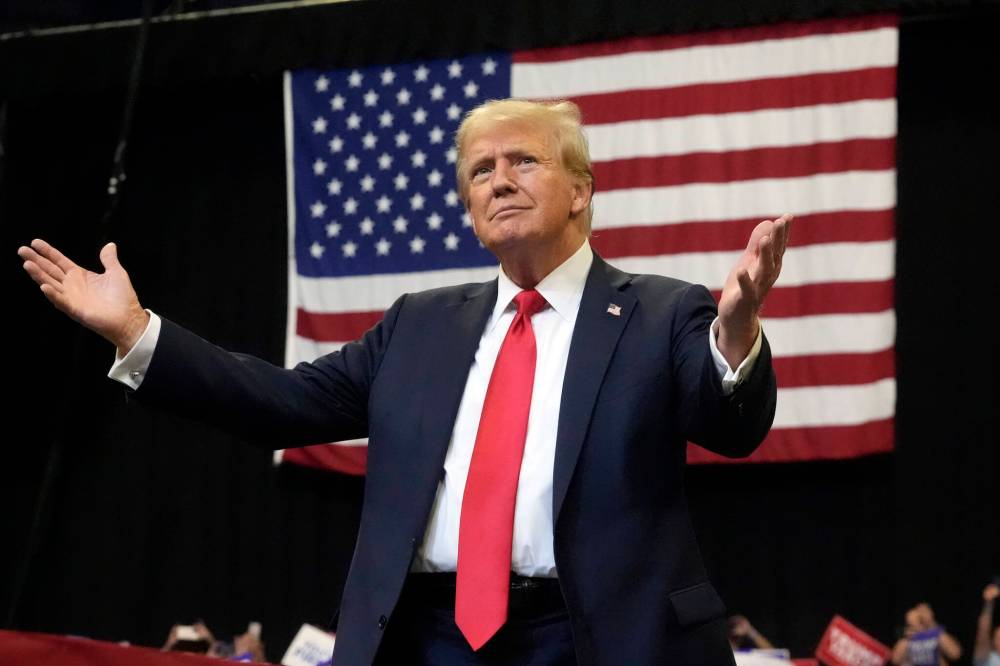
Rick Bowmer / The Associated Press Files
Republican presidential nominee former U.S. president Donald Trump arrives to speak at a campaign rally in Bozeman, Mont., on Aug. 9.
Given that the United States provides their presidents with a high degree of political power and autonomy, the stakes of this decision are high and far-reaching. This judgment provides a virtual carte blanche to any presidential whims, no matter how arbitrary, irresponsible or vindictive, clearly beyond the reach of most laws.
However, it has yet to be seen whether denying election results and encouraging insurrection can be interpreted as official acts or immune unofficial acts that place them above the law. Clearly, Donald Trump believes all his acts are out of the reach of the law, declaring he’s “immune from all of the stuff they charged me with.”
Despite Rambo’s seeming assurances based upon past incursions of the U.S. Supreme Court into the political realm, and his claims the current majority are textualists, as in “nothing out of the ordinary” here, I cannot see how this immunity ruling is, in fact, constitutional as, by my reading, there is no mention or hint of absolute immunity in the constitution’s text.
Trump, regardless of whether he escapes prosecution or not, is a writhing bundle of illegality, a person who acknowledges no moral or civil boundaries, whose oath of office comes across as empty words.
Despite trying every trick in his lawyers’ books to delay prosecution, he is a convicted felon. It appears that scamming government, which in one sense means all Americans, threatening and insulting opponents and non-whites, abusing women and lying about almost everything, are somehow all forgivable and noble in the eyes of MAGA supporters. Or at least of minor consequence.
By continuing to support and endorse Trump, the Republicans have much to answer for and, by legitimizing Trump’s perversities, the U.S. Supreme Court has compromised its claims to impartiality. And let’s not forget political neutrality of the judiciary is one of the guardrails of democracy, and this ruling is clearly a Trump-driven, Trump-protective and Republican-enabling judgment meant to appease a particular faction of the American population. However, the reach of this ruling goes way beyond Trump, regenerating a pattern of Republican aggressiveness and Democratic acquiescence.
Starting with Ronald Reagan, Republican presidents boldly promoted an unfettered marketplace shored up by deregulation, tax cuts and attacks on public spending, measures resulting in the weakening of social safety nets and public education. Democratic presidents, during their terms, regularly supported similar policies, claiming political pragmatism. Today, both parties are implicated in this agenda, which has evolved into Project 2025.
Project 2025, also called 2025 Presidential Transition Project, underwritten and authored by the extreme right-wing Heritage Foundation, assumes a Trump presidency that would, among other initiatives: make the whole federal civil service beholden to the president; politicize the judiciary according to authoritarian Christian nationalism; undermine the rule of law; remove existing checks and balances; eliminate the separation of church and state; revoke environmental measures; imprison immigrants without due process; bring back federal capital punishment; punish anti-white racism; and, jettison the Department of Education. Such imagined totalistic control makes Levine’s warnings look like child’s play. All are open attacks on the original meanings and intent of the civil liberties implied by freedom of speech, assembly and religion, also guardrails of democracy.
Finally, perhaps also anticipated, a Trump presidency would serve to embolden the right, driven by neoliberal ideology elsewhere in the world, including Canada and Manitoba. In Canada, we are witnessing Trump-like behaviour, such as attacks on long-standing public institutions and personal attacks on politicians.

In Manitoba, Progressive Conservatives since the early 1990s have unapologetically pursued their right-wing ideologies while the NDP, citing “middle of the road” pragmatism, has conceded on damaging tax cuts and timidly dealt with unaccountable non-funded private schools and homeschoolers.
The recently defeated Bill 64 in Manitoba was like a page out of Project 2025 with its unilateral attempt to establish provincial caucus control over all aspects of schooling and its proposal to eliminate any local control, make political civil servants out of all teachers and encourage further privatization of education.
Political immunity has always been a challenge to the guardrails of democracy, resting as it does upon a faith in the goodwill and moral and civil judgments of our elected leaders to act in the interest of all of us. When that faith, rightfully or wrongfully, breaks down, as we are witnessing in the Western world, adding greater immunity to the mix further enables authoritarianism and encourages totalitarianism.
We can only hope for democracy to prevail in elections in both countries — a democracy that is a way of life based upon trust and truth, empathy and integrity, rather than only an electoral choice driven by political expediency and opportunism.
John R. Wiens is dean emeritus at the faculty of education, University of Manitoba.
Related Articles
The U.S. Supreme Court — changes and controversy
Advertisement Advertise With Us
Advertisement Advertise With Us
History
Updated on Monday, August 26, 2024 11:01 AM CDT: Fixes typos, style errors
Updated on Monday, August 26, 2024 12:01 PM CDT: Style changes