

Nature will always be victorious — eventually

Advertisement
Read this article for free:
or
Already have an account? Log in here »
To continue reading, please subscribe:
Digital Subscription
One year of digital access for only $1.44 a week*
- Enjoy unlimited reading on winnipegfreepress.com
- Read the E-Edition, our digital replica newspaper
- Access News Break, our award-winning app
- Play interactive puzzles
*Billed as $5.77 plus GST every four weeks. After 52 weeks, price increases to the regular rate of $19.95 plus GST every four weeks. Offer available to new and qualified returning subscribers only. Cancel any time.
To continue reading, please subscribe:
Add Free Press access to your Brandon Sun subscription for only an additional
$1 for the first 4 weeks*
- Enjoy unlimited reading on winnipegfreepress.com
- Read the E-Edition, our digital replica newspaper
- Access News Break, our award-winning app
- Play interactive puzzles
*Your next Brandon Sun subscription payment will increase by $1.00 and you will be charged $17.95 plus GST for four weeks. After four weeks, your payment will increase to $24.95 plus GST every four weeks.
Read unlimited articles for free today:
or
Already have an account? Log in here »
Hey there, time traveller!
This article was published 29/03/2025 (569 days ago), so information in it may no longer be current.
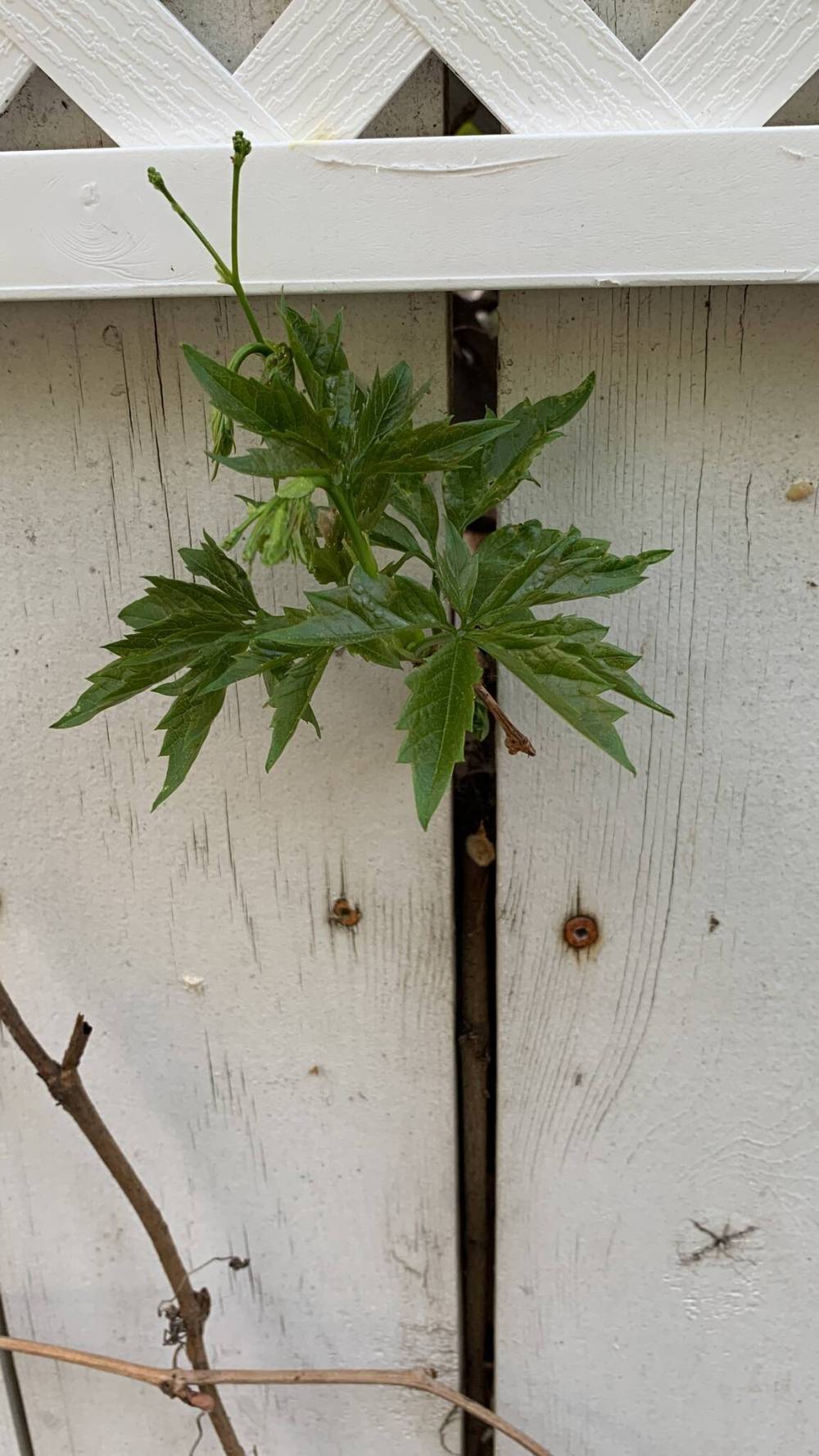
Last spring, the Virginia creeper set out from our front fence and headed on a journey blindly up though the extension on the aluminum drainpipe, eventually coming out through a small opening at a bend six feet above the ground.
Pleased with its success, it made a happy, shiny, light-green bouquet where it poked out of the pipe.
Knowing the propensity for creeper to take over, after all its hard work, I cruelly hauled the traveller back down the pipe.

Russell Wangersky/Free Press
A spruce tree survives clinging to a cliff face by its roots.
The naked yellow-white shoot had the same soft yet stiff feeling of a long shoot on a sprouting potato — in the absence of light inside the drainpipe, it hadn’t bothered with greening up or hardening a layer of bark. It was just, well, questing.
And that takes me back to a secondary point I was toying with in my last column — the problem being secondary points don’t have much room to grow in the 900 or so words I’m allotted, so it withered on its own vine. Until now.
Bear with me a bit. Two weeks ago, I was interested in the journey.
I wrote about finding a maritime waypoint marker on a Newfoundland hilltop, a brass-and-concrete object that had been in the same spot since 1951, when the Canadian Hydrographic Survey placed it there.
What I didn’t have time to mention was that I found it by chance while looking for something else — and that when I found it, it was buried six inches deep in the tangled — woven, really — roots and branches of ground juniper, blueberry, cranberry and other lowbush shrubs.
It was that deeply buried because of something I think about often — the fact nature always wins.
Russell Wangersky/Free Press
Virginia Creeper making its way to a new foothold.
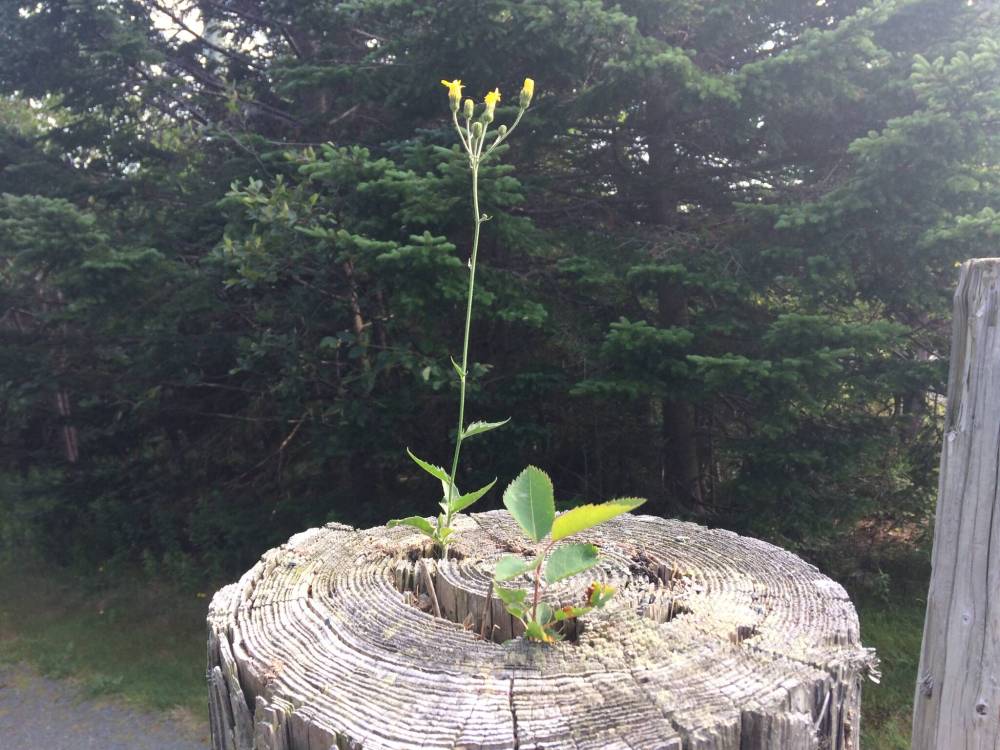
I often post pictures online when I see nature winning — flowers exploiting and expanding cracks in pavement, landwash plants overtaking stone berms on a rocky beach, a sapling springing out of a wooden post, an abandoned car deep in the woods being dressed over by sphagnum moss like a furry green paint job — and the list goes on.
There’s a lot of discussion about the effects of climate change — about the way some species can adapt while others can’t, about how still other species can move northwards to stay in a temperature zone — on land or underwater — that suits them, while others can’t.
Whole species of fish have moved north into new waters as the southern Atlantic has warmed. Mahi Mahi, fish from Floridian waters, have moved up to North Carolina. Snook have moved from the warm-water Caribbean to Florida. Black sea bass are now plentiful in the Gulf of Maine, much farther north than they were just 15 years ago.
But coral reefs aren’t in a position to move.
I’ve watched some of the changes happen right in front of me — big healthy decades-old spruces dying off across an entire peninsula in the last few years because of the change in rainfall intensity and duration.

Russell Wangersky/Free Press
Plants exploit a cracked driveway.
There’s just as much rain in that particular region, but it’s more intense and more of it runs off before spruces can gather it with the shallow fans of their roots, and with the spells between the deluges stretching out, the trees are too big and too thirsty to survive.
But just like weather isn’t climate, single species aren’t nature.
Scores of species on Earth head toward extinction every day. About 2.5 per cent of the total mass of the world’s insects disappears every year now. While you feel you may not miss them, that includes the insect pollinators responsible for the continuation of most human food crops.
There’s already clear evidence there are going to be winners and losers, the losers possibly including millions of people whose homelands become functionally uninhabitable.
But that’s just the weather, if you catch my metaphor.
Because other things are going to fill the gap. Eventually, other things might fill our gap, no matter how hostile we manage to make our environment.
Russell Wangersky/Free Press
New life sprouts from a gatepost.
There are both fungi and bacteria that not only withstand high levels of radiation, but that actually use the radiation to power their metabolism. Ideonella sakaiensis is a microbe that breaks plastic down into metabolically useful elements. Comamonas testosterone is a bacteria that has similar tendencies. They’ll have lots to do, given the amount of plastic we humans generate and discard.
Nature always wins. Eventually.

That doesn’t mean humans will. Not by a long shot.
It wins, with or without us. (It will probably win better without us.) That may sound depressing, but the truth is our individual allotted spans on this Earth are at most 100 years or so.
When I see a plant thriving where no plant should be, it makes me smile a little on the inside — because I know this thing we call life will go on, despite how final a hash we actually make of it for ourselves.

Russell Wangersky/Free Press
Plants colonize a Winnipeg parking lot.
Long into the future, a brass disk set in concrete marking waypoint 555 will still be on a Newfoundland hilltop, most likely buried deep again under the branches and roots and tendrils of a score of different wildland plants that can co-exist with ease. Instead of directions for travel ahead, it might just be a lonely reminder of what was.
Russell Wangersky is the Comment Editor of the Free Press. He can be reached at russell.wangersky@freepress.mb.ca
Russell Wangersky
Perspectives editor
Russell Wangersky is Perspectives Editor for the Winnipeg Free Press, and also writes editorials and columns. He worked at newspapers in Newfoundland and Labrador, Ontario and Saskatchewan before joining the Free Press in 2023. A seven-time National Newspaper Award finalist for opinion writing, he’s also penned eight books. Read more about Russell.
Russell oversees the team that publishes editorials, opinions and analysis — part of the Free Press‘s tradition, since 1872, of producing reliable independent journalism. Read more about Free Press’s history and mandate, and learn how our newsroom operates.
Our newsroom depends on a growing audience of readers to power our journalism. If you are not a paid reader, please consider becoming a subscriber.
Our newsroom depends on its audience of readers to power our journalism. Thank you for your support.
Russell Wangersky
Perspectives editor
Russell Wangersky is Perspectives Editor for the Winnipeg Free Press, and also writes editorials and columns. He worked at newspapers in Newfoundland and Labrador, Ontario and Saskatchewan before joining the Free Press in 2023. A seven-time National Newspaper Award finalist for opinion writing, he’s also penned eight books. Read more about Russell.
Russell oversees the team that publishes editorials, opinions and analysis — part of the Free Press‘s tradition, since 1872, of producing reliable independent journalism. Read more about Free Press’s history and mandate, and learn how our newsroom operates.
Our newsroom depends on a growing audience of readers to power our journalism. If you are not a paid reader, please consider becoming a subscriber.
Our newsroom depends on its audience of readers to power our journalism. Thank you for your support.
Advertisement Advertise With Us
Advertisement Advertise With Us