

Don’t let world-weariness drag you into hate

Advertisement
Read this article for free:
or
Already have an account? Log in here »
To continue reading, please subscribe:

Digital Subscription
One year of digital access for only $205*
- Enjoy unlimited reading on winnipegfreepress.com
- Read the E-Edition, our digital replica newspaper
- Access News Break, our award-winning app
- Play interactive puzzles
*First annual payment billed as $205.00 + GST for one year. This annual subscription will automatically renew at $233.00 + GST every 52 weeks (10% off the regular annual price of $259.35). Offer available to new and qualified returning subscribers only. Cancel any time.
To continue reading, please subscribe:
Add Free Press access to your Brandon Sun subscription for only an additional
$1 for the first 4 weeks*
- Enjoy unlimited reading on winnipegfreepress.com
- Read the E-Edition, our digital replica newspaper
- Access News Break, our award-winning app
- Play interactive puzzles
*Your next Brandon Sun subscription payment will increase by $1.00 and you will be charged $17.95 plus GST for four weeks. After four weeks, your payment will increase to $24.95 plus GST every four weeks.
Read unlimited articles for free today:
or
Already have an account? Log in here »
Hey there, time traveller!
This article was published 17/01/2026 (243 days ago), so information in it may no longer be current.
I wonder sometimes if I’ve started to harden off.
If, after being gradually exposed to the extreme moral cold spell that encompasses the current world, I’ve grown ever more calloused.
Hard-bitten. Jaded, faded, day by day, with the drip, drip, drip of man’s inhumanity to man. Unwilling to believe sometimes that, at the core of most people, there’s actually still a central spine of good.
Russell Wangersky/Free Press
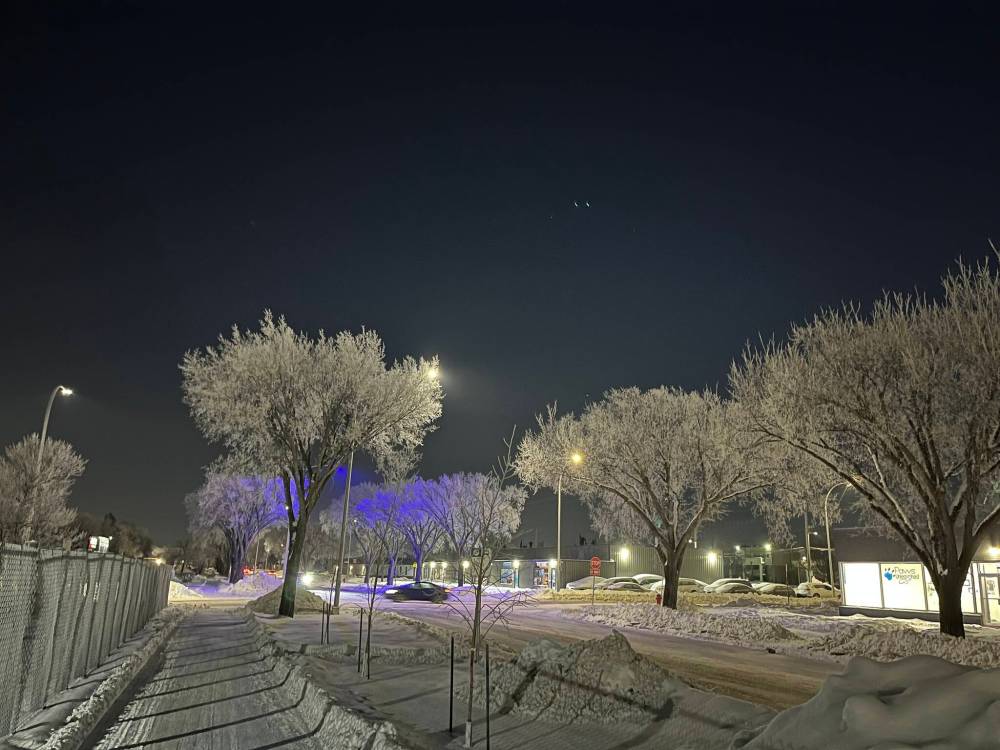
A car passes through the intersection at Mountain and Fife, under frosted trees.
It’s hard not to, especially in times like this when every single day brings a new incarnation of darkness. Russian bombings and missile attacks on Ukrainian civilians and combatants alike, the seeming lawlessness of masked, fatigues-clad U.S. paramilitary forces taking aim at American neighbourhoods, a U.S. president who seems to believe that other countries are his for the taking.
It is not the world’s brightest hour. And all of that darkness is, to me, a constant weight — something that leans in on all of us, heavier and more damaging, I think, than we’re probably conscious of.
I’ve seen it in other people, so I think I can recognize it in myself. I sure hope it’s a passing political phase, a short-lived period we might be able to look back on as a particularly dark time in human history that we were somehow lucky enough to escape.
I fear, though, that we’re learning to be jealous, learning to hate — and worse, that we’re constantly being told that we’re allowed to hate. That we’re supposed to actually revel in hate.
At an earlier point in my life, that might have been something that made me want to take action. Made me want to take part in change, to strive to break out from the dead-end cycle of you-slap-me, I-slap-you that leads nowhere and gains nothing except more of the same.
Even if what I did was small, even if it was the odd and perhaps naïve effort to bring a small handful of something beautiful to those who read what I write.
But right now, I’m having trouble finding even those small and beautiful things. They escape me, crumble in my hands, shift from vibrancy to dust while I wonder why they flee.
Perhaps it’s just age: I can remember — without being able to offer up a specific date or event — that there was a point where my parents stopped being people who looked up and out at, and reached for, the wonders of the world, and instead focused on what was wrong far more often than on what they could make right.
It was the point when my mother, who could scuba dive solo deep in salt springs and fire a .45 revolver, who camped in wildlands alone and sailed small boats on big oceans, stopped pointing to the future and chose a new mantra: “Don’t forget that the world isn’t fair. The world isn’t fair.”
Some great and significant event bent her compass, but I was never told what it was. Was never able to figure out what it was. But it was as if she had let something or someone steal her future.
Perhaps it was as simple as what I feel now: having experienced many, many years and the natures of many, many people, maybe she — like me — found herself mysteriously without energy, and often unable to muster enough to rise up to the fight again.
And she was a fighter, a campaigner, a woman who, when knocked down, got up ready to fight again.
Until, one day, she didn’t.
I desperately hope that is not where I am, at that spot where you whirl around in your own small universe, focusing on the things that are particularly in your grasp, guarding them within the walls of your house and the curtains on your windows so that they cannot be taken, too.
I hope not, because I can remember what it took from her. What it took from us.
Russell Wangersky/Free Press
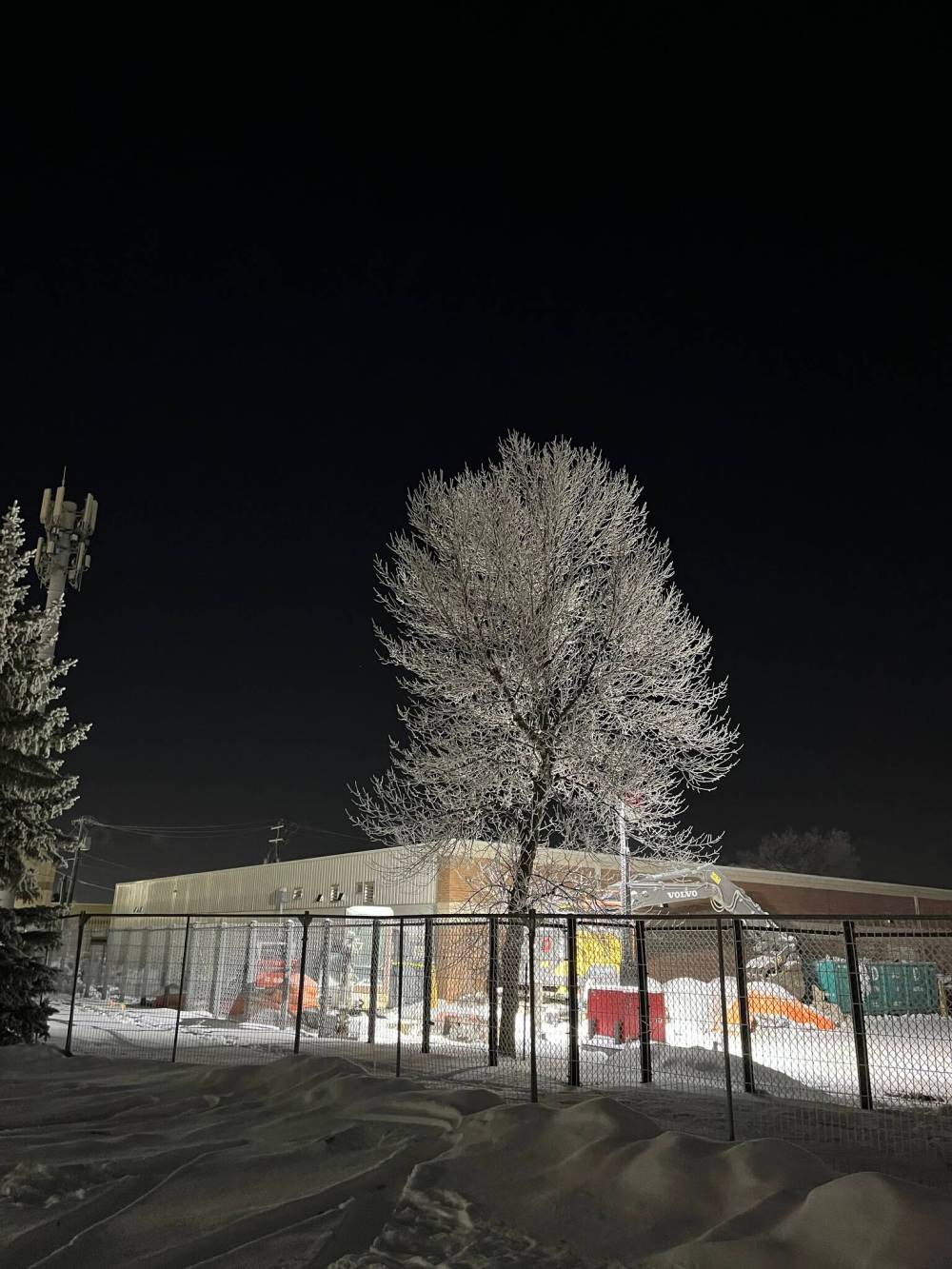
An ice-clad tree on Fife in Winnipeg.
Steve Bannon, the first time Donald Trump was U.S. president, argued that the best way to control the American population was to overwhelm dissent: “The Democrats don’t matter… The real opposition is the media. And the way to deal with them is to flood the zone with shit.”
Well, the zone, and pretty much everything else, is well and truly flooded.
Still, we rise. We rise, in fits and starts and twitches, because we have to. Because the alternative is to lie down and give in. But it’s hard. And though I find it harder every day, pushing against a blind weight of a numbing, sneering horde, I try to rise, too.
Sometimes, relief appears, fleeting, few and far between.
Last week, just before 7 a.m. on Fife Street, and the air was completely still. The January cold had broken and the air had dampened, but everything else, everything, was still deep-frozen.
And the hoarfrost or rime ice had grown the way it does, in fine fronds and plated flakes, from the inside to the out, all of it balanced and even and almost unnatural, as if the uniformity of the fur of ice was proof of its artificiality. It was both perfect and too perfect.

It was, for a brief morning, everywhere. On the trees, on the wires, on the light poles.
On the soul.
It’s still in there.
Don’t you see? We can’t let them take it away.
Russell Wangersky is the Comment Editor at the Free Press. He can be reached at russell.wangersky@freepress.mb.ca
Russell Wangersky
Perspectives editor
Russell Wangersky is Perspectives Editor for the Winnipeg Free Press, and also writes editorials and columns. He worked at newspapers in Newfoundland and Labrador, Ontario and Saskatchewan before joining the Free Press in 2023. A seven-time National Newspaper Award finalist for opinion writing, he’s also penned eight books. Read more about Russell.
Russell oversees the team that publishes editorials, opinions and analysis — part of the Free Press‘s tradition, since 1872, of producing reliable independent journalism. Read more about Free Press’s history and mandate, and learn how our newsroom operates.
Our newsroom depends on a growing audience of readers to power our journalism. If you are not a paid reader, please consider becoming a subscriber.
Our newsroom depends on its audience of readers to power our journalism. Thank you for your support.
Russell Wangersky
Perspectives editor
Russell Wangersky is Perspectives Editor for the Winnipeg Free Press, and also writes editorials and columns. He worked at newspapers in Newfoundland and Labrador, Ontario and Saskatchewan before joining the Free Press in 2023. A seven-time National Newspaper Award finalist for opinion writing, he’s also penned eight books. Read more about Russell.
Russell oversees the team that publishes editorials, opinions and analysis — part of the Free Press‘s tradition, since 1872, of producing reliable independent journalism. Read more about Free Press’s history and mandate, and learn how our newsroom operates.
Our newsroom depends on a growing audience of readers to power our journalism. If you are not a paid reader, please consider becoming a subscriber.
Our newsroom depends on its audience of readers to power our journalism. Thank you for your support.
Advertisement Advertise With Us
Advertisement Advertise With Us