

Which direction will Pierre Poilievre choose?

Advertisement
Read this article for free:
or
Already have an account? Log in here »
To continue reading, please subscribe:

Digital Subscription
One year of digital access for only $205*
- Enjoy unlimited reading on winnipegfreepress.com
- Read the E-Edition, our digital replica newspaper
- Access News Break, our award-winning app
- Play interactive puzzles
*First annual payment billed as $205.00 + GST for one year. This annual subscription will automatically renew at $233.00 + GST every 52 weeks (10% off the regular annual price of $259.35). Offer available to new and qualified returning subscribers only. Cancel any time.
To continue reading, please subscribe:
Add Free Press access to your Brandon Sun subscription for only an additional
$1 for the first 4 weeks*
- Enjoy unlimited reading on winnipegfreepress.com
- Read the E-Edition, our digital replica newspaper
- Access News Break, our award-winning app
- Play interactive puzzles
*Your next Brandon Sun subscription payment will increase by $1.00 and you will be charged $17.95 plus GST for four weeks. After four weeks, your payment will increase to $24.95 plus GST every four weeks.
Read unlimited articles for free today:
or
Already have an account? Log in here »
Hey there, time traveller!
This article was published 31/01/2026 (229 days ago), so information in it may no longer be current.
Federal Conservative Party Leader Pierre Poilievre chooses his future this weekend. That future comes down to the choice he will make between two words: fidelity or fiduciary.
Fidelity to a narrow, loud, and powerful conservative movement that he harnessed to win his party’s leadership and which today exerts primordial control over its image and direction. Or a fiduciary duty to the party he leads to reach beyond that movement and get his party elected so it can govern Canada.
This classic tension exists for all leaders in all parties. But it is acutely felt within the Conservative Party of Canada after its stunning loss to the Lazarus Liberals that rose from the politically dead due to Mark Carney’s resuscitation. Changing leaders is the time-worn way for parties to elude such existential questions about who they are and what they stand for. Conservatives know this more than most.
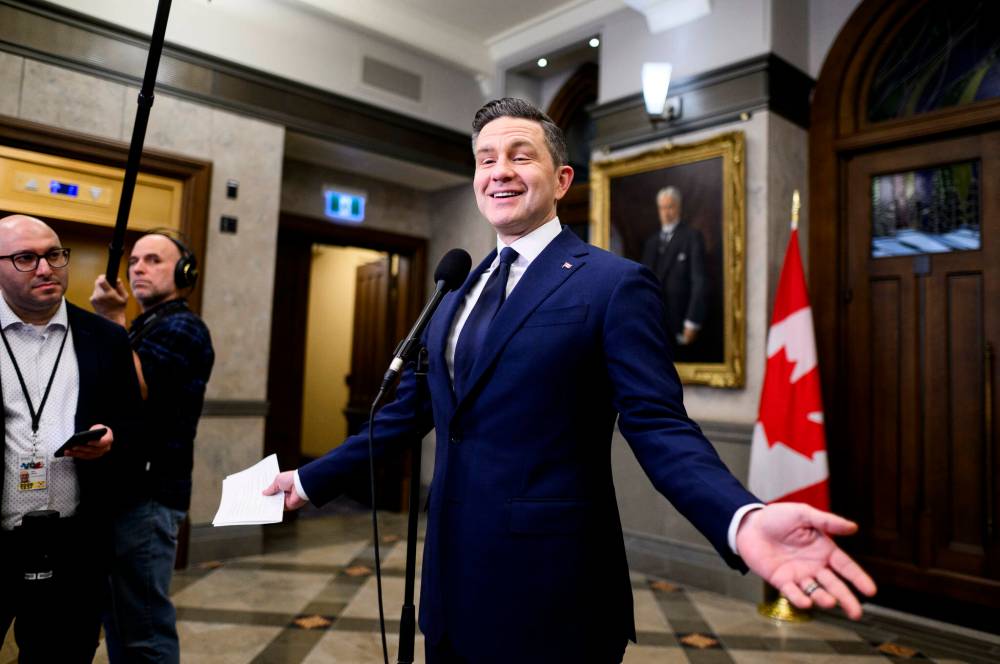
The Canadian Press
If he keeps his job as leader of the Conservative Party, Pierre Poilievre has a crucial decision to make.
That is not what will happen though this weekend in Calgary at the party’s convention with its mandatory leadership review vote. Every indicator suggests Poilievre will win handily. Readers may know the outcome of Friday night’s vote — if he is successful, whatever the tally, his next choice is clear.
Poilievre has laboured mightily to win this vote since his double loss in last April’s federal election of both the country and his own seat. He ran for and won a byelection with an increased majority in a safe Alberta seat to get back into Parliament right away. He has turned up, not down, his anti-Liberal, anti-Carney rhetoric from the election that appeals to his base, swatting away any suggestions that a change in demeanour is called for in the wake of his losses.
The rational explanation for this behaviour is simple. Poilievre had a leadership review to win. He did not want to do anything to alienate his position with Conservative voters in Calgary, even if it meant alienating his position with Canadian voters across the country. A lengthy absence from the House of Commons would have taken him out of the public eye. It would have undermined the relevancy of his leadership with the most important voting bloc, the caucus. He is determined to remain leader.
Poilievre’s dilemma is that conservatives like him, with some liking him a lot. But poll after poll shows many Canadians do not share that enthusiasm. The Conservative leader runs well behind Carney for “best prime minister.” He has lost ground since losing the last election. Change to address this and he risks alienating those conservatives who like the combative Poilievre him just as he is. Don’t change and risk alienating for good those Canadians who will vote for an alternative to the Liberal government but not “this” type of Pierre Poilievre.
Own the libs, but lose the country, is an uncomfortable bargain being thrust upon the leader of the Opposition. But it is one he has helped forge, first with his relentlessly combative image and second, by making a play for those hard-right People’s Party of Canada voters who had deserted the Conservatives in the 2021 election.
He now needs to decide between those two risks. That means forging a bargain with so-called “movement conservatives,” the hardcore base of his support. A bargain that downplays their terminally angry, pro-Trump approach to politics in favour of a serious, prime minister-in-waiting approach that allows voters to see beyond the negative, narrow one-dimensional image he has allowed to congeal against him. That is his only path to electoral success.
Poilievre has the clout to take this path. His command as the authentic torch-bearer of the federal conservative movement gives him more room to manoeuvre, not less. What he needs now is his “Nixon goes to China” pivot. This was the historical characterization that only a true Cold War hawk like former U.S. president Richard Nixon could make the dramatic move to travel to communist China in 1972 and begin to normalize relations. The Republican right aligned with this because they trusted Nixon’s anti-communist credentials not to sell out. Nixon went on to win a landslide election victory that same year.
As he is a child of conservative politics with a deeply embedded set of ideological perspectives on what conservatives should stand for, such a pivot appears hard and distasteful for Poilievre. Fidelity to being leader of a conservative movement of principles, values, and ideas matters a lot to him.

But he is leader of a Conservative party too. These are different things with different missions. Under Poilievre’s tenure, the two have been deliberately merged. He seeks to govern as a conservative, not just a Conservative. For a while, as the Justin Trudeau government fell ever more unpopular, this worked. Until it didn’t. The effect of this strategy has been to create a high floor but a lower ceiling of voter support for his party held back by himself. There just aren’t enough conservatives in Canada to win on their own terms.
If he receives a strong, renewed leadership mandate from his party in Calgary, Poilievre owes a fiduciary duty to his party to flip the proposition. He needs to use that mandate to act from this day forward as leader of a viable and politically appealing alternative governing option called the Conservative Party of Canada.
Poilievre faces a duty dilemma. A duty of fidelity to the movement or a fiduciary duty to the party.
Which call of duty will he answer?
David McLaughlin is a former clerk of the executive council and cabinet secretary in the Manitoba government.
Our newsroom depends on a growing audience of readers to power our journalism. If you are not a paid reader, please consider becoming a subscriber.
Our newsroom depends on its audience of readers to power our journalism. Thank you for your support.
Our newsroom depends on a growing audience of readers to power our journalism. If you are not a paid reader, please consider becoming a subscriber.
Our newsroom depends on its audience of readers to power our journalism. Thank you for your support.
Related Articles
Poilievre’s survival rooted in confirmation bias
Advertisement Advertise With Us
Advertisement Advertise With Us