

Poilievre’s survival rooted in confirmation bias

Advertisement
Read this article for free:
or
Already have an account? Log in here »
To continue reading, please subscribe:

Digital Subscription
One year of digital access for only $205*
- Enjoy unlimited reading on winnipegfreepress.com
- Read the E-Edition, our digital replica newspaper
- Access News Break, our award-winning app
- Play interactive puzzles
*First annual payment billed as $205.00 + GST for one year. This annual subscription will automatically renew at $233.00 + GST every 52 weeks (10% off the regular annual price of $259.35). Offer available to new and qualified returning subscribers only. Cancel any time.
To continue reading, please subscribe:
Add Free Press access to your Brandon Sun subscription for only an additional
$1 for the first 4 weeks*
- Enjoy unlimited reading on winnipegfreepress.com
- Read the E-Edition, our digital replica newspaper
- Access News Break, our award-winning app
- Play interactive puzzles
*Your next Brandon Sun subscription payment will increase by $1.00 and you will be charged $17.95 plus GST for four weeks. After four weeks, your payment will increase to $24.95 plus GST every four weeks.
Read unlimited articles for free today:
or
Already have an account? Log in here »
Hey there, time traveller!
This article was published 02/02/2026 (227 days ago), so information in it may no longer be current.
It’s hard to believe that Conservative Party members who voted to allow Pierre Poilievre’s continued leadership actually understand the consequences of their decision.
In the bubble of the party’s policy convention — suffocated by the relentless lobbying of Poilievre’s allies and perhaps experiencing a contact high from exposure to Alberta separatism — Tories probably thought they were making a decision that sets them up well for the next election. And who knows? Poilievre could redefine the term “political comeback” if he somehow prevails.
This is the man who squandered an unassailable lead in pre-election polling and lost his own seat in the 2025 election. Then, he clawed his way back by winning a byelection (in another province no less) and survived last weekend’s leadership vote. If he goes on to win the next election, Tories will write folk songs about the Unsinkable Pierre.
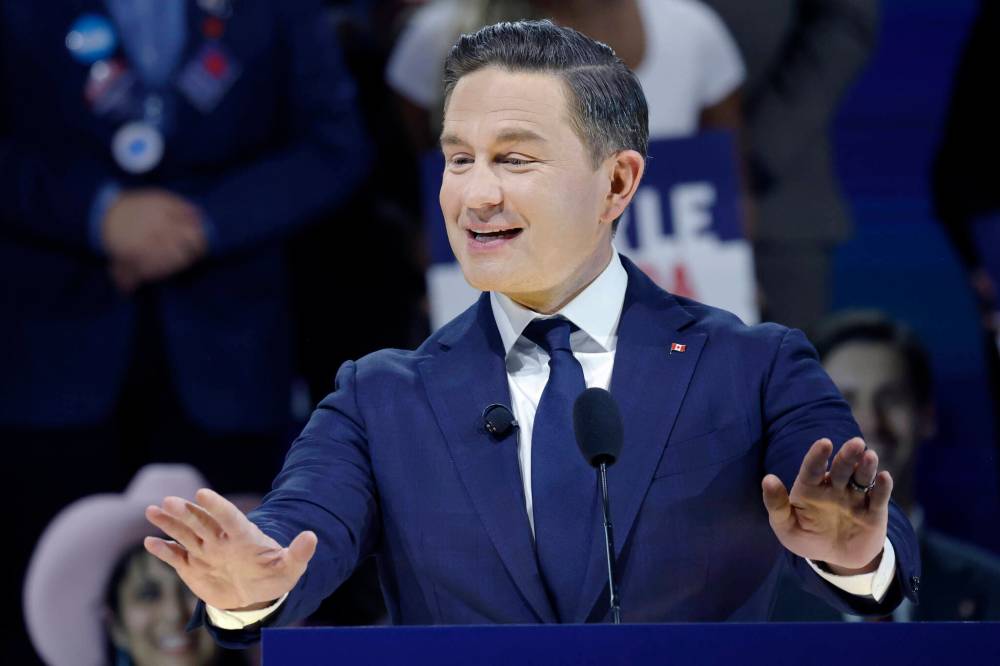
Conservative Leader Pierre Poilievre delivers his keynote address at the party’s national convention in Calgary, Friday, Jan. 30, 2026. (Larry MacDougal / The Canadian Press)
Unfortunately, the odds on that happening are long.
Tories may love Poilievre, but almost nobody else does.
He has a net negative approval rating with men, women, younger people, older Canadians and among the critically important swing voter constituency who, ultimately, decide who wins federal elections. Oh, and while Poilievre sinks ever lower in the estimation of voters, Prime Minister Mark Carney has a significant, double-digit net positive rating across all those demographics.
The bad news for Poilievre even extends to Alberta, the nexus of Conservative support in Canada. A recent Angus Reid poll found Poilievre had a net positive rating of just +2 per cent. For context, Carney — the leader of the party Albertans love to detest — had a +1 per cent net positive rating.
Why weren’t Tories dissuaded by all of Poilievre’s net negatives?
When a critical mass of partisans gather for three days of commiseration and rage, they come out the other end with a deeply rooted confirmation bias. In this case, the bias suggests the last election loss was not Poilievre’s fault, at least not entirely. And that Conservatives got more votes and won more seats than the previous election but were denied as NDP support collapsed and fled to the Liberals. And finally, that voters were so scared of Donald Trump they made an irrational decision to stick with the status quo.
Those are not entirely fallacious theories. Poilievre had the party in a great position to trounce the Liberals before Trump started his second presidential term. And any leader who gets seven per cent more votes and 24 additional seats was not, in strict mathematical terms, a complete disaster.
However, even if you gave Poilievre a pass for “losing” the last election, you can’t overlook the fact it was his style, tone and messaging that allowed the Liberals to close the sizable gap he had opened up for most of the previous two years before the 2025 election.
Prior to Carney coming on the scene, Poilievre was popular in a relative sense because the man he was battling — former Prime Minister Justin Trudeau — was universally detested. While Trudeau teetered on the edge of the abyss, Poilievre was allowed to be rambunctious, irreverent, even downright disrespectful. He gave his enemies cruel nicknames, made outlandish (and often factually and empirically unsupportable) allegations, hung out with unsavoury characters from the far-right of our political spectrum, talked about waging a Trumpian culture war against “woke” elements in government and generally flouted political civility.
Then, two things happened that changed the game.
Trump threatened Canada and the Liberals finally convinced Trudeau to step down. Meanwhile, Poilievre forged ahead, seemingly unaware the political ground under his feet had shifted seismically. The Tory leader kept on barking and name calling even as Canadian voters were signalling that they did not want a Trump-style politician running their country.
All of that said, the result of the leadership review in Calgary was really the best possible outcome for Canadians of all political stripes. If nothing else, it was definitive and allows Poilievre to go forward without having to face questions about whether his own party is behind him. And that should allow him to go back to Ottawa and provide effective opposition, which will most definitely be needed in the months ahead.

Carney’s soaring popularity could easily translate into hubris, particularly if there is a quiet consensus among all parties in the House of Commons that now is not the time for another federal election. In an context like that, a competent opposition is crucial. Canadians don’t want inflammatory allegations; they want political leaders who think of the welfare of Canada before their own political aspirations.
Based on the results of the vote, core Tories must believe that Poilievre can be that leader. Competent in opposition and inspiring to Canadians who fear Trump. However, to be that guy, he’d have to adopt a significantly different tone and message. Evidence to date, including his fiery, pre-leadership review speech on the weekend, is that Poilievre has no interest in doing that.
That leaves the Tories in an awkward situation. Rather than amending strategy and message to win back support, they are going to have to wait until Carney and the Liberals make enough mistakes and their popularity suffers.
That’s what you get when you walk-back a team that failed so miserably the last time: a leader who can only succeed if the other team fails.
dan.lett@freepress.mb.ca
Dan Lett is a columnist for the Free Press, providing opinion and commentary on politics in Winnipeg and beyond. Born and raised in Toronto, Dan joined the Free Press in 1986. Read more about Dan.
Dan’s columns are built on facts and reactions, but offer his personal views through arguments and analysis. The Free Press’ editing team reviews Dan’s columns before they are posted online or published in print — part of the our tradition, since 1872, of producing reliable independent journalism. Read more about Free Press’s history and mandate, and learn how our newsroom operates.
Our newsroom depends on a growing audience of readers to power our journalism. If you are not a paid reader, please consider becoming a subscriber.
Our newsroom depends on its audience of readers to power our journalism. Thank you for your support.
Dan Lett is a columnist for the Free Press, providing opinion and commentary on politics in Winnipeg and beyond. Born and raised in Toronto, Dan joined the Free Press in 1986. Read more about Dan.
Dan’s columns are built on facts and reactions, but offer his personal views through arguments and analysis. The Free Press’ editing team reviews Dan’s columns before they are posted online or published in print — part of the our tradition, since 1872, of producing reliable independent journalism. Read more about Free Press’s history and mandate, and learn how our newsroom operates.
Our newsroom depends on a growing audience of readers to power our journalism. If you are not a paid reader, please consider becoming a subscriber.
Our newsroom depends on its audience of readers to power our journalism. Thank you for your support.
Related Articles
Conservatives, Poilievre seek to carry convention momentum back into Parliament



Advertisement Advertise With Us
Advertisement Advertise With Us