

Out of the black, back into brilliant green

Advertisement
Read this article for free:
or
Already have an account? Log in here »
To continue reading, please subscribe:

Digital Subscription
One year of digital access for only $205*
- Enjoy unlimited reading on winnipegfreepress.com
- Read the E-Edition, our digital replica newspaper
- Access News Break, our award-winning app
- Play interactive puzzles
*First annual payment billed as $205.00 + GST for one year. This annual subscription will automatically renew at $233.00 + GST every 52 weeks (10% off the regular annual price of $259.35). Offer available to new and qualified returning subscribers only. Cancel any time.
To continue reading, please subscribe:
Add Free Press access to your Brandon Sun subscription for only an additional
$1 for the first 4 weeks*
- Enjoy unlimited reading on winnipegfreepress.com
- Read the E-Edition, our digital replica newspaper
- Access News Break, our award-winning app
- Play interactive puzzles
*Your next Brandon Sun subscription payment will increase by $1.00 and you will be charged $17.95 plus GST for four weeks. After four weeks, your payment will increase to $24.95 plus GST every four weeks.
Read unlimited articles for free today:
or
Already have an account? Log in here »
Regeneration.
Rĭ-jĕn′ə-rā′shən.
We’re rebuilding — though we know it will be a very different place, perhaps for years — perhaps for a generation.
Russell Wangersky / Free Press
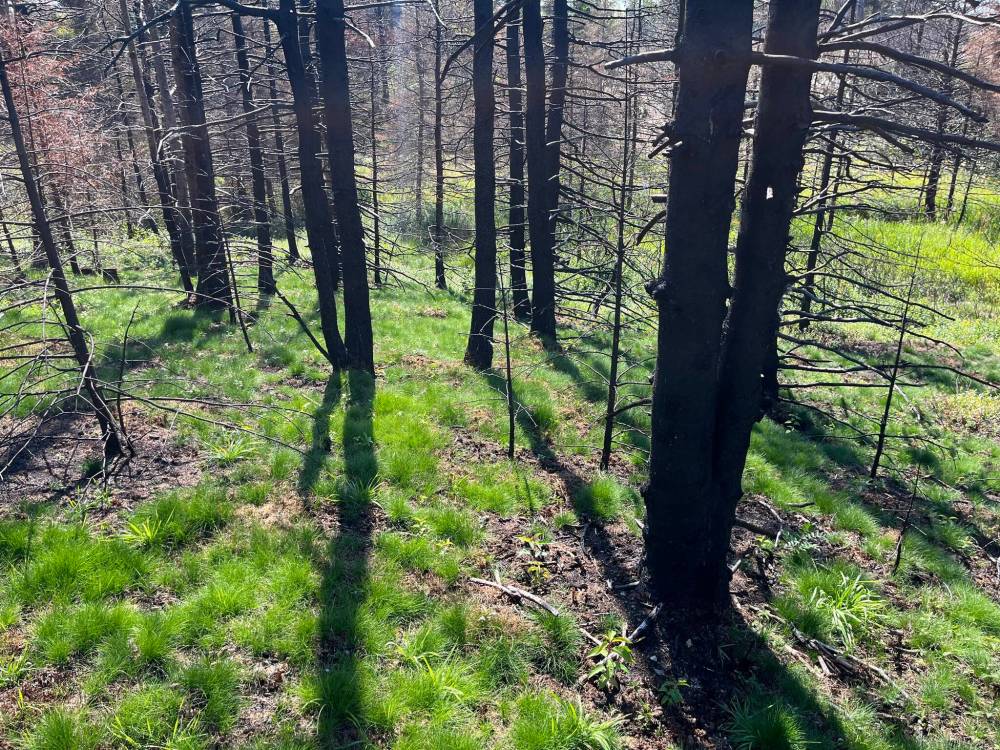
Four months after the first Adam’s Cove, NL, forest fire, grass has replaced deep banks of moss.
Thursday marked a full year since a forest fire burned down the house we had in Adam’s Cove, N.L., a hand-built house that had stood on a foundation of huge gathered and carefully placed stones since the First World War. More than seven tandem loads of boulders went for post-fire safe disposal. My back hurts thinking of the wiry homesteaders who hauled and placed them, and I feel for the small pony that pulled the rock cart.
Starting again feels like the only thing we can do — hoping against hope that the hundreds of burned acres that were destroyed in two separate forest fires last year will regenerate in some form close to the familiar.
Right now, all we know is that the night sky will look mostly the same, though it will be framed by a rim of far fewer trees, and that the moon will still rise huge and yellow-white on clear summer nights.
I’m going to document what I can — how a burned land comes back to life after fire, and how a community that lost some 200 homes manages to do the same.
Where the fires touched down, the changes are stark. In some places, the fire was hot enough to burn away the topsoil, leaving only sand and rock, especially in a curving valley nicknamed The Snake.
In other places, the fire was fickle, burning one house but leaving its close neighbour untouched, or catching the tops of the trees on high ground but leaving grass and shrubs intact along the low-ground courses of streams and brooks.
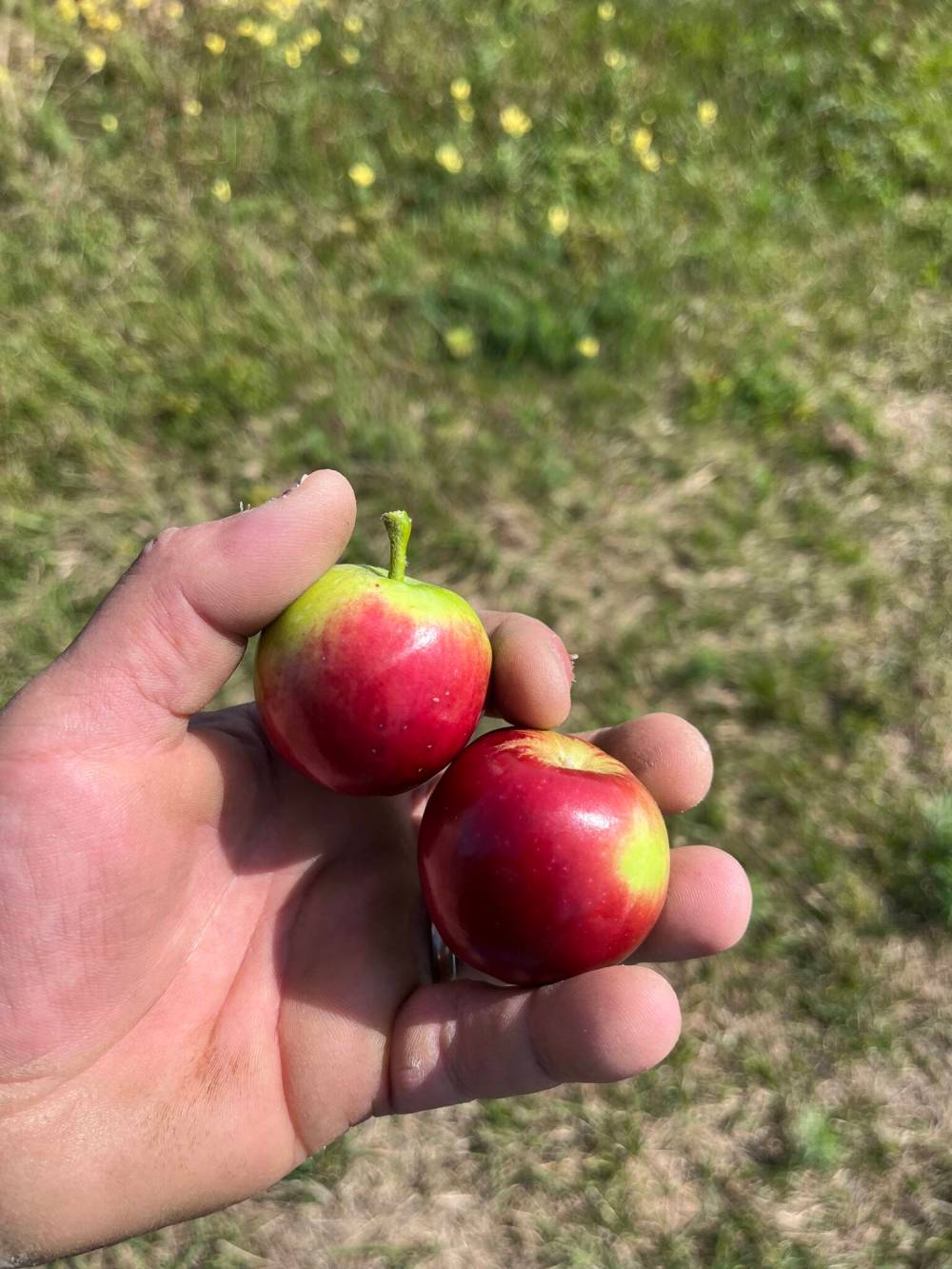
Apple trees that were 75 to 100 years old burned and died in the fires — other apple trees threw out strange large new leaves from burnt branches, and may have survived. This spring will tell that tale. Many of the apple trees I keep track of have outlived even the homes of the people who lived there: long before the fires, I kept records of trees near old foundations, foundations I found either when the apple trees bloomed or when the lilacs planted by homeowners made their brief soft-purple appearance. The imported trio of abandoned Newfoundland homes — apple trees, lilacs, and unkempt clusters of yellow lilies.
Russell Wangersky / Free Press
Apples from trees that survived the Conception Bay North wildfires.
The blueberry barrens, woven with shrub spruce, simple rose and red osier dogwood, will likely recover, though the spruces certainly won’t be part of the equation again for at least 10 years, enough time for past cones to foster new saplings.
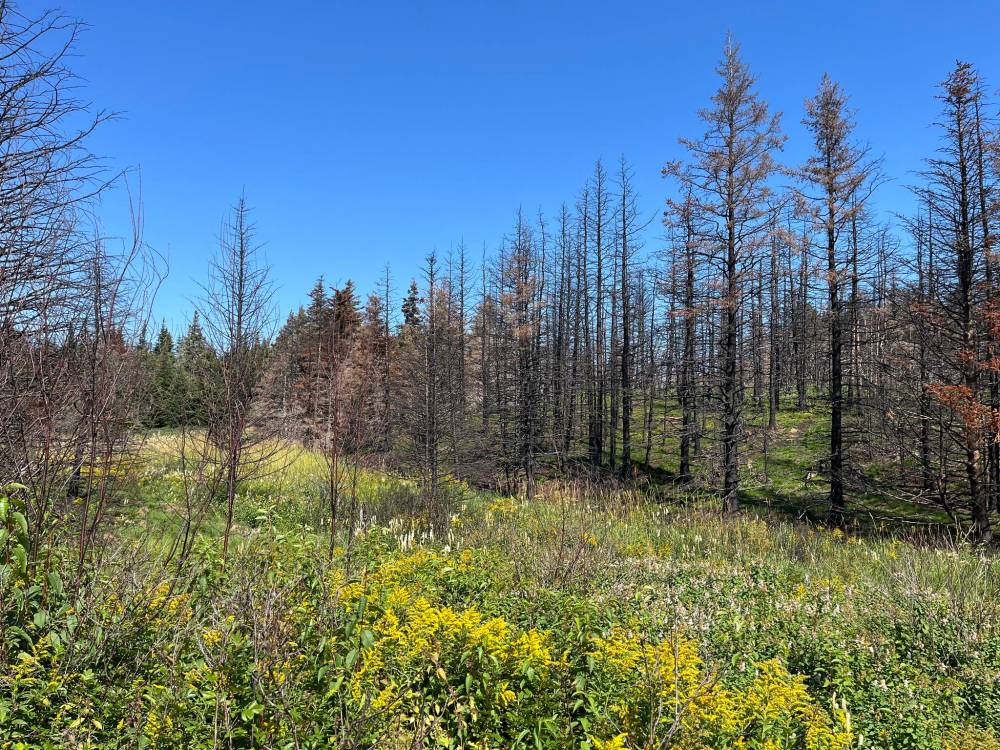
The standing burnt firs and tall spruce are charcoal-black and needleless now — but I’m told they will quickly foster a new sort of life. The insects that revel in the rotting wood of trees that will turn silver-white as the burned bark falls away — and then the birds that revel in eating those same insects. Nature will still win, but in a different way.
Some significant recoveries were already evident early last fall; fireweed was living up to its name, spreading far and wide in fields cleared of spring’s flattened tall yellow grass. I can only imagine how it will look in the coming summer — and how the legions of drifts of the feather-light fireweed seeds in their surrounds of crystalline spikes must have looked as they caught and travelled on the fall winds. Not thick like Winnipeg’s spring cottonwood fluff, more like armadas of uncounted individual roiling and slow-travelling wanderers.
Under what had been a canopy of mature spruce across the brook, there used to be deep pillows of sphagnum moss. By last fall, the burnt moss was failing and stands of meadow grass had sprung up like they had just been waiting for the opportunity of direct sunlight.

I hope to follow it for years — I hope to write about it for years.
How long is obviously not at all in my hands.
Russell Wangersky / Free Press
Four months after the first Adam’s Cove fire, in early September, regeneration has already started.
I want to write about what comes back — and what doesn’t. How the landscape changes, and whether features like the nearby forest of wind-stunted and bent long-needle pines return or decide that the effort is too great. I suspect they will: the pines seem to dedicate themselves to growing cones when they’re as young as five years old, and the ground in the pine forest above Broad Cove is scattered with a thick layer of cones. Some will start the cycle again, I hope, amidst the blackened wasteland. I hope to look at regeneration in both the macro and micro sense — from the success of single clusters of ferns to what happens to the fingerprint of fire on whole oceanside capes. If it sounds interesting, stay with me as I travel.
I recognize, by the way, that columns about the detailed recovery and change in a small patch of Newfoundland may not all be of interest for a Winnipeg audience, so much of what I plan to write will be on my Substack, Found in Place — russellwangersky.substack.com
Russell Wangersky is the comment editor at the Free Press. He can be reached at russell.wangersky@freepress.mb.ca
Russell Wangersky
Perspectives editor
Russell Wangersky is Perspectives Editor for the Winnipeg Free Press, and also writes editorials and columns. He worked at newspapers in Newfoundland and Labrador, Ontario and Saskatchewan before joining the Free Press in 2023. A seven-time National Newspaper Award finalist for opinion writing, he’s also penned eight books. Read more about Russell.
Russell oversees the team that publishes editorials, opinions and analysis — part of the Free Press‘s tradition, since 1872, of producing reliable independent journalism. Read more about Free Press’s history and mandate, and learn how our newsroom operates.
Our newsroom depends on a growing audience of readers to power our journalism. If you are not a paid reader, please consider becoming a subscriber.
Our newsroom depends on its audience of readers to power our journalism. Thank you for your support.
Russell Wangersky
Perspectives editor
Russell Wangersky is Perspectives Editor for the Winnipeg Free Press, and also writes editorials and columns. He worked at newspapers in Newfoundland and Labrador, Ontario and Saskatchewan before joining the Free Press in 2023. A seven-time National Newspaper Award finalist for opinion writing, he’s also penned eight books. Read more about Russell.
Russell oversees the team that publishes editorials, opinions and analysis — part of the Free Press‘s tradition, since 1872, of producing reliable independent journalism. Read more about Free Press’s history and mandate, and learn how our newsroom operates.
Our newsroom depends on a growing audience of readers to power our journalism. If you are not a paid reader, please consider becoming a subscriber.
Our newsroom depends on its audience of readers to power our journalism. Thank you for your support.
Advertisement Advertise With Us
Advertisement Advertise With Us