

Heavy is the hammer when sleep doesn’t come at night

Advertisement
Read this article for free:
or
Already have an account? Log in here »
To continue reading, please subscribe:
Digital Subscription
One year of digital access for only $1.44 a week*
- Enjoy unlimited reading on winnipegfreepress.com
- Read the E-Edition, our digital replica newspaper
- Access News Break, our award-winning app
- Play interactive puzzles
*Billed as $5.77 plus GST every four weeks. After 52 weeks, price increases to the regular rate of $19.95 plus GST every four weeks. Offer available to new and qualified returning subscribers only. Cancel any time.
To continue reading, please subscribe:
Add Free Press access to your Brandon Sun subscription for only an additional
$1 for the first 4 weeks*
- Enjoy unlimited reading on winnipegfreepress.com
- Read the E-Edition, our digital replica newspaper
- Access News Break, our award-winning app
- Play interactive puzzles
*Your next Brandon Sun subscription payment will increase by $1.00 and you will be charged $17.95 plus GST for four weeks. After four weeks, your payment will increase to $24.95 plus GST every four weeks.
Read unlimited articles for free today:
or
Already have an account? Log in here »
I’m keenly aware that it’s a foolish process. That there’s no gain to it, that it solves nothing, and only leaves me with more questions than I started with.
But …
Three a.m. — the night is still, the sheets only covering my feet, the rest of me uncovered in the heat of Winnipeg’s late spring. June, and the days have already occasionally reached the 30s, the nights lingering above 20 degrees, hot enough for weather office heat warnings. Sheets bunched up where they’re cast aside in rumpled mounds. Outside, there are the late-night racers on Portage, the late loud homewards-walkers, while the house is grumbling and shifting with the changes in temperature and humidity, its movements imperceptible but their sounds distinct. A soft clang, a click, the crack of two floorboards somewhere realigning. There’s thunder along the horizon.
Russell Wangersky/Free Press
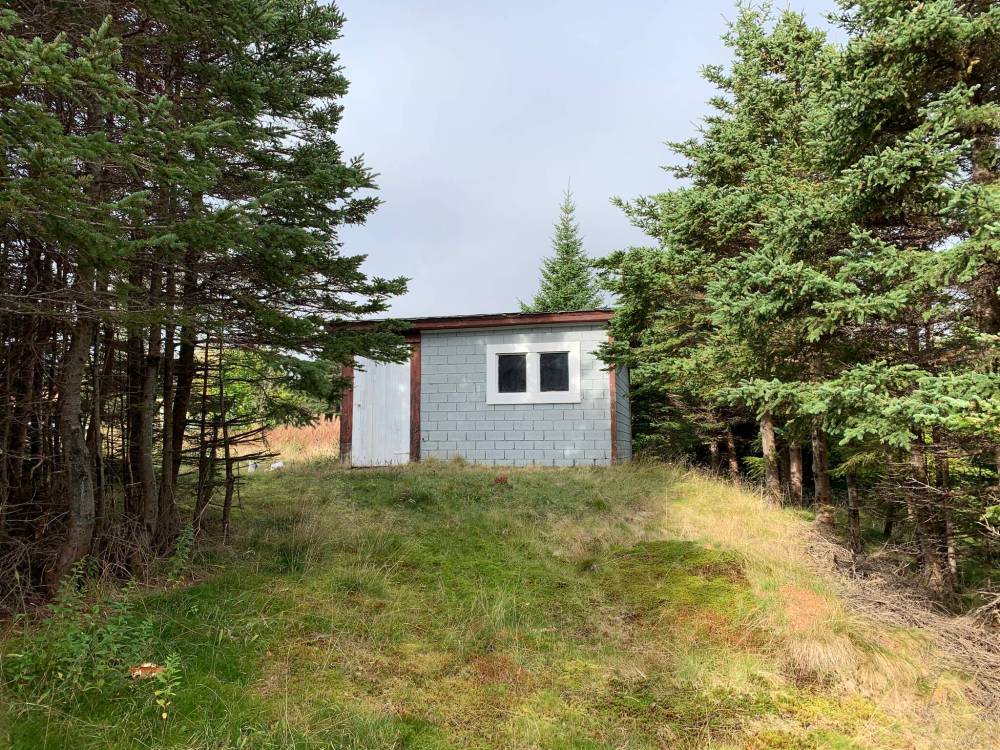
The shed over the root cellar before the fire, Adam’s Cove, NL.
And I’m awake, rebuilding. Designing. Planning.
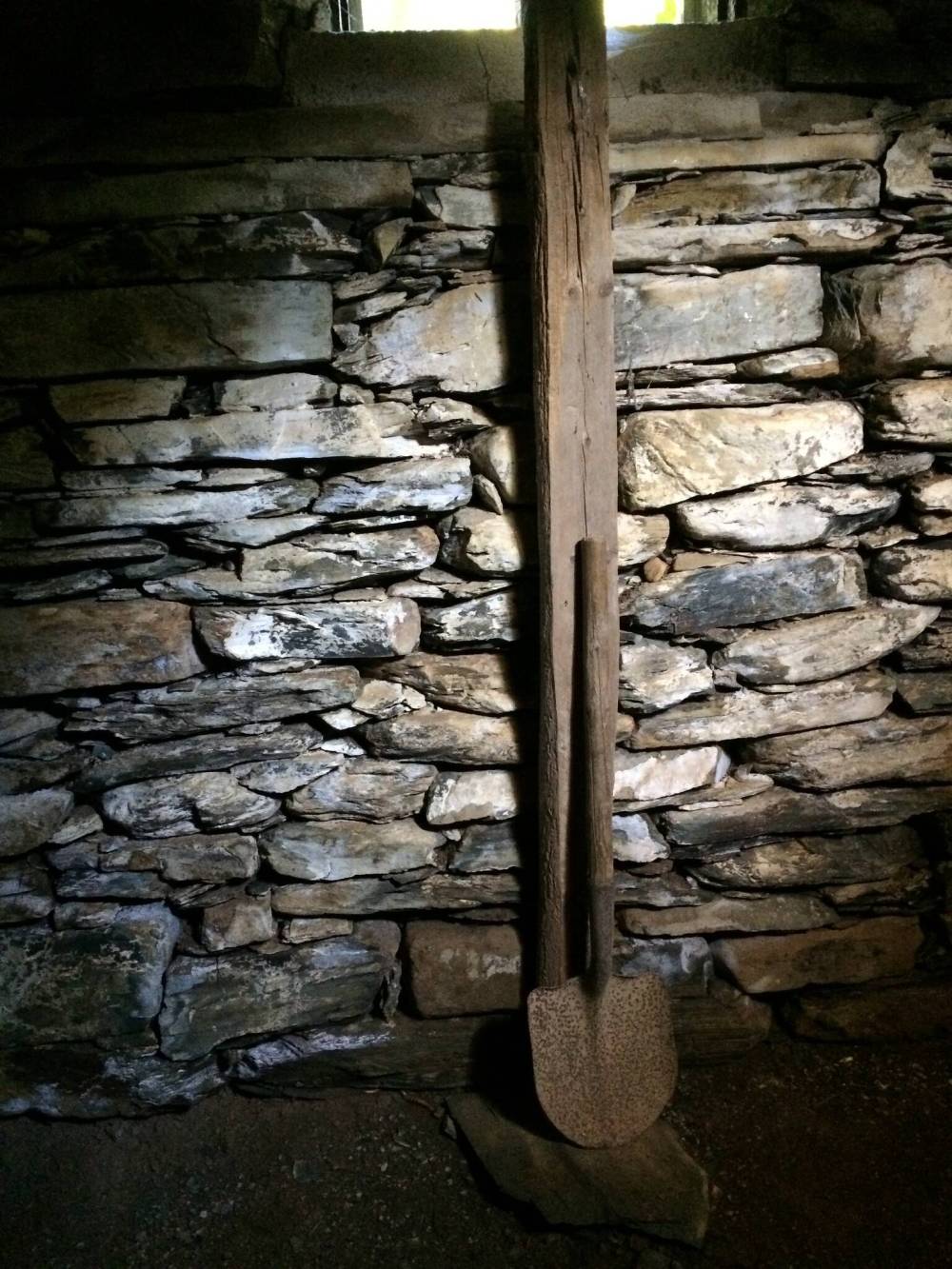
Half a country away, there’s a drystone foundation 10 feet deep, four walls and a dirt floor, a root cellar for a house over 100 years old. The house and the shed that used to stand atop the root cellar are gone, burned. The drystone walls are topped with a narrow concrete surround that serves to hold all of the top row of stones in place, and also to hold the sills of the shed. The connection between the concrete surround and the shed was four bolts set into the surround when it was wet slurry.
Three of the bolts are intact, though one is bent and is capped by a nut that, as yet, I’ve been unable to shift. The other two nuts and their attendant washers are safely in a brown paper bag in an old milk crate in the small barn, the only building left standing after the fire.
And I, in Winnipeg, in the dark, flat on my back at 3 a.m., am trying to calculate how to replace those sills. I have only the roughest approximation of the measurements of the concrete cap, a handmade drawing sent by a neighbour. But I’m loosely planning on pressure treated four by fours, cut down where the foundation bolts are so that I can at least anchor them at three points. Oh, and one bolt is bent, and will need to be straightened. Gently. A little persuasion with a hammer, taps light enough not to snap an old and fire-weakened bolt or flatten the precise twirl of its threads.
I know that it’s a fool’s errand. The night planning, that is. That no matter how much I fret, how much I worry at this problem, I will not be able to solve it tonight or any night. It can only be solved in the doing, and the doing is likely to take me in directions I haven’t even thought of yet.
And I wonder why humans work this way. How we can become derailed from the important and wonderful task of sleeping, the joy of eight hours of rest with no responsibilities, by taking on jobs that cannot reasonably be completed? Do we need the work of tasks more than we know, enough for them to surface in our sleeping hours because our waking hours haven’t done enough of them?
Downstairs, the fridge rattles awake and whirrs gently. It has a harmonic somewhere in the house, some loose piece of something that sings along with it in near-harmony.
I roll over. My hand had been between my face and the pillow, and my fingers are tingling. I shift until I’m comfortable.
Try to picture the bolts again. Somewhere in my head, there must be more information, hidden in some as yet untried mental cupboard.
Last fall, we put a floor over the underground portion of the root cellar so nothing could fall in, the stringers set tight on a deep inside lip of the concrete. I must have looked at those bolts dozens of times. Why haven’t I kept track of their location, their size, even just the height the stringers and floor stand above them?
My one true skill is collecting and storing information — often accidentally. Where something’s been left in the house — what’s on the counter — whether the garden shed is locked or not. It all streams in and lodges, mostly useless, but occasionally important. I’m used to having it throw itself up again when it’s most needed.
But this time, nothing, and with it, the frustration of being unable to move anything forwards. I want to get where we’re going. I want to sink myself deep into the process. But building figments and filaments all night long gets us nowhere.
Russell Wangersky/Free Press
Inside the root cellar, Adam’s Cove, NL.
And I wonder, as I always do, what possible reason there is for the way our minds have developed — is imagination worth the sheer effort and brain space it takes, compared to the shallow returns it often delivers?
But soon, we will be building. We will approach those bolts and test their mettle. (Metal?)
And start to try and deliver a phoenix from ashes.

I also know in a clear and sad way that, whatever it is, it can’t be what it was. It may well be something wonderful. I believe it can be something wonderful. But it already was something wonderful. I can picture it as it was so clearly, though I’m now struggling to remember bits of its skeleton.
Windows.
At four-thirty in the morning, I surrender my plans for bolts and switch to windows, window wells, and the window ledges. How they will fit in the framing. How high they should be above the ground. How many should we use? I have old wooden winter storm windows in the little barn, the kind that used to be help in place by four turning clips — one along each edge — that held the windows in place with fiction, and friction alone.
Sleep will come back eventually, when I let go of the nightwork. If I can.
Russell Wangersky is the Comment Editor at the Free Press. He can be reached at russell.wangersky@freepress.mb.ca
Russell Wangersky
Perspectives editor
Russell Wangersky is Perspectives Editor for the Winnipeg Free Press, and also writes editorials and columns. He worked at newspapers in Newfoundland and Labrador, Ontario and Saskatchewan before joining the Free Press in 2023. A seven-time National Newspaper Award finalist for opinion writing, he’s also penned eight books. Read more about Russell.
Russell oversees the team that publishes editorials, opinions and analysis — part of the Free Press‘s tradition, since 1872, of producing reliable independent journalism. Read more about Free Press’s history and mandate, and learn how our newsroom operates.
Our newsroom depends on a growing audience of readers to power our journalism. If you are not a paid reader, please consider becoming a subscriber.
Our newsroom depends on its audience of readers to power our journalism. Thank you for your support.
Russell Wangersky
Perspectives editor
Russell Wangersky is Perspectives Editor for the Winnipeg Free Press, and also writes editorials and columns. He worked at newspapers in Newfoundland and Labrador, Ontario and Saskatchewan before joining the Free Press in 2023. A seven-time National Newspaper Award finalist for opinion writing, he’s also penned eight books. Read more about Russell.
Russell oversees the team that publishes editorials, opinions and analysis — part of the Free Press‘s tradition, since 1872, of producing reliable independent journalism. Read more about Free Press’s history and mandate, and learn how our newsroom operates.
Our newsroom depends on a growing audience of readers to power our journalism. If you are not a paid reader, please consider becoming a subscriber.
Our newsroom depends on its audience of readers to power our journalism. Thank you for your support.
Advertisement Advertise With Us
Advertisement Advertise With Us