

With or without us, nature will move on

Advertisement
Read this article for free:
or
Already have an account? Log in here »
To continue reading, please subscribe:
Digital Subscription
One year of digital access for only $1.44 a week*
- Enjoy unlimited reading on winnipegfreepress.com
- Read the E-Edition, our digital replica newspaper
- Access News Break, our award-winning app
- Play interactive puzzles
*Billed as $5.77 plus GST every four weeks. After 52 weeks, price increases to the regular rate of $19.95 plus GST every four weeks. Offer available to new and qualified returning subscribers only. Cancel any time.
To continue reading, please subscribe:
Add Free Press access to your Brandon Sun subscription for only an additional
$1 for the first 4 weeks*
- Enjoy unlimited reading on winnipegfreepress.com
- Read the E-Edition, our digital replica newspaper
- Access News Break, our award-winning app
- Play interactive puzzles
*Your next Brandon Sun subscription payment will increase by $1.00 and you will be charged $17.95 plus GST for four weeks. After four weeks, your payment will increase to $24.95 plus GST every four weeks.
Read unlimited articles for free today:
or
Already have an account? Log in here »
I don’t know what I expected.
I mean, I expected nature to win. That, to me, is a given.
But I didn’t expect it to win like this, easily rolling with the punches. Rolling on the tide.
RUSSELL WANGERSKY / FREE PRESS
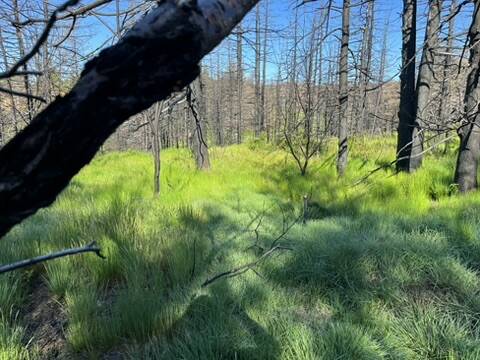
With the spruce canopy burned away in a Newfoundland forest fire, a vast moss bed has been replaced with lush grasses.
Some things are the same as they have always been.
Capelin — small, eager fish that spawn when the ocean reaches the right spring temperature for their eggs to hatch and thrive — are rolling on the beach in Adam’s Cove, N.L. They are sharp and bony-edged — their sides almost rising into a point where the bones run along tight under their skin — but they also have black backs and a green stripe and a purple stripe along their sides, a silver belly underneath, so they look almost as if they’ve chosen three-tiered eye shadow for their once-a-year tilt at haphazard reproduction. The process sees their eggs and milt strewn in the waves, to — hopefully — make sticky contact with the ocean bottom.
They’re like a hundred million smelt in the near-waters to shore, and almost all the males will die in the spawn. Mallotus villosus, the Atlantic capelin, has as its closest historic relative Enoplophthalmus, a long-extinct European fish species from the Oligocene and early Miocene epochs.
Enoplophthalmus’s fossil form is, well, remarkably like stretched-out and desiccated capelin bones tossed up on the beach after the spawn, though the separation between today’s fish and its fossil cousin is believed to be between 23 million and 33.9 million years.
Capelin is a critical early summer food species for gannets and whales and cod and countless other species, and its spawning, always at the same ocean temperature, is crucial.
Tomorrow, the beach sand will be spongy with their thousands upon thousands of fertilized eggs, and the smell will be the high, rich note of noble rot — both horribly off-putting and oddly entrancing. A mix of oyster and a stinking cheese you have to force past your nostrils in order to taste, but ultimately worth the effort.
Their roll on the beaches is both a magic occurrence and a lockstep necessity: without it, things that must happen, will not. And everything, from the small success of seabird chicks to the enormous appetite of whales, would change.
RUSSELL WANGERSKY / FREE PRESS
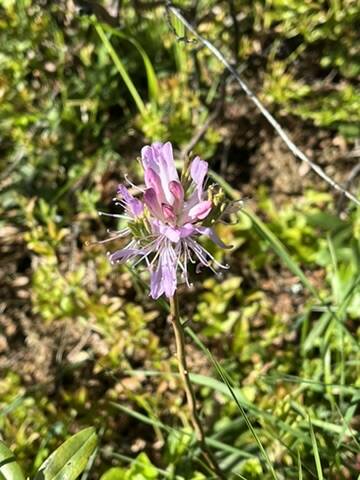
A single flower rises above ground burnt over last year in Adam’s Cove, N.L.
But they keep coming, at least for now, their line having sprung from a great upheaval period of global cooling and expanding ice sheets.
Through a smaller lens, survival here is different. Some things are just holding on. Others are quickly changing.
Big Yellow, a 25-foot-high apple tree that produces a vast number of easily bruised, soft-skinned yellow apples, lost all of its lower branches to last summer’s fires. There is a scatter of green leaves on its very top branches — will it survive? It’s hard to know. Will it bear fruit again? Less likely; sad, because it was one of the most productive trees, its roots deep and satisfied in a constant seep, so dry spells hardly affected it.
Other things are also changing. Mature poplar stands are now dead sentinels, grey and sky-reaching, but all around them, their scions have risen in miniature forests, all the same three-foot-tall single-leaf-festooned sapling, too young yet for the extravagance of branches.
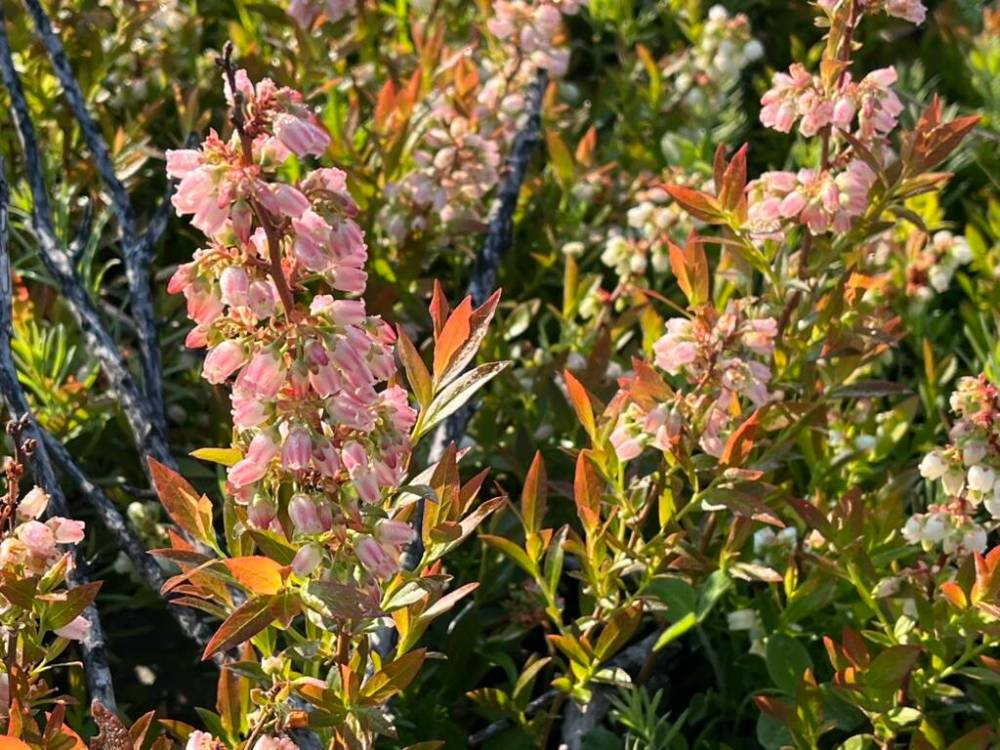
The blueberries, enriched by soot from the fires and freed from shade by other ground cover, are a riot of bloomer-shaped blossoms, and have filled in every space that has burned.
There are rafts of grasses in the moss beds under the burned spruce where no grasses have ever been. It is like their seeds were waiting endlessly for just this possibility, and they took advantage the moment sun and moisture combined. The firs are shedding their burned-black bark, revealing honey-gold columns of perfect wood that will no doubt silver in the elements by the fall.
It is as if it’s all a fascinating workaround — and a sign that nature will work around us as well.
RUSSELL WANGERSKY / FREE PRESS
A riot of blueberry flowers awaits bees a year after being swept by a forest fire.
There are plenty of areas that are not faring as well — where the fires burned so hot and so long that even the soil burned away, leaving broad expanses of bare rock and little more than sand. It’s hard to regenerate in a place where critical building blocks are gone, likely not to return for generations.
A shaded moon came up last night, cloaked and smeared and yellow in the fog. Tonight’s moon was yellow, too, as it rose through the horizon’s atmosphere, the tree branches set out matte-black against it.
A chain of thunderstorms is coming, through Port Blandford and George’s Brook and Clarenville, and a chain of late-June thunderstorms is absolutely average in Winnipeg.
In Newfoundland, it is not.
Nature is ready for all of this, despite the daunting size of new calamities. I am not.
Things are where or what they should not be. I want things to come back — to be what they are supposed to be, to be the ways they used to be.

We build a shed to replace a shed, right on the root cellar foundations where the old shed used to be before the fire took it and the house. As if that could make any difference. Hammers draw blood, nails spike and cut, splinters embed. The shed is not Lazarus risen, despite the offerings. It’s a collection of square corners and building code requirements, very much unlike the comfortable slump and sag of its predecessor, with its beams of spruce logs planed flat on two sides, the scaly bark on the rest of the logs left in place.
RUSSELL WANGERSKY / FREE PRESS
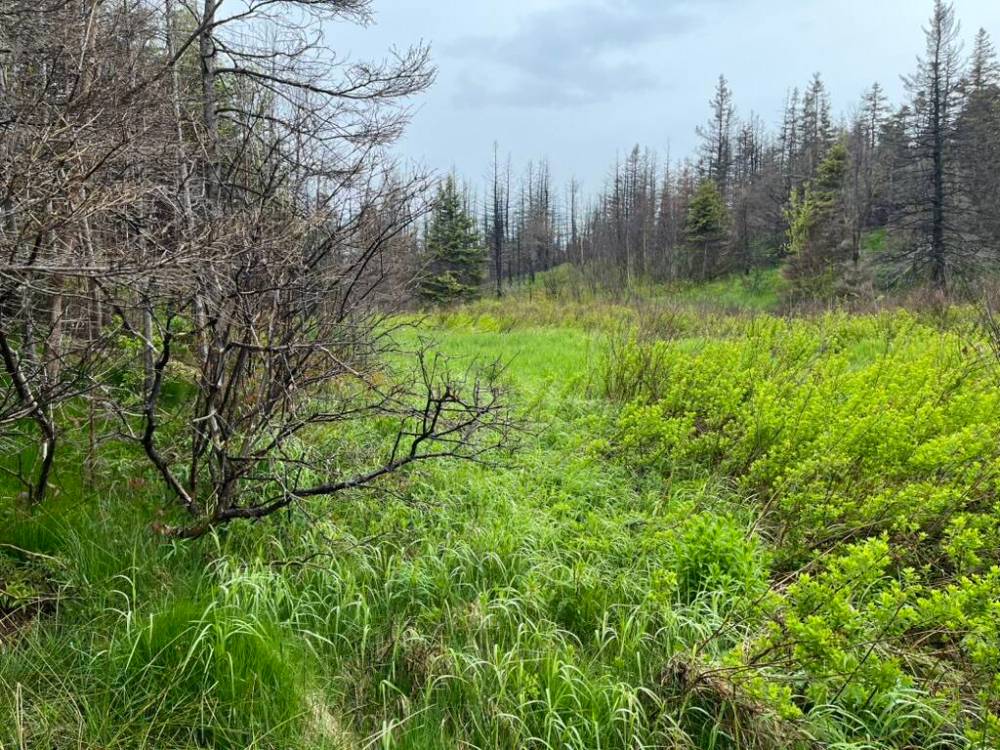
A brook valley that last year’s forest fires in Adam’s Cove jumped over.
But we adapt. Not as quickly, it seems, as nature.
I do not know what to think, or what to expect next.
But I trust that with or without us, it will sit right when it comes.
Russell Wangersky is the Comment Editor at the Free Press. He can be reached at russell.wangersky@freepress.mb
Russell Wangersky
Perspectives editor
Russell Wangersky is Perspectives Editor for the Winnipeg Free Press, and also writes editorials and columns. He worked at newspapers in Newfoundland and Labrador, Ontario and Saskatchewan before joining the Free Press in 2023. A seven-time National Newspaper Award finalist for opinion writing, he’s also penned eight books. Read more about Russell.
Russell oversees the team that publishes editorials, opinions and analysis — part of the Free Press‘s tradition, since 1872, of producing reliable independent journalism. Read more about Free Press’s history and mandate, and learn how our newsroom operates.
Our newsroom depends on a growing audience of readers to power our journalism. If you are not a paid reader, please consider becoming a subscriber.
Our newsroom depends on its audience of readers to power our journalism. Thank you for your support.
Russell Wangersky
Perspectives editor
Russell Wangersky is Perspectives Editor for the Winnipeg Free Press, and also writes editorials and columns. He worked at newspapers in Newfoundland and Labrador, Ontario and Saskatchewan before joining the Free Press in 2023. A seven-time National Newspaper Award finalist for opinion writing, he’s also penned eight books. Read more about Russell.
Russell oversees the team that publishes editorials, opinions and analysis — part of the Free Press‘s tradition, since 1872, of producing reliable independent journalism. Read more about Free Press’s history and mandate, and learn how our newsroom operates.
Our newsroom depends on a growing audience of readers to power our journalism. If you are not a paid reader, please consider becoming a subscriber.
Our newsroom depends on its audience of readers to power our journalism. Thank you for your support.
Advertisement Advertise With Us
Advertisement Advertise With Us