

A bigger grid, and a tougher one
Advertisement
Read this article for free:
or
Already have an account? Log in here »
To continue reading, please subscribe:

Digital Subscription
One year of digital access for only $205*
- Enjoy unlimited reading on winnipegfreepress.com
- Read the E-Edition, our digital replica newspaper
- Access News Break, our award-winning app
- Play interactive puzzles
*First annual payment billed as $205.00 + GST for one year. This annual subscription will automatically renew at $233.00 + GST every 52 weeks (10% off the regular annual price of $259.35). Offer available to new and qualified returning subscribers only. Cancel any time.
To continue reading, please subscribe:
Add Free Press access to your Brandon Sun subscription for only an additional
$1 for the first 4 weeks*
- Enjoy unlimited reading on winnipegfreepress.com
- Read the E-Edition, our digital replica newspaper
- Access News Break, our award-winning app
- Play interactive puzzles
*Your next Brandon Sun subscription payment will increase by $1.00 and you will be charged $17.95 plus GST for four weeks. After four weeks, your payment will increase to $24.95 plus GST every four weeks.
Read unlimited articles for free today:
or
Already have an account? Log in here »
The Free Press editorial of Aug. 21, Time for a stronger Canadian grid, makes a case that should unsettle anyone who read it.
A co-ordinated attack on nine substations could bring down the American electrical grid.
The transformers needed to repair it carry lead times of 128 weeks and longer, from countries on the U.S. president’s tariff list.
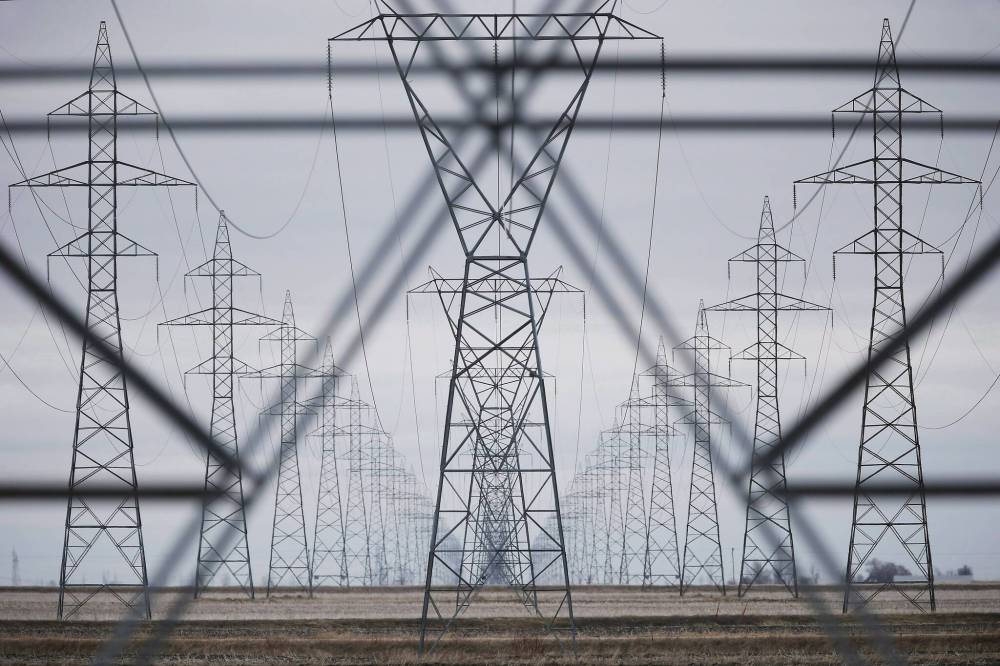
John Woods / THE CANADIAN PRESS
Hydro power lines, just outside Winnipeg.
And because the North American system is effectively one machine, a fault in Ohio once darkened Toronto.
Its conclusion, that Canada needs an east-west grid of its own, is right.
But the editorial leaves the more interesting question unasked.
Why is a continent’s electricity supply hostage to nine substations and a two-year parts queue in the first place?
Because we built a grid with no memory.
Electricity on today’s system has to be generated at the instant it is consumed.
Supply and demand are matched second by second, with almost nothing in between to absorb a shock.
When a line fails, the load it was carrying does not stop existing.
It shifts onto neighbouring lines, which overload in turn.
That is what cascading means.
The 2003 blackout the editorial describes was not a freak event.
It was the design working as designed.
Two technologies have quietly made that design obsolete.
Neither appears in the editorial.
The first is power electronics: solid-state converters, the same class of device already sitting inside every solar inverter and electric-car charger.
They do the voltage conversion that transformers do.
Swedish entrepreneur Jonas Birgersson, speaking on the energy podcast Volts in January, put the comparison starkly.
Transformer suppliers are quoting three-and-a-half years, while power electronics doing equivalent conversion can be air-freighted in three-and-a-half hours.
Transformers are heavy, custom industrial goods from a shrinking supplier base.
Converters are semiconductors and they follow the curve semiconductors follow — cheaper and better every year.
They have a second property that matters more for the editorial’s scenario.
Each converter can be electrically isolated from whatever sits on the other side of it.
A fault arrives at the port and stops there.
Rifle fire at a substation becomes a local repair job instead of the first domino.
The second technology is batteries, not as a source of power, but as the memory the grid lacks.
Birgersson’s analogy is the internet, which survives damage because every node holds a buffer and routes around trouble.
A broken link means a slow download, not a continental outage.
Put batteries at every node, in homes, in businesses, at substations, in parked electric cars and electricity gains the same tolerance.
The numbers from his pilot project in Lund, Sweden, are the surprising part.
A hundred kilowatt-hours of battery in each of 10 buildings, serving 270 apartments, cut the grid capacity the site buys over a year by roughly 60 per cent.
A single kilowatt-hour in a house let it shrink its grid connection from 16 amps to one amp.
And the largest battery fleet is the one already arriving in driveways.
Birgersson reckons that if Sweden’s vehicles were all electric, their parked batteries could run the country for 10 hours.
Europe has begun changing the law to match the hardware.
Since July, under the EU’s reformed electricity market rules, households have a right to energy sharing.
Two neighbours with solar panels and batteries may simply agree to share what they generate.
That is a short legal sentence with long consequences, because the barrier to a distributed grid was never only technical.
Manitoba has a particular reason to care and it isn’t hypothetical.
On July 29, a windstorm cut power to more than 30,000 Manitoba Hydro customers, most of them in Winnipeg.
Some waited three days.
Hydro called the damage at least as bad as June’s storm, which it had already described as the worst summer storm damage on record.
No saboteur was required; wind and trees sufficed.
With batteries in those neighbourhoods, most of those customers would have been dark for minutes.
That is the argument’s real force.
The rifle scenario is speculative.
Manitoba storms are annual, worsening and already here.
One investment answers both, which means the case for it doesn’t depend on anyone believing in the attack.
None of which argues against the east-west line.
Our reservoirs are a genuine national asset, the ideal partner for wind and solar elsewhere in the country, holding water back when the wind blows and releasing it when it doesn’t.
Selling that flexibility in both directions is a real opportunity and it needs wires.
But reservoirs sit behind the transmission system.

They do nothing for you when the substation between you and them is down.
A longer line to Ontario, by itself, buys a grid that is bigger and just as brittle.
Build the line.
Then spend the next two decades putting buffers at the edges, because that is the work that decides whether the next storm costs Winnipeg an hour or three days.
Stuart Williams, M.Sc., is a Wolseley resident with a master’s degree in computer science. He is a passionate advocate for renewable energy who writes out of an urgent concern for the future of our children.
Related Articles
New Brunswick won't stop supplying power to Maine at this point, premier says



Advertisement Advertise With Us
Advertisement Advertise With Us