

Liberals take economic gamble as budget does little to protect against significant downturn

Advertisement
Read this article for free:
or
Already have an account? Log in here »
To continue reading, please subscribe:

Digital Subscription
One year of digital access for only $205*
- Enjoy unlimited reading on winnipegfreepress.com
- Read the E-Edition, our digital replica newspaper
- Access News Break, our award-winning app
- Play interactive puzzles
*First annual payment billed as $205.00 + GST for one year. This annual subscription will automatically renew at $233.00 + GST every 52 weeks (10% off the regular annual price of $259.35). Offer available to new and qualified returning subscribers only. Cancel any time.
To continue reading, please subscribe:
Add Free Press access to your Brandon Sun subscription for only an additional
$1 for the first 4 weeks*
- Enjoy unlimited reading on winnipegfreepress.com
- Read the E-Edition, our digital replica newspaper
- Access News Break, our award-winning app
- Play interactive puzzles
*Your next Brandon Sun subscription payment will increase by $1.00 and you will be charged $17.95 plus GST for four weeks. After four weeks, your payment will increase to $24.95 plus GST every four weeks.
Read unlimited articles for free today:
or
Already have an account? Log in here »
Hey there, time traveller!
This article was published 28/02/2018 (3116 days ago), so information in it may no longer be current.
Depending on who you talk to, the federal Liberal government’s most recent budget is either a stable, stay-the-course spending plan or a profound exercise in whistling by the fiscal graveyard.
It’s important to remember reaction to federal budgets tends to be varied, to say the least. However, in this instance, the gap between the glass-half-full and glass-half-empty constituencies seems a little wider than in the past.
First, the glass-half-full argument.
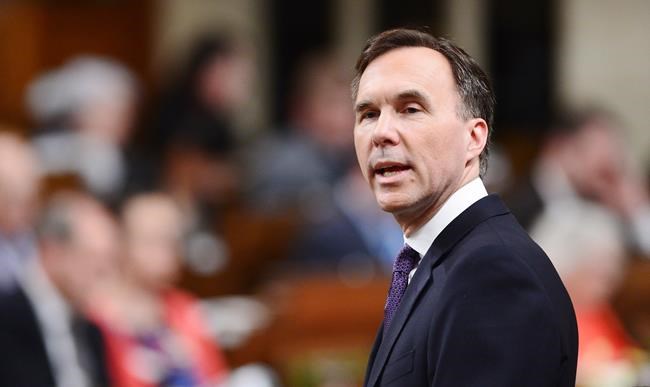
According to the Liberals, this is a stay-the-course budget that makes little progress on eliminating the deficit — estimated at about $18 billion at the end of the 2018-19 fiscal year — but does lower the debt-to-GDP ratio, the principal measuring stick for fiscal stability.
The government did find about $20 billion of new expenditures over the next and future fiscal years to support scientific research and development, deliver new tax credits for low-income working people, improve First Nations child welfare and housing, devise a new national pharmacare program, improve parental leave, and bring pay equity to federally regulated workplaces.
In its bid to galvanize this as the “gender fairness” budget, the Liberals are wagering the equity commitment can significantly increase the take-home pay for some of Canada’s working women. That would recast paternal leave and pay equity largely as an economic development initiative, rather than a social policy.
Getting more women into the workforce, and ensuring they are paid equitably with men in jobs of similar scope, skill and responsibility, does have the potential to be a major economic driver. A McKinsey Global Institute study last fall suggested improving pay in industries and job classifications normally dominated by female workers could translate into $150-billion in additional economic activity by 2026.
For the glass-half-empty crowd, there is little room for applause.
Critics are concerned pay equity will not, on its own, create an economic impact of that scale. They point out pay equity must be accompanied by an affordable, national child-care program to make any significant progress in getting more women into the workforce.
The Liberals will attempt to drown out those naysayers by pointing to other measures, such as increased funding for First Nations child welfare, housing, and safe drinking water. The glass-half-empty crowd will note the new funding, while welcome, is not enough to make meaningful improvements to the lives of Indigenous people on reserves.
Same goes on scientific research and increased funding to protect wilderness areas. Positive steps, but not nearly enough to make meaningful progress on either file.
Political critics will accuse the government led by Prime Minister Justin Trudeau of delivering a budget that does not solve any problems, but simply checks off a number of boxes for key constituencies.
These critics believe the Liberals have no real fiscal plan, other than to blurt out words such as “pay equity,” “wilderness area,” “climate change,” and “better lives for Indigenous people” — and hope it combines to create a compelling brand for voters. They will point out two of the biggest budget pledges (pay equity and pharmacare) are just pledges at this point, with no proof they will ever come to fruition.
While glass-half-full and glass-half-empty combatants fight over the impact of the budget initiatives, there is little disagreement across the political spectrum this budget does not include any dramatic measures to protect the treasury against a significant downturn in the economy, triggered by policy decisions now unfolding to the south.
U.S. President Donald Trump’s desire to tear up the North American Free Trade Agreement has the potential to dramatically disrupt the Canadian economy. It is still not clear whether U.S. lawmakers — many of whom represent constituents that are beneficiaries of freer trade — will get behind the plan. But the renegotiation now going on in Washington, D.C., has a great potential for mayhem, which the Trudeau government has either discounted or dismissed.
The Liberals have also not made any plans to insulate Canada’s economy from disruption in global markets triggered largely by the tax cuts approved by U.S. Congress late last year. Among them: a precipitous drop in the corporate income-tax rate, putting it now well below the rates charged in Canada and other competing nations.
Optimists believe the tax cuts will largely turn out to be meaningless in the grand, global economic scheme of things.
Pessimists see a doomsday scenario where investors abandon currencies in countries with higher tax rates to invest in U.S. companies that will become more profitable and valuable as a result of the tax cuts.

The recent wave of stock buybacks triggered by the tax cut windfalls — which can dramatically increase the value of a company’s stocks — is fuelling concern the Canadian dollar, among other international currencies, is about to take a beating.
Federal Finance Minister Bill Morneau has built a $3-billion contingency into this budget, but that could easily be swamped if the worst-case scenarios on NAFTA and tax competitiveness come to fruition.
As far as political strategies go, it is never a bad idea for a sitting government to sprinkle largesse on key constituencies ahead of an election.
Unless, of course, some seismic event comes along and blows your economy out of the water — and that modest largesse can quickly become the hallmark of a foolish and incompetent government.
dan.lett@freepress.mb.ca
Dan Lett is a columnist for the Free Press, providing opinion and commentary on politics in Winnipeg and beyond. Born and raised in Toronto, Dan joined the Free Press in 1986. Read more about Dan.
Dan’s columns are built on facts and reactions, but offer his personal views through arguments and analysis. The Free Press’ editing team reviews Dan’s columns before they are posted online or published in print — part of the our tradition, since 1872, of producing reliable independent journalism. Read more about Free Press’s history and mandate, and learn how our newsroom operates.
Our newsroom depends on a growing audience of readers to power our journalism. If you are not a paid reader, please consider becoming a subscriber.
Our newsroom depends on its audience of readers to power our journalism. Thank you for your support.
Dan Lett is a columnist for the Free Press, providing opinion and commentary on politics in Winnipeg and beyond. Born and raised in Toronto, Dan joined the Free Press in 1986. Read more about Dan.
Dan’s columns are built on facts and reactions, but offer his personal views through arguments and analysis. The Free Press’ editing team reviews Dan’s columns before they are posted online or published in print — part of the our tradition, since 1872, of producing reliable independent journalism. Read more about Free Press’s history and mandate, and learn how our newsroom operates.
Our newsroom depends on a growing audience of readers to power our journalism. If you are not a paid reader, please consider becoming a subscriber.
Our newsroom depends on its audience of readers to power our journalism. Thank you for your support.
Related Articles
Paternity leave only partial solution

Advertisement Advertise With Us
Advertisement Advertise With Us