

In South Korea it’s literally shut up and play
Advertisement
Read this article for free:
or
Already have an account? Log in here »
To continue reading, please subscribe:

Digital Subscription
One year of digital access for only $205*
- Enjoy unlimited reading on winnipegfreepress.com
- Read the E-Edition, our digital replica newspaper
- Access News Break, our award-winning app
- Play interactive puzzles
*First annual payment billed as $205.00 + GST for one year. This annual subscription will automatically renew at $233.00 + GST every 52 weeks (10% off the regular annual price of $259.35). Offer available to new and qualified returning subscribers only. Cancel any time.
To continue reading, please subscribe:
Add Free Press access to your Brandon Sun subscription for only an additional
$1 for the first 4 weeks*
- Enjoy unlimited reading on winnipegfreepress.com
- Read the E-Edition, our digital replica newspaper
- Access News Break, our award-winning app
- Play interactive puzzles
*Your next Brandon Sun subscription payment will increase by $1.00 and you will be charged $17.95 plus GST for four weeks. After four weeks, your payment will increase to $24.95 plus GST every four weeks.
Read unlimited articles for free today:
or
Already have an account? Log in here »
Hey there, time traveller!
This article was published 24/04/2020 (2327 days ago), so information in it may no longer be current.
There is a troubling omission of voices in world football’s desperate scheme to resume competition: those of the players.
Ever since the major leagues of Europe, as well as those on this continent and every other, either suspended their schedules or postponed their kick-offs, the athletes that produce their products have been mostly quiet. Many, to their credit, have engaged with local organizations to help communities struggling with the health and economic effects of COVID-19, and with the news cycle focused almost exclusively on the global pandemic, they’ve done so without the fanfare that so often accompanies their good deeds.
But when it comes to their own resumption of work — radio silence.
Now, there could be several reasons why their opinions haven’t been actively solicited. Professional athletes — especially in non-franchise environments that are the reality in most of the world — are essentially private contractors who are still getting paid. No doubt the coronavirus will change the way those agreements are constructed, but for now (and this, admittedly, applies mostly to players representing the clubs and leagues that are watched on TV) there isn’t the urgency to speak out about missed days at the training ground.
Additionally, a misplaced or ill-advised comment could affect future contracts and sponsorship opportunities, so the safest approach is to say nothing at all.
Expect that to change in the very near future.
In less than two weeks, South Korea’s K League 1 will begin its 2020 schedule. Given that country’s aggressive COVID-19 testing, tracking and reduced rate of infection, on Friday the division’s administrators and public health officials gave the green light to begin a season that will kick off with Jeonbuk Motors vs. Suwon Bluewings on May 8.
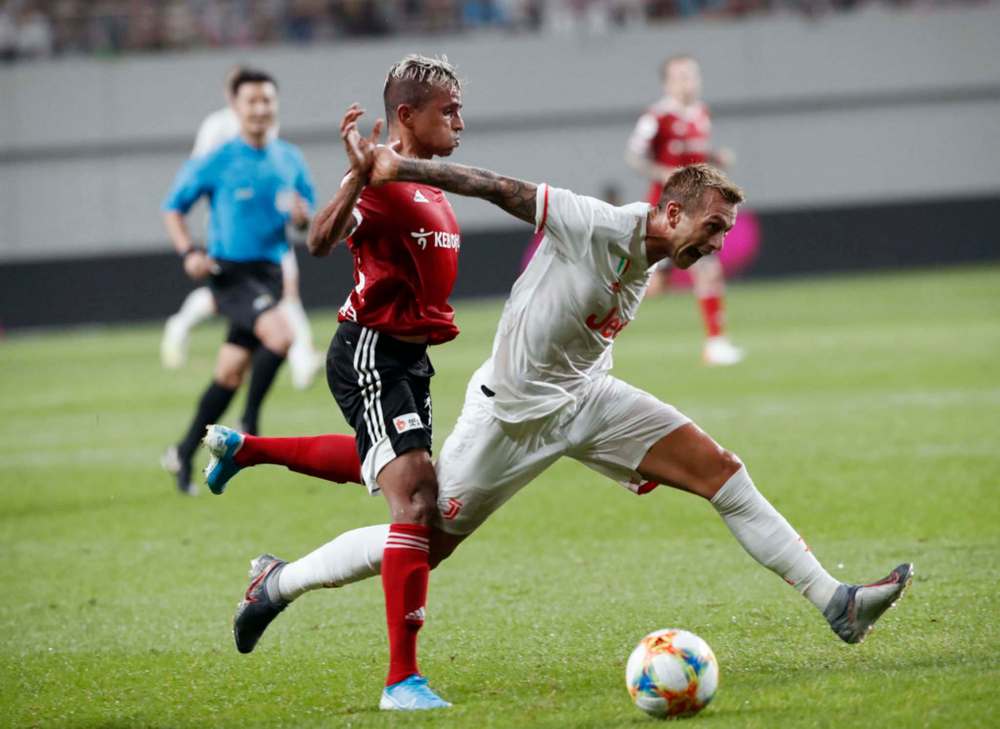
It goes without saying that matches will be played without supporters in the stands. Players will also be forbidden from approaching the referee, and they won’t even be allowed to converse with their teammates over the 90 minutes.
There is something utterly ridiculous about being prohibited from talking and yet being expected to challenge a group of opponents for the ball on a corner kick — and with mouths closed, of course. No spittle permitted, even if it means you can’t breathe.
The symbolism, however unintended, is as stark as it is disturbing: just play, don’t talk. Keep your mouths shut.
Refreshingly, there’s at least one Korean player who simply isn’t having it. Speaking to reporters on Friday, as per the Associated Press, Incheon United captain Kim Do-hyeok remarked that if he and his teammates couldn’t speak to one another on the pitch, they “might as well not play soccer at all.”
A lot can happen before May 8, but even if K League 1 does go ahead it seems only a matter of time before it’s inevitably suspended because a player, coach, broadcaster or stadium staff member tests positive for the virus.
This is the scenario that will be most closely monitored in Europe, which is a few weeks behind Asia in the pandemic’s course and is hoping to restart its biggest leagues later next month or in early June.
The Bundesliga — by far the most prudent of Europe’s most prestigious divisions — pulled off something of a diplomatic masterstroke this week when it convinced its television partners to continue paying their licensing fees. The thing is, the German top flight has to restart its season and finish it at or around the end of June or it will be obliged to repay the rights holders.
Advised by a medical task force, the Deutsche Fussball Liga that oversees Germany’s professional divisions is proposing a “comprehensive quarantine” of players and the personnel who come into contact with them — likely in hotels or other compounds, similar as to what’s being considered by the National Hockey League. On top of that, players are being prescribed “sport-appropriate mouth-nose protection” — masks, in other words, that won’t slip off the face. The masks will have to be changed every 15 minutes, and if one does happen to fall off the referee must stop the match.
If it all sounds extra to the point of absurdity, it’s because it is. And then there are the broadcasters, camera people, sound technicians, security personnel, medical and support staff and other match-day workers that typically number up to 500. What about them?
It might be possible to produce a game for television with a skeleton crew of less than 300, but what of their own safety? If they’re part of the quarantine, what of their families? Who’s home-schooling their children and shopping for groceries? These voices are important as well.

Is it really worth it?
The extent to which professional sports is willing to risk the well-being of its workers is bad enough. Restarting the industry amidst the eerie quiet of athletes and other employees is even worse. It’s alarming.
If it seems a bit off to proceed in these circumstances, enabled by convenient silence, it’s because it is.
jerradpeters@gmail.com
Twitter @JerradPeters
Our newsroom depends on a growing audience of readers to power our journalism. If you are not a paid reader, please consider becoming a subscriber.
Our newsroom depends on its audience of readers to power our journalism. Thank you for your support.
Our newsroom depends on a growing audience of readers to power our journalism. If you are not a paid reader, please consider becoming a subscriber.
Our newsroom depends on its audience of readers to power our journalism. Thank you for your support.
Related Articles
Italian government sets May 18 return for soccer training






Advertisement Advertise With Us
Advertisement Advertise With Us