

Makeup of city workforce doesn’t reflect urban diversity

Advertisement
Read this article for free:
or
Already have an account? Log in here »
To continue reading, please subscribe:

Digital Subscription
One year of digital access for only $205*
- Enjoy unlimited reading on winnipegfreepress.com
- Read the E-Edition, our digital replica newspaper
- Access News Break, our award-winning app
- Play interactive puzzles
*First annual payment billed as $205.00 + GST for one year. This annual subscription will automatically renew at $233.00 + GST every 52 weeks (10% off the regular annual price of $259.35). Offer available to new and qualified returning subscribers only. Cancel any time.
To continue reading, please subscribe:
Add Free Press access to your Brandon Sun subscription for only an additional
$1 for the first 4 weeks*
- Enjoy unlimited reading on winnipegfreepress.com
- Read the E-Edition, our digital replica newspaper
- Access News Break, our award-winning app
- Play interactive puzzles
*Your next Brandon Sun subscription payment will increase by $1.00 and you will be charged $17.95 plus GST for four weeks. After four weeks, your payment will increase to $24.95 plus GST every four weeks.
Read unlimited articles for free today:
or
Already have an account? Log in here »
Hey there, time traveller!
This article was published 31/08/2024 (739 days ago), so information in it may no longer be current.
In 2018, Brian Bowman campaigned for Winnipeg mayor on a promise to put the issue of reopening pedestrian crossings at Portage and Main to a public vote. Long a flashpoint for civic disagreement, the reopening argument was to be settled thusly, though non-binding.
The result, as most of us remember, was a resounding “no” to the proposed change. The pedestrians were to stay underground at Winnipeg’s famous intersection, and vehicles would continue to assert their dominance above.
Once the votes were tallied, the addresses of those who voted “yes” were pinned onto a map of Winnipeg in one shade and “no” tallies in another.

The resulting piece of artistic commentary threw our city’s divide into bright contrast: those who lived closest to Portage and Main were most likely to be in favour of opening it; those the furthest, least likely. The map showed a perfect moat surrounding a little island in our city’s core.
Let’s admit it: we’re a bit curmudgeonly. If something doesn’t benefit us directly, it’s probably a terrible idea, as the red-and-green map suggests.
But who is the “us” when it comes to decision-making for our city? According to the City of Winnipeg’s recent staff-diversity report, “us” is decidedly not representative of the people who actually live here.
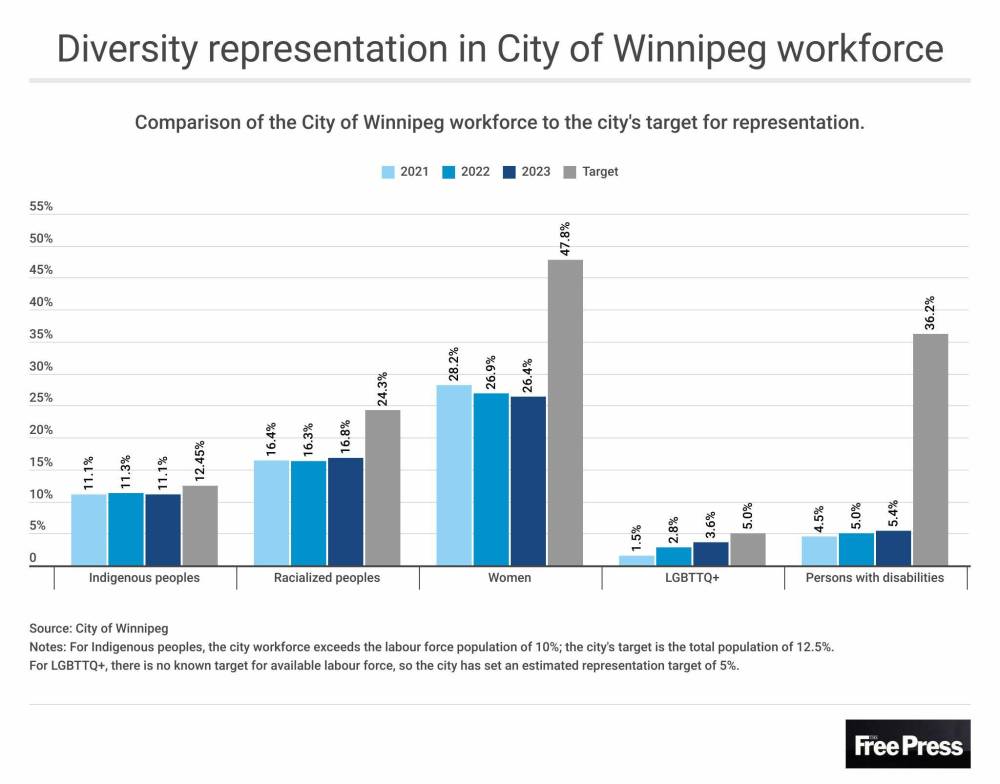
In the report, the 10,000-plus Winnipeggers who are employed by their city were asked to voluntarily identify themselves if belonging to one of five groups: Indigenous peoples, racialized peoples, women, LGBTTQ+ and/or persons with disabilities. The results were compared against current city-wide demographics of people of working age, exposing a shortfall in all categories.
Based on the participating respondents, our city is staffed and run by a workforce that is 73.6 per cent male, 96.4 per cent heterosexual and 83.2 per cent white. This is the “us” our city refers to when they talk about “our” priorities.
These are the perspectives with highest representation on the city payroll. And this is who designs the hiring and retention strategies that perpetuate this inequity.
Despite the City of Winnipeg’s pledge to redouble recruitment efforts, establish a camp to promote firefighting as a career choice for young women, reach out to newcomers and provide diversity training for existing staff, the current and ongoing situation at city hall will continue to ripple outward and negatively affect the lives and prospects of Winnipeggers who do not fit the current country-club version of “us.”
The barriers to employment must be eradicated by the City of Winnipeg itself, not just obfuscated or explained away.
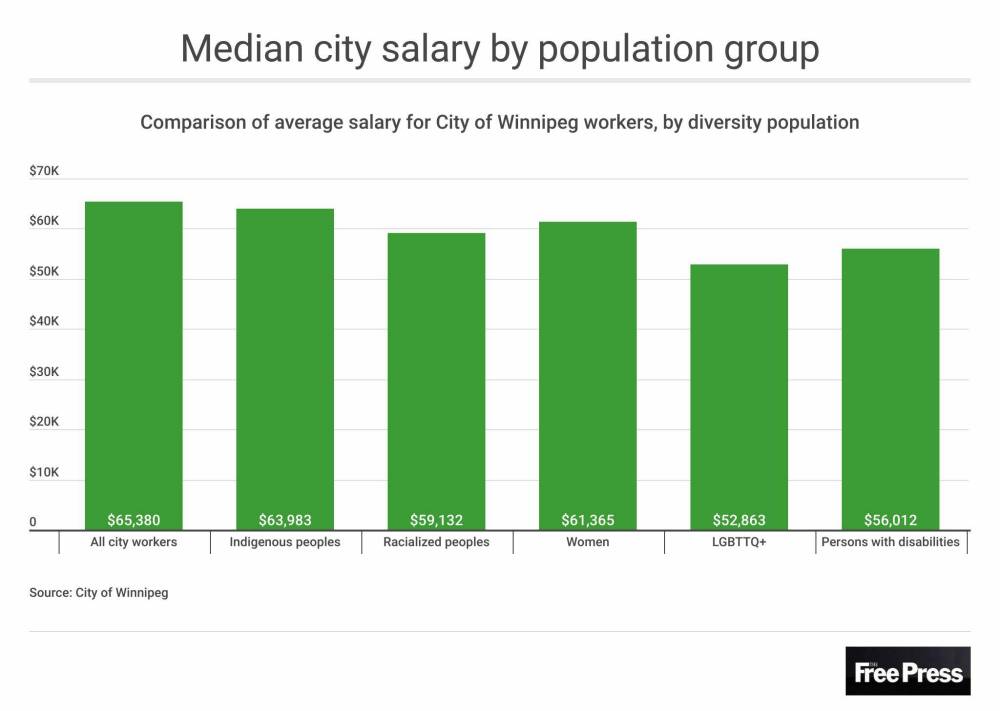
For example, the median wages of the identified equity-deserving groups are shown to be consistently lower than the overall median for city workers, implying that many of the lowest earners on the city payroll are in equity-deserving groups.
But just last month the mayor rejected calls to pay all city workers a living wage, a change that clearly and specifically would benefit equity-deserving employees.
Furthermore, the proportion of women employed by the City of Winnipeg stands at just 26.4 per cent (compared to 47.8 per cent city-wide, in the economy at large), and has declined five years in a row.
Forget promises to “do better,” what has already been implemented at city hall to reverse this? If women are not gaining employment with the City of Winnipeg, or are actively leaving those jobs year over year, there are limits to how long the city can continue to blame the pandemic’s effect on women’s employment levels, especially considering this downward trend predates COVID-19.
Why isn’t the City of Winnipeg an aspirational place to work? A place where a newcomer can get vital training and experience while earning enough to support their family? A place where a single mother has the flexibility required to meet responsibilities both at home and at work? A place where Indigenous folks felt valued for our identity and lived experiences?
When decisions and power are concentrated in one worldview, we miss out on the potential to tap into a wider diversity of insights, and we weaken our city. When we don’t have people in the room representing those who will be affected by decisions we make, we hinder the progress of our city as a whole.

Of course, Mayor Gillingham recently reversed course on Portage and Main, but not because the needs of those who live nearby were finally heard.
No, he reversed course because we can no longer afford to maintain the underground concourse. Millions of dollars in upkeep could have been saved in intervening years, if only the voices of the people most directly affected had been heard in the first place.
The thin promises that accompanied the release of the workforce-diversity report are insufficient and disingenuous.
If we are ever going to understand one another in this city, and become richer for it, we need to dismantle antiquated ideas not only at Portage and Main, but also at city hall.
rebecca.chambers@freepress.mb.ca
Rebecca explores what it means to be a Winnipegger by layering experiences and reactions to current events upon our unique and sometimes contentious history and culture. Her column appears alternating Saturdays.
Our newsroom depends on a growing audience of readers to power our journalism. If you are not a paid reader, please consider becoming a subscriber.
Our newsroom depends on its audience of readers to power our journalism. Thank you for your support.
Rebecca explores what it means to be a Winnipegger by layering experiences and reactions to current events upon our unique and sometimes contentious history and culture. Her column appears alternating Saturdays.
Our newsroom depends on a growing audience of readers to power our journalism. If you are not a paid reader, please consider becoming a subscriber.
Our newsroom depends on its audience of readers to power our journalism. Thank you for your support.
Related Articles
Civic workforce losing women, lacks diversity: report
Advertisement Advertise With Us
Advertisement Advertise With Us